Understanding Poincare's recurrence theorem

Click For Summary
Poincare's recurrence theorem suggests that particles in a closed system will eventually return to their original state after a long time, which can be vastly longer than the age of the Universe. This idea challenges the intuitive understanding of particle behavior, as one might expect them to disperse indefinitely. However, the second law of thermodynamics remains intact because it deals with statistical properties rather than deterministic outcomes, and the likelihood of returning to the original state is exceedingly low. The calculation of the time for recurrence involves considering the phase space volume and the characteristic time for particles to move out of that volume. Ultimately, while the theorem implies potential reversibility, practical applications of thermodynamics do not experience such breakdowns.
JD_PM
Messages
1,125
Reaction score
156
The Poincare's recurrence theorem :
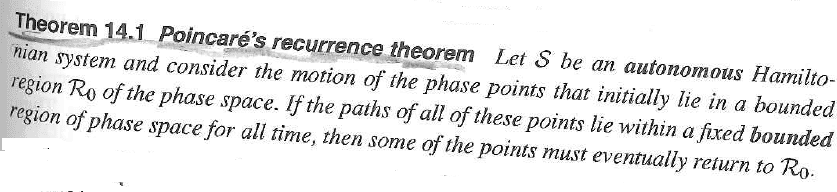
PoincareTheorem.png


This theorem implies the following:

Suppose a container is divided in two by a wall. Half of it contains particles and the other none. If you were to remove the wall and wait a very very long time, the particles would eventually be found in the same half of the container.

To me this statement is counter-intuitive. I would expect the particles to jiggle around forever.

Why am I wrong?

I have read the proof but I would rather discuss the theorem to understand it.
 
  • Like
Likes atyy
Physics news on Phys.org
JD_PM said:
Summary:: I want to understand the idea of Poincare's recurrence theorem

To me this statement is counter-intuitive. I would expect the particles to jiggle around forever.
They ”jiggle around” randomly forever. This means that they will eventually come back to the original state (or very close to it) by pure chance. The time for this to happen can be orders of magnitude longer than the age of the Universe.
 
  • Like
Likes atyy, JD_PM and vanhees71
Thanks for your answer.

Orodruin said:
This means that they will eventually come back to the original state (or very close to it) by pure chance.

Doesn't this mean that the second law of Thermodynamics breaks down? Theoretically, if all particles eventually come back to the original state means that ##\Delta S =0##. This is actually what shocks me about this theorem.

Orodruin said:
The time for this to happen can be orders of magnitude longer than the age of the Universe.

Actually my book justifies that the second law is not violated because very long time means ##10^{20}## years.

To me that is not a good reason because, in the end we end up with ##\Delta S =0## so we still have the same issue.

By the way, how is this time calculated?
 
JD_PM said:
Doesn't this mean that the second law of Thermodynamics breaks down?
No. Thermodynamics is about the statistical properties of the system and the resulting macro states. It is not describing the fully deterministic situation. Looking at statistical mechanics, you have the different statistical ensembles that will allow you to derive the thermodynamic properties of the system.

JD_PM said:
By the way, how is this time calculated?
This depends on how close you want to get to the original state in phase space. Take a characteristic time to move out of that volume and multiply by the ratio of the total phase space volume accessible and the phase space volume you want to move back to. This gives you an upper estimate.
 
  • Like
Likes JD_PM
JD_PM said:
Doesn't this mean that the second law of Thermodynamics breaks down?

The laws of thermodynamics are not fundamental, and they can break down in theory, but these are so rare that there is not any breakdown in practice.
 
  • Like
Likes JD_PM
atyy said:
The laws of thermodynamics are not fundamental

What do you mean saying 'not fundamental'?
 

Similar threads

  • · Replies 1 ·
Replies
1
Views
2K
  • · Replies 1 ·
Replies
1
Views
2K
Replies
4
Views
2K
  • · Replies 7 ·
Replies
7
Views
3K
  • · Replies 35 ·
2
Replies
35
Views
2K
  • · Replies 1 ·
Replies
1
Views
3K
  • · Replies 4 ·
Replies
4
Views
3K
  • · Replies 3 ·
Replies
3
Views
7K
  • · Replies 7 ·
Replies
7
Views
3K
  • · Replies 6 ·
Replies
6
Views
1K