Understanding Shear Flow Problems: Finding A' in q=QV/I Formula | Help Needed!

Click For Summary

Discussion Overview

The discussion revolves around understanding shear flow problems, specifically the application of the formula q=QV/I and the determination of the variable A' in various contexts. Participants are exploring how to effectively apply these concepts to a specific problem involving the spacing of nails in a composite beam made of three boards.

Discussion Character

  • Exploratory
  • Technical explanation
  • Debate/contested
  • Mathematical reasoning

Main Points Raised

  • One participant expresses difficulty in understanding how to determine A' in the formula, noting that it seems to vary significantly from problem to problem.
  • Another participant suggests that for calculating shear in the upper nails, A' should be the area of the top board, and similarly for the bottom nails, indicating that each pair must be considered separately.
  • There is a discussion about whether the beam is a composite beam and if there are lateral loads involved, raising questions about the nature of the shear load being analyzed.
  • Several participants agree that finding the appropriate Q to use is case-dependent and confirm that the approach of analyzing shear flow for each nail separately is valid.
  • One participant mentions that their calculations yield impractical nail spacing, prompting others to suggest checking input values for accuracy.
  • Clarifications are made regarding the calculation of shear flow per nail and how to derive nail spacing from it, with some participants confirming their understanding of the process.

Areas of Agreement / Disagreement

Participants generally agree on the need to analyze shear flow for each nail separately and the importance of determining the correct A' value. However, there remains uncertainty regarding the specific calculations and assumptions involved, as well as the practicality of the derived nail spacing.

Contextual Notes

Participants note that the problem involves assumptions about symmetry and the distribution of loads, which may affect the calculations. There is also mention of the need to verify input values to ensure realistic outcomes.

Who May Find This Useful

This discussion may be useful for students and professionals dealing with shear flow problems in structural engineering, particularly those working with composite beams and nail spacing calculations.

Saladsamurai
Messages
3,009
Reaction score
7
PLEASE! Shear Flow HELP

We are doing shear flow problems and my instructor has been unable to explain the topic in a general enough way to apply effectively to all problems. Our (my class) difficulty is understanding in the formula q=QV/I where the variable Q=yA' what to use for A'.

It seems to vary so drastically from problem to problem that there is no set way to find it.

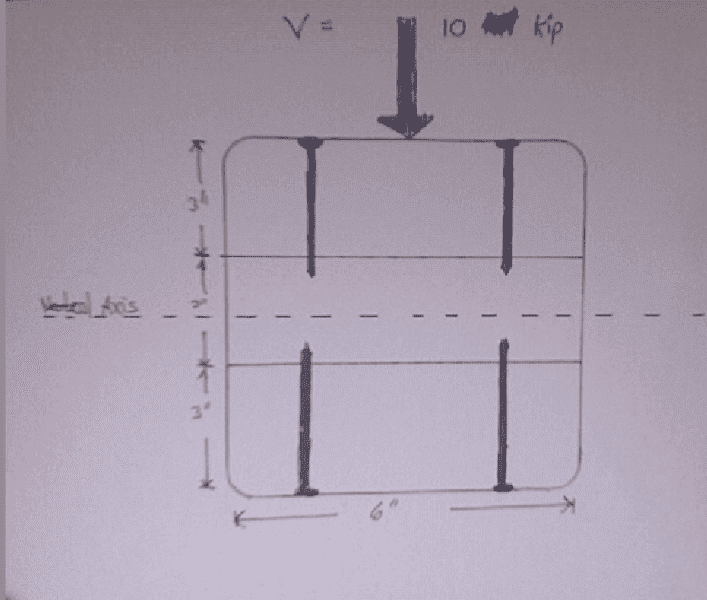
Will someone please explain to me what to use for A' in this problem:

The three boards are nailed together as shown. How should the nails be spaced if each nail can resist 100 lbs?
Picture2-6.png


I was thinking of using [tex]q=\frac{F}{spacing}=\frac{QV}{I}[/tex] and only using the area of the top board. This would get me the spacing if there were only two nails. Then I could multiply that number by two to get it for four nails since it is symmetrical about the neutral axis.

Does this sound right?
 
Physics news on Phys.org
I hate to be a pain. But since no one ever checks this forum, I am going to bump this thread every few minutes until it gets some views. I figure if I keep it in the "header" someone has to look at it eventually.

Sorry to be a PITA, but I really need to get this!
 
Slow down, chief! A sure fire way to not get help is to keep posting before an answer, because helpers often look for problems with 0 responses, not multiple ones.
Anyway, the value for A', for calcualting shear in the upper nails,is the area of the top board. Similarly, for calculating shear in the bottom nails, you have to use A' for the bottom board. You can't just spread the load amongst both sets, you've got to look at each pair separately (they each see the same shear flow because of symmetery). Otherwise, your approach seems OK. Check your value for V or the allowable nail force...one or the other seems too high or low.
 
Is this a composite beam? Besides the normal load, is there a lateral load as well?

Is one interested in the shear load along the nails (between nails and wood) or through the cross-section of the nails?
 
It is actually shear flow which is defined as force per unit length along a longitudinal plane. http://en.wikipedia.org/wiki/Shear_flow

What is tricky is finding out which Q to use. It is different on a case by case basis. I think that my assumption, though, was correct. To analyze the shear flow in each nail, I could use the top board (it is three boards nailed together by the way) and find the shear flow in two nails and then divide that number by two (since the beam is symetrical).
 
Saladsamurai said:
It is actually shear flow which is defined as force per unit length along a longitudinal plane. http://en.wikipedia.org/wiki/Shear_flow

What is tricky is finding out which Q to use. It is different on a case by case basis. I think that my assumption, though, was correct. To analyze the shear flow in each nail, I could use the top board (it is three boards nailed together by the way) and find the shear flow in two nails and then divide that number by two (since the beam is symetrical).
I think you may have it right, but unless you show some numbers, I can't be sure. When you calculate the shear flow for at the joint between the top and middle board, you must divide that flow by 2 to get the shear in each nail at the top. To get the shear in each nail at the bottom, you calculate the shear flow at the joint between the bottom and middle board, and divide that flow by 2. Is this what you are saying? But when i run your numbers, i get a very impractical small nail spacing along the length of the member in order to keep the nail shear force to 100 pounds per nail; that's why I asked you to check your input values.
 
PhanthomJay said:
To get the shear in each nail at the bottom, you calculate the shear flow at the joint between the bottom and middle board, and divide that flow by 2. Is this what you are saying?

Yes. That is. Sweet!

But when i run your numbers, i get a very impractical small nail spacing along the length of the member in order to keep the nail shear force to 100 pounds per nail; that's why I asked you to check your input values.

Yeah, I made up the problem and pulled the numbers out of the sky. I left my text at home and the question was urking me... so I just made one up.

Thanks. I will probably revive this thread when I find another problem with less forgiving geometry. Those are the ones that kill me.
 
Saladsamurai said:
Thanks. I will probably revive this thread when I find another problem with less forgiving geometry. Those are the ones that kill me.
Great. Be sure to start a new thread when you post another problem. BTW, when you divide the shear flow by 2, you get the shear flow per nail in kips per inch, q_n, then you find the nail spacing along the member length using s = F/q_n, as you had previously noted. I just wanted to clarify that.
 

Similar threads

Replies
1
Views
2K
  • · Replies 2 ·
Replies
2
Views
3K
  • · Replies 1 ·
Replies
1
Views
4K
Replies
4
Views
2K
  • · Replies 1 ·
Replies
1
Views
2K
  • · Replies 5 ·
Replies
5
Views
3K
  • · Replies 11 ·
Replies
11
Views
5K
  • · Replies 14 ·
Replies
14
Views
6K
  • · Replies 19 ·
Replies
19
Views
7K
  • · Replies 11 ·
Replies
11
Views
2K