SUMMARY
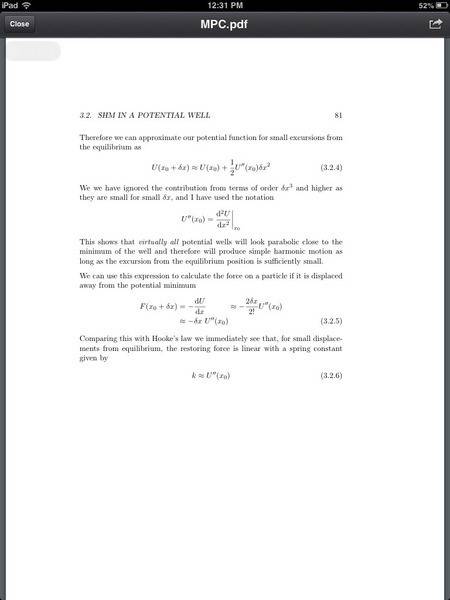
The discussion centers on the relationship between the force function F(x+xo) and the derivative of potential energy dU/dx in the context of simple harmonic motion (SHM). It establishes that the force F is defined as F = -dU/dx, leading to the conclusion that the force constant k is equivalent to the second derivative of the potential energy function U. The proof begins with the potential energy function U = 1/2 kx^2, demonstrating that the first derivative yields the linear force law, while the second derivative confirms the force constant.
PREREQUISITES
- Understanding of simple harmonic motion (SHM)
- Familiarity with potential energy functions
- Knowledge of calculus, specifically differentiation
- Concept of force as a derivative of potential energy
NEXT STEPS
- Study the derivation of force from potential energy in SHM
- Explore the implications of the second derivative in physics
- Learn about the applications of force constants in oscillatory systems
- Investigate advanced topics in calculus related to physical systems
USEFUL FOR
Students of physics, particularly those studying mechanics, educators teaching SHM concepts, and anyone interested in the mathematical foundations of force and potential energy relationships.