Understanding the Divergence Theorem

Click For Summary

Homework Help Overview

The discussion revolves around the application of the divergence theorem in the context of vector calculus, specifically regarding the flux of the curl of a vector field over a given surface. Participants are examining whether the surface in question can be considered closed for the purposes of applying the theorem.

Discussion Character

  • Conceptual clarification, Assumption checking, Exploratory

Approaches and Questions Raised

  • Participants are questioning the closure of the surface involved and whether it meets the criteria for applying the divergence theorem. Some suggest considering additional surfaces to create a closed volume, while others explore the implications of using Stokes' theorem instead.

Discussion Status

The discussion is active, with participants offering various perspectives on the closure of the surface and the applicability of different theorems. Some guidance has been provided regarding the use of additional surfaces to facilitate the application of the divergence theorem, but no consensus has been reached on the best approach.

Contextual Notes

Participants are navigating the complexities of the problem, including the geometric nature of the surface and the implications of having boundaries. There is an acknowledgment of potential tricks or alternative methods that could be employed to address the problem effectively.

Amaelle
Messages
309
Reaction score
54
Homework Statement
Let Σ = [(x, y, z) ∈ R3 : z=-1/4+√(x^2+y^2) 0 <= z<=1/2]
be a surface oriented
so that the normal versor of Σ forms an obtuse angle with the fundamental versor of the z–axis.
Compute the flux of the curl of the vector field
F(x, y, z) = 2yz *exponontiel(x^2+z^2),3z*exponontiel(x^2+y^2),(0,5x+z)exponontiel(x^2+y^2)
Relevant Equations
Divergence theorem
Good day all
my question is the following

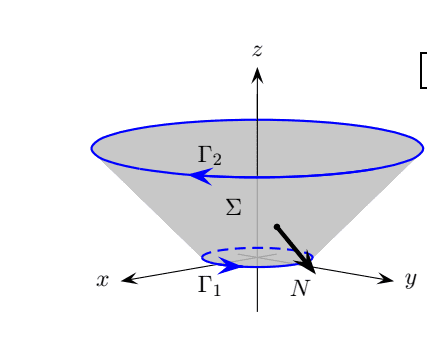
Is it correct to (after calculation the new field which is the curl of the old one)to use the divergence theroem on the volume shown on that picture?
1598617194382.png

The divergence theorem should be applied on a closed surface , can I consider this as closed?
Thanks a lot!
 

Attachments

  • 1598617076608.png
    1598617076608.png
    4 KB · Views: 271
  • 1598617076608.png
    1598617076608.png
    4 KB · Views: 289
Last edited by a moderator:
Physics news on Phys.org
yes, I believe so
 
  • Like
Likes   Reactions: Amaelle
Amaelle said:
Homework Statement:: Let Σ = [(x, y, z) ∈ R3 : z=-1/4+√(x^2+y^2) 0 <= z<=1/2]
be a surface oriented
so that the normal versor of Σ forms an obtuse angle with the fundamental versor of the z–axis.
Compute the flux of the curl of the vector field
F(x, y, z) = 2yz *exponontiel(x^2+z^2),3z*exponontiel(x^2+y^2),(0,5x+z)exponontiel(x^2+y^2)
Relevant Equations:: Divergence theorem

Good day all
my question is the following

Is it correct to (after calculation the new field which is the curl of the old one)to use the divergence theroem on the volume shown on that picture?

The divergence theorem should be applied on a closed surface , can I consider this as closed?
Thanks a lot!

I might be reading the problem incorrectly, but when I read flux of the curl, that suggests an integral of the form:
\iint_S (\nabla \times \vec F ) \cdot \vec{dS}

I am not fully convinced that the surface illustrated is closed as the tops are open? (i.e. am I correct in thinking that the surface does not span across that?) The illustrations (namely the paths) seem to suggest the use of Stokes' theorem to me, but perhaps I am mis-interpreting the photo.

If you were to use Gauss' theorem, then we would have \nabla \cdot (\nabla \times \vec F ), which is 0 for any vector field \vec F. This would suggest the answer would be 0, but I'm not sure that is what the problem is looking for.

I will keep reading to see whether I can make sense of the illustrations.
 
  • Like
Likes   Reactions: Amaelle
##\Gamma _1, \text{ and } \Gamma _2## are the top and bottom and they're closed evidently
 
  • Like
Likes   Reactions: Amaelle
Thanks a lot for you answer this is exactely what I'm asking for
the exercice describe a cone, and there is then they asked us to calculate the curl of the field over a specific region, my question is : Can I suppose that region closed between (z=0 and z=sqrt(x^2+y^2)-1/4 ) to see it a locked volume even though materially the initial solid is not ( we have a cone)?
 
let me rephrase my question
we can use the divergence theorem in a sphere because it's geometrically closed
can we use the divergence on a topless and botomless cylinder? ( just suppose the exsitance of a virtual walls?
 
Amaelle said:
let me rephrase my question
we can use the divergence theorem in a sphere because it's geometrically closed

Yes

Amaelle said:
can we use the divergence on a topless and botomless cylinder? ( just suppose the exsitance of a virtual walls?
No, I don't think so. Including the extra surfaces would add extra contributions into your surface integral.
 
  • Informative
  • Like
Likes   Reactions: etotheipi and Amaelle
thanks a lot !
 
  • Like
Likes   Reactions: Master1022
Amaelle said:
thanks a lot !
No problem.

However, there may be tricks involved by using extra surfaces and then doing other integrals to get rid of the extra contributions. Not sure whether that will be easier or not here. For example, if were to include those extra surfaces (top and bottom) and then evaluate the total surface integral (perhaps with gauss theorem) to get some result R_{total}. Then we need to remove the contributions of the bottom and top due to 'outward' pointing vectors. Then we would have two more surface integrals (top and bottom) which we need to evaluate (perhaps with Stokes' Theorem) to yield R_{bottom} and R_{top}. Then we could do: R_{final} = R_{total} - R_{top} - R_{bottom}
That should yield the correct result, but am not sure whether that would shorten or elongate the working time...

Hope that makes some sense. If not, am happy to explain further, but it was only another (potentially longer) method of reaching the solution.
 
  • Informative
Likes   Reactions: Amaelle
  • #10
thanks a million it does really help
 
  • #11
Yes a closed surface is a surface with no boundaries. The surface in your problem has two boundaries, so it is not closed. But you can still use @Master1022's approach of considering a closed surface consisting of the given surface joined to two other surfaces with boundaries ##\Gamma_1## and ##\Gamma_2## respectively, and then subtracting off the flux through these two surfaces :smile:
 
  • Informative
Likes   Reactions: Amaelle
  • #12
Thanks a lot :)
 
  • #13
There seems to be some confusion here.

You are asked to compute <br /> \int_\Sigma \nabla \times \mathbf{F}\cdot d\mathbf{S}. That can be done using Stokes's Theoem: <br /> \int_\Sigma \nabla \times \mathbf{F}\cdot d\mathbf{S} = \oint_{\partial \Sigma} \mathbf{F} \cdot d\mathbf{x}. Here \partial \Sigma consists of two disjoint curves, oriented as shown in the diagram.
 
  • Like
  • Informative
Likes   Reactions: Delta2, etotheipi and Amaelle
  • #14
yes true , thanks a lot, but I was also trying to see if I can use the divergence theorem with the new field (the curl of the old one) and the volume would be the closed volume shown on the picture
 
  • #15
Go For It!
 
  • Love
Likes   Reactions: Amaelle

Similar threads

  • · Replies 15 ·
Replies
15
Views
2K
Replies
28
Views
2K
Replies
8
Views
3K
  • · Replies 7 ·
Replies
7
Views
3K
Replies
29
Views
3K
  • · Replies 4 ·
Replies
4
Views
4K
  • · Replies 17 ·
Replies
17
Views
6K
  • · Replies 5 ·
Replies
5
Views
3K
  • · Replies 3 ·
Replies
3
Views
2K
  • · Replies 1 ·
Replies
1
Views
6K