Understanding the Doppler Effect: Solving the Bat Problem

Join the discussion
Ask a follow-up here, or get your own question answered by working scientists, mathematicians and engineers — people, not an autocomplete.
Real named experts · corrections over time · the nuance an AI answer skips
1 reply · 5K views
physicsfan999
Messages
1
Reaction score
0
Homework Statement
A bat flying at 4.10 m/s is chasing an insect flying in the same direction. The bat emits a 40.0-kHz chirp and receives back an echo at 40.4 kHz. (Take the speed of sound in air to be 340 m/s.)
Relevant Equations
f_o=f_s(v+v_o/v-v_s)
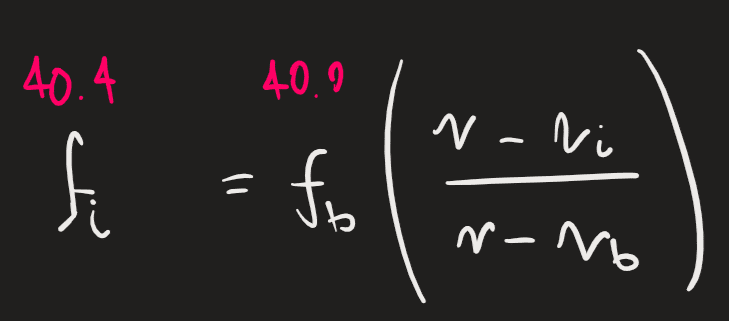
I'm struggling a lot with this problem on the Doppler effect. I understand the first step which is to treat the bat as the source of the emitted sound, giving
1614718292037.png


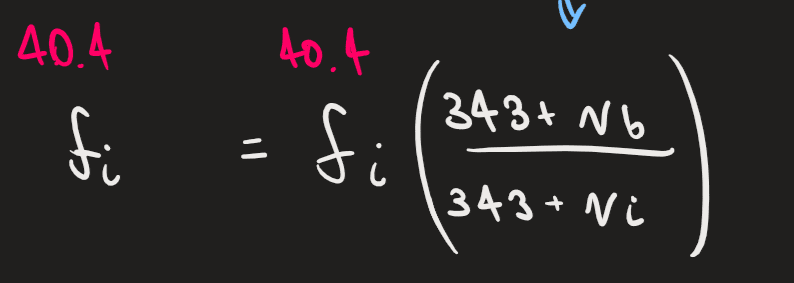
And the second to treat the bat now as the observer, but instead of using f_b on the left the solution involves setting both frequencies to the reflected wave.
1614718268174.png

I understand there should 2 different variables here for the equation to make sense but I need help understanding why the second step involves setting the two frequencies the same. Thanks in advance!
 
Physics news on Phys.org
physicsfan999 said:
Homework Statement:: A bat flying at 4.10 m/s is chasing an insect flying in the same direction. The bat emits a 40.0-kHz chirp and receives back an echo at 40.4 kHz. (Take the speed of sound in air to be 340 m/s.)
Relevant Equations:: f_o=f_s(v+v_o/v-v_s)

I'm struggling a lot with this problem on the Doppler effect. I understand the first step which is to treat the bat as the source of the emitted sound, giving

View attachment 279012

And the second to treat the bat now as the observer, but instead of using f_b on the left the solution involves setting both frequencies to the reflected wave.
View attachment 279011
I understand there should 2 different variables here for the equation to make sense but I need help understanding why the second step involves setting the two frequencies the same. Thanks in advance!
As you correctly say, this is a 2-stage process. In stage-1 we find the observed frequency (##f_i##) with the insect as the observer). In stage-2 we treat ##f_i## as the source frequency because this is the frequency of the reflected signal sent from the insect to the bat.

Your final equation$$f_i = f_i (\frac {343 + v_b}{343 + v_i})$$is wrong. You need to give the final observed frequency (by the bat) a different symbol:$$f_{observed-by-bat} = f_i (\frac {343 + v_b}{343 + v_i})$$Can I suggest you watch this:
Edit - typo' corrected.
 
Reply
  • Like
Likes   Reactions: collinsmark, Doc Al and rsk