Understanding the four bar linkage DOF

Click For Summary
SUMMARY

The discussion centers on the degrees of freedom (DOF) in a four-bar linkage mechanism, specifically applying Gruebler's condition to determine that the DOF is 1. The calculation provided is DOF = 3(l-1) + 2j1 + 2j2, where l=4, j1=4, and j2=0, confirming the single degree of freedom. The conversation clarifies that while multiple links may seem to contribute additional DOFs, their movements are interdependent, resulting in only one independent DOF for the mechanism. The distinction between dependent and independent movements is crucial for understanding the behavior of linked mechanisms.

PREREQUISITES
  • Understanding of Gruebler's condition for calculating DOF
  • Familiarity with kinematic chains and linkages
  • Basic knowledge of parametric equations in motion analysis
  • Concept of independent versus dependent movements in mechanical systems
NEXT STEPS
  • Study the application of Gruebler's condition in various mechanical systems
  • Explore the kinematics of five-bar linkages and their DOF calculations
  • Learn about parametric equations and their role in motion analysis
  • Investigate the principles of independent and dependent movements in complex mechanisms
USEFUL FOR

Mechanical engineers, students studying kinematics, and anyone involved in the design and analysis of linkages and mechanisms will benefit from this discussion.

Sanchayan Ghosh
Messages
11
Reaction score
0
Hello guys,

I have a doubt with understanding DOFs. I have taken the example of the four bar linkage. According to Grueblr's condition, the DOF of this mechanism is 1.
\mbox{DOF} = 3(l-1) + 2j_1 + 2j_2\\l=4\ j_1=4\ j_2=0\\\mbox{DOF} = 1
220px-4_bar_linkage_animated.gif

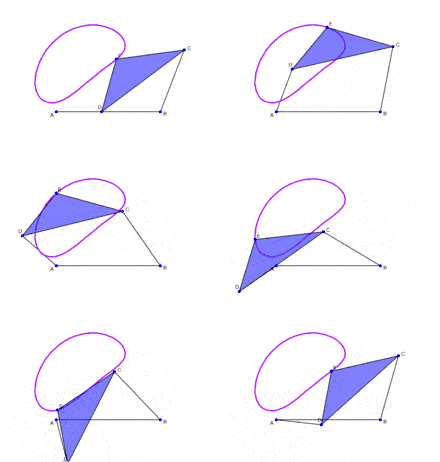
In the above figure, the links next to the ground link rotate. So it should be 2 DOFs. Then, the ternary link rotates, so it should be 1 more DOF. However, it is not so. This is a really fundamental place I am going wrong in. May anyone please explain this, as due to this I have difficulty understanding isomers in mechanisms.

Thank You
 
Last edited by a moderator:
Engineering news on Phys.org
This is a very good question to have, but fortunately isn't too hard to answer.

Let's look at link AD. Point D definitely moves in a way that changes its x- and y-coordinates. But you could also express the angle of the link as theta (one degree of freedom), and then x=rAD cos(theta), and y=rAD sin(theta). Since x and y are both dependent on one variable, theta, they are not independent, and do not constitute two degrees of freedom. It is a form of parametric equations.

Another way to look at it is that you could replace the link AD by making the circle it creates into a slot in a piece of metal, insert a pin at point D, and place the pin in the slot. Point D would still follow the same path, its position described by its displacement along that path.

Taking that a little further, it doesn't matter whether a slot is 1) straight and oriented along the x-axis, 2) straight but angled (so that x and y change with motion), 3) curved in a circle, or 4) a more complex curve like your point E moves in - in every case motion along it is only one (independent) degree of freedom.
 
It has 1 DOF for the mechanism. Meaning that if you move one link, all other links can be at only one already predetermined position.

In the following 5-bar linkage, you have 2 DOF. Meaning if you know the position of 2 links, you know the position of all links. If you know the position of only one link, there is a multitude of possible positions for the other links.

 
Sirs,
Thank you for the answers. I think I have understood. However, I would like to articulate my understanding.

So, as jack said, for every movement of say one link, the other links if they move in only one way and end up in only one position, the two links are counted as moving together in a relation and the dof is 1 for it. So if two links are moving, 1 dof is if I move one link the other one moves and can only possesses one position for a predetermined motion of the link which I moved. However, if the dependent link, say translates and reached a position or rotates about an axis and reached its position, then it is called as having 2 dof and similarly based on the movement and final position , it can have more dof. Please do tell me if I am being right. Here.Thanks a lot.
1f60a.png
1f60b.png
 

Similar threads

  • · Replies 2 ·
Replies
2
Views
3K
  • · Replies 62 ·
3
Replies
62
Views
6K
  • · Replies 3 ·
Replies
3
Views
5K
  • · Replies 1 ·
Replies
1
Views
2K
  • · Replies 3 ·
Replies
3
Views
3K
  • · Replies 1 ·
Replies
1
Views
1K
Replies
1
Views
1K
  • · Replies 2 ·
Replies
2
Views
1K
Replies
6
Views
4K
  • · Replies 5 ·
Replies
5
Views
2K