Understanding the Limit Step in LaPlace Transforms

Click For Summary
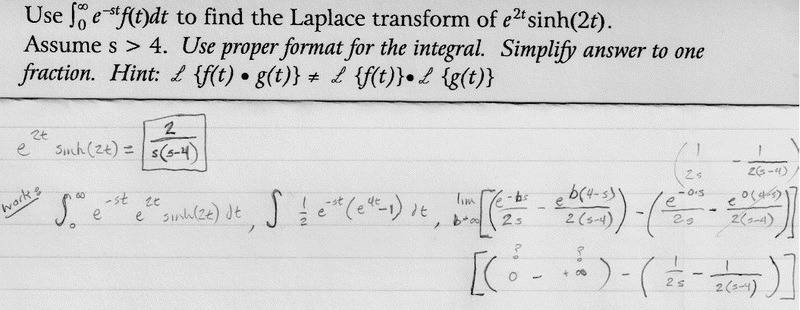
The discussion focuses on clarifying the limit step in LaPlace transforms, particularly when evaluating the behavior of exponents as a variable approaches infinity. It emphasizes that for values of s greater than 4, both exponents become negative multiples of b, leading them to converge to zero as b approaches infinity. This understanding is crucial for accurately completing the limit step in the transformation process. The participants seek a clearer explanation of these concepts to ensure proper application in their work. Overall, grasping these limit behaviors is essential for mastering LaPlace transforms.
Jeff12341234
Messages
179
Reaction score
0
I'm not sure about the answers to parts of the limit step of the work. Can you explain what the answer to that step should be?

uOmJnEv.jpg
 
Physics news on Phys.org
Jeff12341234 said:
I'm not sure about the answers to parts of the limit step of the work. Can you explain what the answer to that step should be?

uOmJnEv.jpg

Use that s>4. If that's so, then both of the exponents are a negative number times b, and so do go to 0 as b->infinity.
 
thanks
 
Last edited:
Question: A clock's minute hand has length 4 and its hour hand has length 3. What is the distance between the tips at the moment when it is increasing most rapidly?(Putnam Exam Question) Answer: Making assumption that both the hands moves at constant angular velocities, the answer is ## \sqrt{7} .## But don't you think this assumption is somewhat doubtful and wrong?

Similar threads

  • · Replies 1 ·
Replies
1
Views
1K
  • · Replies 2 ·
Replies
2
Views
2K
  • · Replies 10 ·
Replies
10
Views
2K
  • · Replies 4 ·
Replies
4
Views
3K
  • · Replies 4 ·
Replies
4
Views
3K
Replies
2
Views
2K
  • · Replies 3 ·
Replies
3
Views
3K
Replies
2
Views
2K
Replies
2
Views
2K
  • · Replies 8 ·
Replies
8
Views
2K