Understanding the Maxwell Stress Tensor

Click For Summary

Homework Help Overview

The discussion revolves around the Maxwell Stress Tensor and its application in expressing electromagnetic forces. Participants are exploring the mathematical formulation and conceptual understanding of the tensor, particularly in static cases where certain terms may drop out.

Discussion Character

  • Conceptual clarification, Mathematical reasoning, Assumption checking

Approaches and Questions Raised

  • Participants are attempting to relate the stress tensor to physical concepts, questioning how it represents forces and interacts with the fields. There is a focus on understanding the implications of the tensor in different scenarios, including its behavior in static conditions.

Discussion Status

Some participants have provided insights into the relationship between the stress tensor and fundamental theorems in calculus, while others are clarifying their understanding of the terms involved. There is an ongoing exploration of the concepts without a clear consensus on all points raised.

Contextual Notes

Participants are navigating through complex mathematical expressions and their physical interpretations, with some noting the importance of unit consistency in their discussions. The original poster expresses a desire to deepen their understanding of the tensor's properties and implications.

JD_PM
Messages
1,125
Reaction score
156
Homework Statement
Maxwell Stress Tensor
Relevant Equations
##\vec F = \oint_{s} \vec T \cdot d \vec a - \epsilon \mu \frac{\partial }{\partial t} \oint_{V} \vec S d\tau ##
The elecromagnetic force can be expressed using the Maxwell Stress Tensor as:

$$\vec F = \oint_{s} \vec T \cdot d \vec a - \epsilon \mu \frac{\partial }{\partial t} \oint_{V} \vec S d\tau $$

(How can I make the double arrow for the stress tensor ##T##?)

In the static case, the second term drops out because the magnetic field is zero.

I have read (from Griffiths) that ##T## represents the force per unit area acting on the surface. But then he states:

Screenshot (394).png


Let's see if understand what's going on:
Screenshot (396).png


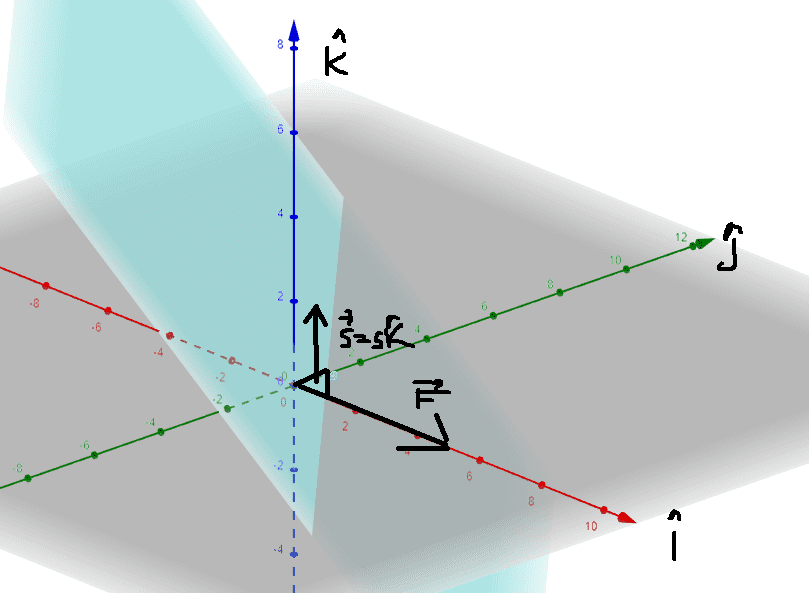
I'd say that the stress tensor on the triangle projected on xy plane would be : ##T_{ik}##. Is this correct?

Besides, I am seeking for understanding it. After solving an example exercise
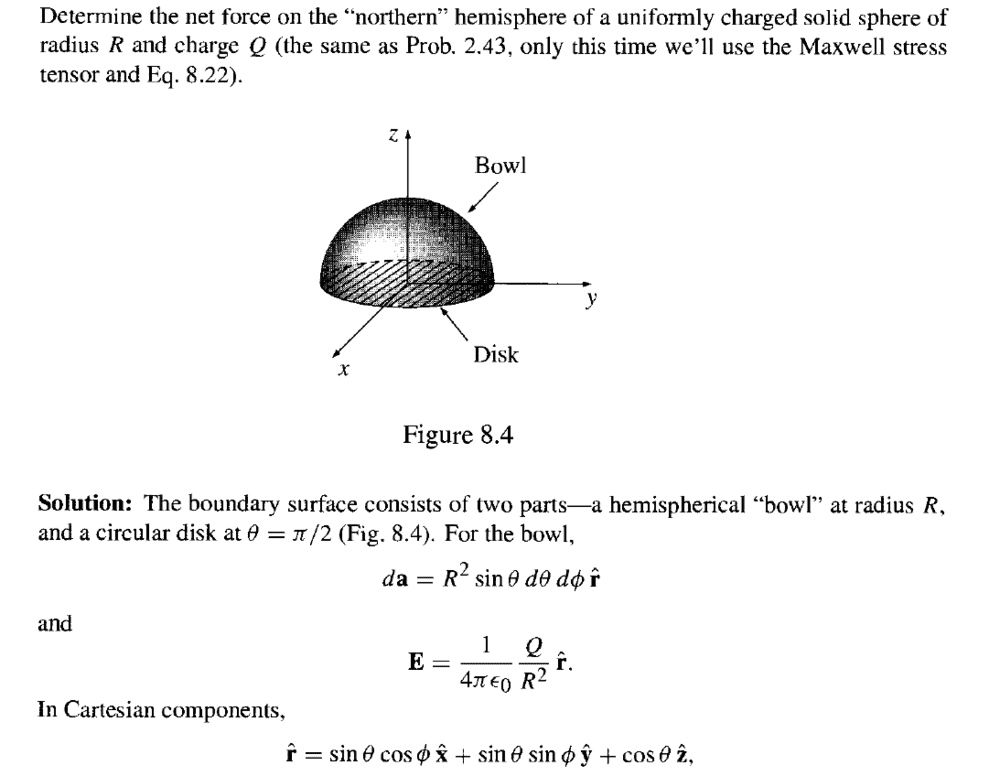
Screenshot (397).png


(The exercise is not solved above of course)

But I want to focus on what he states at the end:

Screenshot (401).png


How can the tensor 'sniff out what is going inside'?

I don't understand why.
 

Attachments

  • Screenshot (400).png
    Screenshot (400).png
    47.4 KB · Views: 556
Physics news on Phys.org
This is the same thing as the
fundamental theorem of calculus ##\int^b_a dx\, \frac{df}{dx} = f\left(b\right)-f\left(a\right)##
Stokes theorem: ##\int_S d^2 r\, \mathbf{\hat{n}}.\boldsymbol{\nabla}\times\mathbf{F}=\oint_{\partial S} dl \mathbf{\hat{l}}.\mathbf{F}##
Gauss Theorem: ##\int_V d^3 r\, \boldsymbol{\nabla}.\mathbf{F}=\oint_{\partial V} d^2 r\, \mathbf{\hat{n}}.\mathbf{F}##

etc. Generally this is known as Generalized Stokes Theorem. The point is that integrating a form (##f## or ##\mathbf{F}##) on the boundary of a manifold (##\partial S## or ##\partial V##) is equal to the integral of the exterior derivative (##\frac{df\left(x\right)}{dx},\, \boldsymbol{\nabla}\times\mathbf{F},\, \boldsymbol{\nabla}.\mathbf{F}##) over that manifold.

In your case ##\mathbf{f}=\boldsymbol{\nabla}.\mathbf{T}+\dots## so

##\mathbf{F}=\int_V d^3 r\, \mathbf{f} = \int_V d^3 r\, \boldsymbol{\nabla}.\mathbf{T}+\dots = \oint_{\partial V} d^2r\, \mathbf{\hat{n}}.\mathbf{T}+\dots##
 
  • Like
Likes   Reactions: JD_PM
Thanks for your reply.

I understand that ##\epsilon \mu \oint_{V} \vec S d\tau## represents the momentum stored in the fields and
##\oint_{s} \vec T \cdot d \vec a## is the momentum per unit time flowing in through the surface.
 
I think you are correct, but check your units (just in case)
 

Similar threads

  • · Replies 4 ·
Replies
4
Views
2K
  • · Replies 10 ·
Replies
10
Views
1K
  • · Replies 3 ·
Replies
3
Views
5K
  • · Replies 18 ·
Replies
18
Views
1K
Replies
4
Views
2K
  • · Replies 1 ·
Replies
1
Views
6K
  • · Replies 11 ·
Replies
11
Views
2K
  • · Replies 3 ·
Replies
3
Views
3K
  • · Replies 8 ·
Replies
8
Views
3K
Replies
22
Views
4K