Understanding the notation in Group Theory

Click For Summary
The discussion centers on understanding group theory notation, specifically the operation denoted by ##\circ## and its implications for group axioms. Participants clarify that ##x \circ (y \circ z)## represents a binary operation where ##x, y, z## are elements of the group ##G##, not functions. The notation can be confusing, especially for those new to abstract mathematics, and it is suggested that a more foundational text may be necessary for better comprehension. The conversation also touches on the importance of prerequisite knowledge in mathematics and the need for clear definitions of operations versus functions. Overall, a solid grasp of group theory requires understanding its axioms and operations, which may be challenging without a proper background.
Adesh
Messages
735
Reaction score
191
Homework Statement
What does these symbols mean?
Relevant Equations
##f : R \rightarrow R##
I was studying mathematical logic and came across this statement of group theory
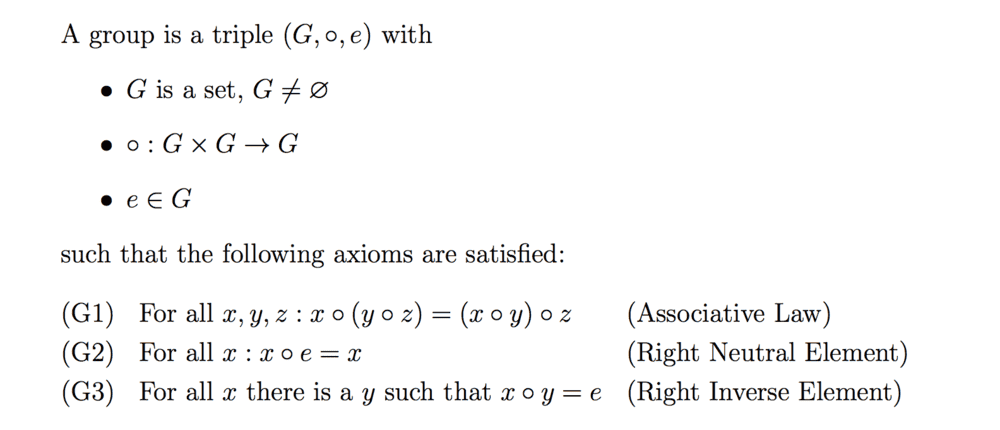
Screen Shot 2020-01-11 at 12.30.02 PM.png

I'm having a hard time in understanding it. I have concluded that ##G## is any set but not an empty one, ##\circ## is a function having input as two variables (both variables are from set ##G##) and gives just one output (which is also in ##G##) and there exists an element ##e## in ##G##.

But I'm not able to understand the axioms, what does ##x~~\circ~~(y\circ z) ## means? In above notation ##\circ## is a function and from some previous knowledge I know that ##g\circ f## means ##g(f(x))##, so are those ##x,y~ \textrm{and}~ z## functions? but why we have that ##\circ## between them? What is it trying to convey?

Thank you. Any help will be much appreciated
 
Physics news on Phys.org
If you are studying a book on Group Theory and cannot understand the axioms, then something is wrong.

Why not do an Internet search? Perhaps for "Group mathematics" and see if the vast amount of material available online can shed any light on this.
 
  • Like
Likes Adesh
PeroK said:
If you are studying a book on Group Theory and cannot understand the axioms, then something is wrong.

Why not do an Internet search? Perhaps for "Group mathematics" and see if the vast amount of material available online can shed any light on this.
Okay, I have got you. You’re saying that my doubt shows that I have skipped many things and it the consequence of lack of some prerequisite knowledge, am I right?
 
Adesh said:
Okay, I have got you. You’re saying that my doubt shows that I have skipped many things and it the consequence of lack of some prerequisite knowledge, am I right?

I meant that if the book presents the group axioms without further comment, then it is probably assuming you already know what a group is. Does it have no explanation, examples or notes? Does it not say what the purpose of group theory is?

Group theory you should be able to study without a lot of prerequsites. But you probably need a text at the right level.

See what you make of the material you find online.
 
Adesh said:
Homework Statement:: What does these symbols mean?
Homework Equations:: ##f : R \rightarrow R##

I was studying mathematical logic and came across this statement of group theory
View attachment 255442
I'm having a hard time in understanding it. I have concluded that ##G## is any set but not an empty one, ##\circ## is a function having input as two variables (both variables are from set ##G##) and gives just one output (which is also in ##G##) and there exists an element ##e## in ##G##.

But I'm not able to understand the axioms, what does ##x~~\circ~~(y\circ z) ## means? In above notation ##\circ## is a function and from some previous knowledge I know that ##g\circ f## means ##g(f(x))##, so are those ##x,y~ \textrm{and}~ z## functions? but why we have that ##\circ## between them? What is it trying to convey?

Thank you. Any help will be much appreciated

Change the ##\circ## in your book by ##*## so you cannot confuse it with function composition.

##x,y,z## are not functions but elements of the group ##G##.

##x*(y*z)## means that you perform the function ##*## first to the pair ##(y,z)## and you get an output ##a## then ##x*(y*z)=x*a## and this gives an output ##b##.

If you are confused about this, just change ##*## by ##+## and take ##G=\mathbb{R}##. Then this law becomes ##(x+y)+z=x+(y+z)##, which should look familiar.
 
  • Like
Likes jml53 and Adesh
Math_QED said:
Change the ##\circ## in your book by ##*## so you cannot confuse it with function composition.

##x,y,z## are not functions but elements of the group ##G##.

##x*(y*z)## means that you perform the function ##*## first to the pair ##(y,z)## and you get an output ##a## then ##x*(y*z)=x*a## and this gives an output ##b##.

If you are confused about this, just change ##*## by ##+## and take ##G=\mathbb{R}##. Then this law becomes ##(x+y)+z=x+(y+z)##, which should look familiar.
So, what does $$ * : G \times G \rightarrow G $$ means? Does it mean that ##*## is a function from ##G \times G## to ##G##?
 
PeroK said:
I meant that if the book presents the group axioms without further comment, then it is probably assuming you already know what a group is. Does it have no explanation, examples or notes? Does it not say what the purpose of group theory is?
The book is an introductory text on mathematical logic, here is a free pdf. The first page of the book looks like this
Screen Shot 2020-01-11 at 3.40.34 PM.png
 
Adesh said:
So, what does $$ * : G \times G \rightarrow G $$ means? Does it mean that ##*## is a function from ##G \times G## to ##G##?
Yes, formally that's what addition and multiplication are. These are also known as binary operations.
 
  • Like
Likes Adesh
PeroK said:
Yes, formally that's what addition and multiplication are. These are also known as binary operations.
What's the difference between an operation and a function?
 
  • #10
Adesh said:
What's the difference between an operation and a function?
The difference is in the definition. Anyway I said "binary operation".

If you have never studied any abstract mathematics you might struggle with that book on formal logic.

You will need to learn some mathematics first, I suggest.
 
  • Like
Likes member 587159 and Adesh
  • #11
Adesh said:
So, what does $$ * : G \times G \rightarrow G $$ means? Does it mean that ##*## is a function from ##G \times G## to ##G##?

Yes, that's exactly what it means. ##*## takes two groups elements and associates a unique other group element with it.

So one could wrote ##*(g,h)## for the image of the pair ##(g,h)## under this function but this looks very cumbersome. For example, instead of ##(g*h)*k## one should then write ##*(*(g,h),k)## and it gets even worse for larger expressions. So therefore we just write ##(g*h)*k##. If you see more group theory, you will see that eventually we don't even bother writing the ##*## and we just write ##gh## instead of ##g*h##.
 
  • Like
Likes Adesh and PeroK
  • #12
PeroK said:
The difference is in the definition. Anyway I said "binary operation".

If you have never studied any abstract mathematics you might struggle with that book on formal logic.

You will need to learn some mathematics first, I suggest.

Second this. If you don't realize at this point that addition of real numbers is in fact a function ##\mathbb{R} \times \mathbb{R} \to \mathbb{R}##, group theory or formal logic might be too early.
 
  • #13
Math_QED said:
Second this. If you don't realize at this point that addition of real numbers is in fact a function ##\mathbb{R} \times \mathbb{R} \to \mathbb{R}##, group theory or formal logic might be too early.
I know that, in my calculus course I had some trivial exercise where we had to prove the associativity, commutivity of some binary operations. But it was only for exam purpose and hence I couldn’t learn anything.
 
  • #14
Adesh said:
I know that, in my calculus course I had some trivial exercise where we had to prove the associativity, commutivity of some binary operations. But it was only for exam purpose and hence I couldn’t learn anything.

The pdf you linked is a sophisticated introduction to logic. If you have a strong constitution, you might be able to work your way through it using other resources such as this forum. What are your goals?

For the study of logic, it would be easier to begin with a more elementary text. It also may turn out that your main interest becomes mathematical topics like Group Theory instead of Logic.

But I'm not able to understand the axioms, what does x ∘ (y∘z) means? In above notation ∘ is a function and from some previous knowledge I know that g∘f means g(f(x)), so are those x,y and z functions? but why we have that ∘ between them? What is it trying to convey?

If we use ##\circ## to denote the name of a binary operation then, in the general ##f(x,y)## type notation we would write "##\circ (x,y)##" instead of "##x \circ y##". So "##x \circ (y \circ z)##" in general notation is ##\circ (x, \circ (y,z))##.

As others mentioned, "##\circ##" is often used to denote the operation of composing functions. It turns out that this is an apt notation for the abstract binary opertion in Group Theory ( Cayley's Theorem). However, many introductory texts prefer to use other notation just as "##a*b##" or "##(a)(b)##" for the abstract binary operation in a group.
 
  • Like
Likes Adesh
  • #15
Stephen Tashi said:
What are your goals?
I want to make myself eligible so that I can understand the works of Mr. Bertrand Russell and his expedition on reducing the mathematics to logic.
Stephen Tashi said:
If we use ∘∘\circ to denote the name of a binary operation then, in the general f(x,y)f(x,y)f(x,y) type notation we would write "∘(x,y)∘(x,y)\circ (x,y)" instead of "x∘yx∘yx \circ y". So "x∘(y∘z)x∘(y∘z)x \circ (y \circ z)" in general notation is ∘(x,∘(y,z))∘(x,∘(y,z))\circ (x, \circ (y,z)).
Thank you so much for clarifying that. So, ## x *(y*z) = (x*y)*z## means this ##f(x, f(y,z)) = f(f(x,y), z) ##. Am I right?
 
  • #16
Adesh said:
I want to make myself eligible so that I can understand the works of Mr. Bertrand Russell and his expedition on reducing the mathematics to logic.
Good luck with that. Back in the 30s, Kurt Gödel pretty much drove a stake into the heart of what Russell and Whitehead were trying to do -- https://plato.stanford.edu/entries/goedel-incompleteness/.
Adesh said:
Thank you so much for clarifying that. So, ## x *(y*z) = (x*y)*z## means this ##f(x, f(y,z)) = f(f(x,y), z) ##. Am I right?
Yes.
 
  • Like
Likes Stephen Tashi
  • #17
Mark44 said:
Good luck with that. Back in the 30s, Kurt Gödel pretty much drove a stake into the heart of what Russell and Whitehead were trying to do -- https://plato.stanford.edu/entries/goedel-incompleteness/.
Yes, I know that. But don't you think that it is very strange that no one ever tried to re-look what Russell wanted. For every theory we got successors, for example Quantum Mechanics got so many successors after Niels Bohr, Relativity got so many people interested to capture gravitational waves, Set theory got so many successors after Cantor but why not Russell? (I think that Russell was in fact the successor of George Boole, but saying this may be controversial)
 
  • #18
Adesh said:
But don't you think that it is very strange that no one ever tried to re-look what Russell wanted.
No, I don't think it's strange. Russell and Whitehead published Principia Mathematica between 1910 and 1913, and Gödel and others refuted what Russell and Whitehead were trying to do in Vol III of PM some 20 years later. That's 90 years ago, plenty of time for people to take another look.

The thing about mathematics is that someone can come up with an elegant theorem, but all it takes is a single counterexample to disprove the elegant theorem.
 
  • Like
Likes Adesh
  • #19
From the screen you've posted and the question about the operation, you need a more basic book I think, something that would start by an introduction to set theory.
 
  • #20
archaic said:
From the screen you've posted and the question about the operation, you need a more basic book I think, something that would start by an introduction to set theory.
Please suggest me something, I need an introductory book on logic.
 
  • #21
Adesh said:
Please suggest me something, I need an introductory book on logic.
Why do you want to learn logic? What are your purposes? The answer to the question you ask depends on this info.
 
  • #22
Math_QED said:
Why do you want to learn logic? What are your purposes? The answer to the question you ask depends on this info.
I want to learn that logic which Frege and Peano pioneered in. Well I know I’m sounding naive, but Logic is thing according to me is governing all sciences. A man sitting in his room conjectured that there exists a black hole (just by little Mathematics) in universe, how? It’s just because of Inductive Logic, isn’t it?
 
  • #24
Adesh said:
I want to learn that logic which Frege and Peano pioneered in. Well I know I’m sounding naive, but Logic is thing according to me is governing all sciences. A man sitting in his room conjectured that there exists a black hole (just by little Mathematics) in universe, how? It’s just because of Inductive Logic, isn’t it?

And are you interested in mathematical logic or more the philosophical aspect of logic?
 
  • #25
Math_QED said:
And are you interested in mathematical logic or more the philosophical aspect of logic?
Philosophical aspect, I’m very much interested in Wittgenstein’s philosophy. But for career purpose I have to study the mathematical aspect too.
 

Similar threads

  • · Replies 3 ·
Replies
3
Views
2K
Replies
4
Views
1K
  • · Replies 7 ·
Replies
7
Views
3K
  • · Replies 26 ·
Replies
26
Views
845
  • · Replies 1 ·
Replies
1
Views
2K
  • · Replies 8 ·
Replies
8
Views
2K
  • · Replies 5 ·
Replies
5
Views
2K
Replies
11
Views
3K
  • · Replies 14 ·
Replies
14
Views
3K
  • · Replies 7 ·
Replies
7
Views
1K