Understanding the PLL Block Diagram & Stable Point of Operation

  • Thread starter Thread starter OliskaP
  • Start date Start date
  • Tags Tags
    Loop Phase
Click For Summary
The discussion centers on understanding the PLL (Phase-Locked Loop) block diagram and its stable point of operation. The PLL generates currents in phase with the voltage's positive fundamental sequence, requiring the input to the PI controller to average zero for stability. For average power to be zero, the current and voltage must be orthogonal, meaning their phase difference must be 90 degrees. Additionally, the frequency of the PLL must match the system frequency to maintain synchronization, as being out of sync can disrupt operation. Resources like the "Instantaneous Power Theory and Applications to Power Condition" and the Signetics book are recommended for further understanding.
OliskaP
Messages
38
Reaction score
7
I have some trouble fully understanding the PLL block diagram shown below in the figure. The PLL circuit is used to generate currents (i alpha and i beta) which are in phase with the positive fundamental sequence of the voltage.

I am using the book "Instantaneous Power Theory and Applications to Power Condition" which I found as a pdf on the web.

The authors write:
  • The only way for the PLL to reach a stable point is if the input to the PI controller in steady state has an average value of zero.
For the average power to be zero in steady state the current ia and voltage va has to be orthogonal to each other, i.e. cos(\phi) = 0.

The author also write that the frequency \omega has to be equal to the system frequency and the current and voltages has to be orthogonal to reach a stable point of operation.

Why must \omega be equal to system frequency to reach a stable point of operation?I would appreciate if someone help me fully understood how this circuit works

EDIT: I forgot to write 2pi/3 at the left bottom block, i wrote pi/3.
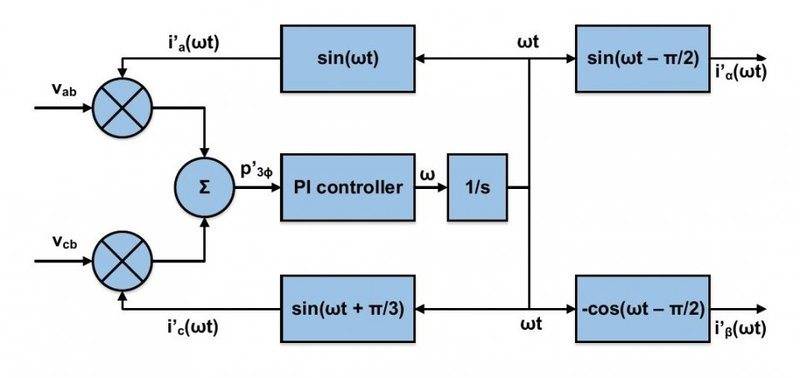
PLL.JPG
 
Engineering news on Phys.org
the best book i know of for PLL's is Signetics from 1972.

it's archived at https://archive.org/details/bitsavers_signeticsdcsPLLApplications_5800304

i saved a copy in my 'electronics' folder. Signetics NE565 datasheet is a companion piece.

OliskaP said:
Why must ω\omega be equal to system frequency to reach a stable point of operation?

That's what PLL's do, lock on to a frequency. Being out of sync is like grinding gear teeth. Read about capture transient in that Signetics book.
 
  • Like
Likes OliskaP
http://www.ece.usu.edu/ece_store/spec/LM565.pdf
 
  • Like
Likes OliskaP
Thank you @jim hardy , i'll read what you suggested tomorrow morning.
 
I am trying to understand how transferring electric from the powerplant to my house is more effective using high voltage. The suggested explanation that the current is equal to the power supply divided by the voltage, and hence higher voltage leads to lower current and as a result to a lower power loss on the conductives is very confusing me. I know that the current is determined by the voltage and the resistance, and not by a power capability - which defines a limit to the allowable...

Similar threads

Replies
26
Views
6K
Replies
1
Views
2K
  • · Replies 10 ·
Replies
10
Views
2K
Replies
9
Views
2K
  • · Replies 3 ·
Replies
3
Views
2K
  • · Replies 1 ·
Replies
1
Views
7K
  • · Replies 7 ·
Replies
7
Views
2K
  • · Replies 1 ·
Replies
1
Views
724
  • · Replies 4 ·
Replies
4
Views
1K
Replies
2
Views
3K