Disclaimer: It's been awhile since I've worked with two-port networks, so I might be a little rusty.
EEuser said:
Homework Statement:: What is S(21) for a perfect Transmission Line?
Homework Equations:: See images below
If a perfect transmission line is lossless, then would the S parameter for a perfect transmission line be
View attachment 255194?
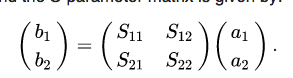
Homework Equation: S parameter matrix
View attachment 255195
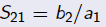
Yes, you can say that [itex]S_{21} = b_2/a_1[/itex], but I suspect that's not the whole answer for what is being asked (I think).
You see, [itex]S_{21} = b_2/a_1[/itex] is always the case, so long as [itex]a_2 = 0[/itex], because that's how the parameters were measured. Even if the network involves some sort of lossy, complicated transformers and whatnot, that relationship still holds.
But I think you can get more specific. Knowing that the network is supposed to represent a
perfect,
lossless transmission line (without anything fancy), what is the relationship between [itex]a_1[/itex] and [itex]b_2[/itex]?
That said, I don't know whether the intended answer is willing to accommodate a phase difference. Even a perfect, lossless transmission line might incur a phase difference if the transmission line is long. But in any case, you should be able to at least say something about the magnitude, [itex]| S_{21} |[/itex]. If you're working with a DC network, ignore this paragraph and give the answer for [itex]S_{21}[/itex] directly. If you're working with AC networks, then the answer might not be so simple since the parameter can be a complex number, but you should at least be able to say something about the parameter's magnitude.
 ?
?