Understanding Total Voltage in Parallel Circuits

Click For Summary

Homework Help Overview

The discussion revolves around understanding the total voltage in parallel circuits, specifically addressing the relationship between voltage drops across resistors and the independence of the total voltage from individual resistor values.

Discussion Character

  • Conceptual clarification, Assumption checking

Approaches and Questions Raised

  • Participants explore the concept of voltage in parallel circuits, questioning why the total voltage is independent of certain resistors. They discuss the application of Kirchhoff's law and the implications of tracing potential differences along different paths in the circuit.

Discussion Status

Participants are actively engaging with the problem, raising questions about circuit completeness and the placement of the power source. Some guidance has been offered regarding the relationship between voltage and resistors, but multiple interpretations and approaches are still being explored.

Contextual Notes

There is a noted lack of a complete circuit diagram, which some participants indicate is necessary for clarity. Assumptions about the placement of the voltage source and the nature of the paths taken in the circuit are also under discussion.

physics_CD
Messages
6
Reaction score
0
Homework Statement
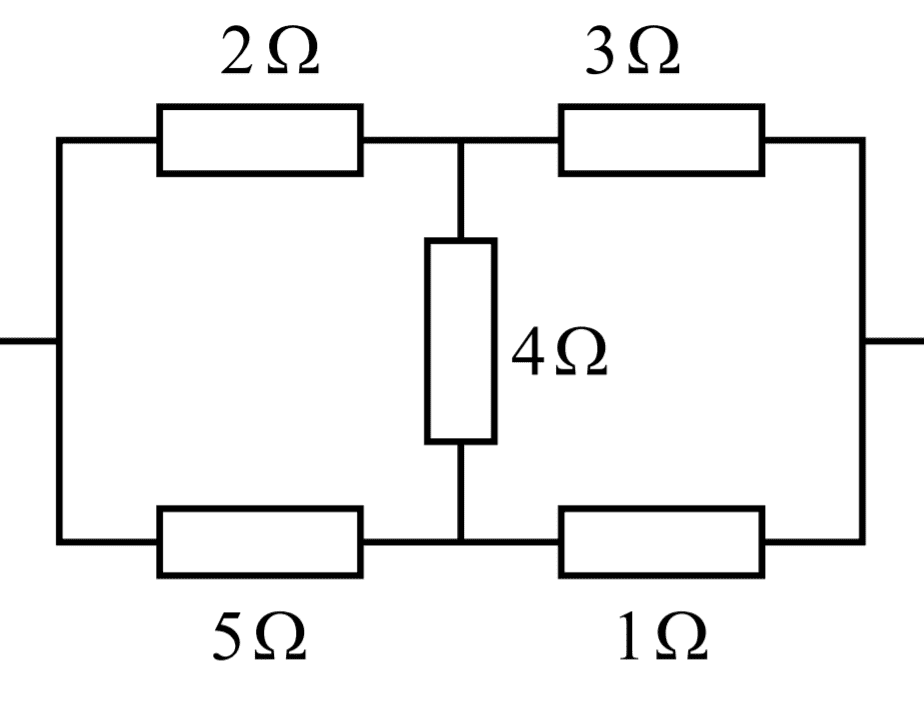
I have this resistor which is connected to some battery (not very important). I don't understand why the total voltage is equal to the voltage drop over the 3 Ω and 2 Ω resistors. Why is it not dependent on the resistor in the middle with 4 Ω . I do understand it if the 4 Ω were substituted with a wire. But how can it be that there is no difference whether it is 4 Ω or 0 Ω?
Relevant Equations
.
I really don't have any clue why the total voltage is equal to the voltage drop over the 3 Ω and 2 Ω resistors and independent of the 4 Ω resistor . Does it have to do with parallel circuits?
Udklip3.PNG
 
Physics news on Phys.org
And just where are you applying the voltage. Your circuit is incomplete without showing that. I assume it's on the far left and far right but you need to say. Draw the circuit WITH the power source.
 
phinds said:
And just where are you applying the voltage. Your circuit is incomplete without showing that. I assume it's on the far left and far right but you need to say. Draw the circuit WITH the power source.

Yes it is the far left and far right. I am sorry for not mentioning it.
 
There are a few ways of thinking about it. Suppose the potential on the far left is A volts, the potential at the node between the ##2\Omega## and ##3\Omega## resistors is B volts, and the potential on the far right is C Volts. Then the magnitude of the change in potential tracing along the very top loop is the sum of the individual changes: ##(A-B) + (B-C) = A-C##.

This is similar to how Kirchoff's law is formulated, though we would need to have a closed loop like @phinds mentioned to apply it, with the power source connected to the far left and far right.
 
  • Like
Likes   Reactions: physics_CD
etotheipi said:
There are a few ways of thinking about it. Suppose the potential on the far left is A volts, the potential at the node between the ##2\Omega## and ##3\Omega## resistors is B volts, and the potential on the far right is C Volts. Then the magnitude of the change in potential tracing along the very top loop is the sum of the individual changes: ##(A-B) + (B-C) = A-C##.

This is similar to how Kirchoff's law is formulated, though we would need to have a closed loop like @phinds mentioned to apply it, with the power source connected to the far left and far right.
But there are different ways I can go from A to B. Does this mean that the voltage drop is independent of which path I choose to go? (I assume that I can't go over the same path)
 
physics_CD said:
But there are different ways I can go from A to B. Does this mean that the voltage drop is independent of which path I choose to go? (I assume that I can't go over the same path)

Yes. The magnitude of the potential difference between the two end points is ##A-C##, since that is what we've labeled them. Now if we trace along any possible path from one end to the other, and add up all of the changes in potential as we go, we'll always end up with this value. It is a property of a conservative field that the change in potential energy is only dependent on the start and end points.

Of course, if want to start figuring out the currents through individual components, we will need to work out the potentials at some of the nodes in the middle.
 
Last edited by a moderator:
  • Like
Likes   Reactions: physics_CD
@physics_CD you are seriously overthinking this. If you have a battery hooked to the far left and far right, WHY would you expect the voltage of the battery to be effected by the value of the resistors (unless they were ALL zero in which case you'd have a short circuit)?

IF you would just DRAW the battery the way I asked I think it might be more clear to you.
 
Last edited:
  • Like
Likes   Reactions: jim mcnamara and etotheipi

Similar threads

  • · Replies 3 ·
Replies
3
Views
2K
  • · Replies 3 ·
Replies
3
Views
2K
Replies
3
Views
2K
Replies
9
Views
1K
Replies
2
Views
6K
  • · Replies 10 ·
Replies
10
Views
3K
Replies
9
Views
2K
  • · Replies 2 ·
Replies
2
Views
731
  • · Replies 1 ·
Replies
1
Views
813
  • · Replies 6 ·
Replies
6
Views
2K