Discussion Overview
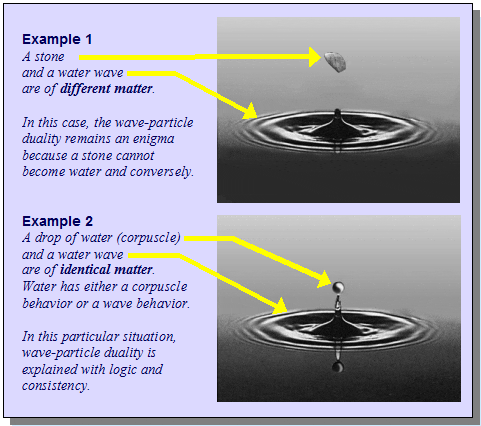
The discussion revolves around the concept of wave-particle duality, particularly through the analogy of water, exploring whether this analogy effectively represents the dual nature of quantum objects. Participants examine the historical context and relevance of wave-particle duality in modern quantum mechanics, debating its validity and implications.
Discussion Character
- Debate/contested
- Conceptual clarification
- Technical explanation
Main Points Raised
- Some participants argue that water exhibits both wave and particle characteristics, suggesting it could serve as a useful analogy for wave-particle duality in quantum physics.
- Others contend that wave-particle duality is a deprecated concept in modern physics, asserting that it is not applicable in the context of quantum mechanics.
- One participant emphasizes that the wave and particle descriptions in quantum mechanics are approximations and that neither is fundamentally built on the other.
- Another participant points out that quantum objects should not be classified strictly as waves or particles, but rather as quantum entities that exhibit different properties based on measurement.
- Some participants reference textbooks to illustrate that wave-particle duality is often treated as a historical concept rather than a current scientific framework.
- Questions are raised about the meaningfulness of discussing wave characteristics in relation to single particles, with calls for concrete experimental examples.
Areas of Agreement / Disagreement
Participants express multiple competing views regarding the validity and relevance of wave-particle duality, with no consensus reached on the effectiveness of the water analogy or the status of wave-particle duality in contemporary physics.
Contextual Notes
Some participants note that the analogy of water may oversimplify the complexities of quantum mechanics, and there are unresolved questions about the definitions and interpretations of wave and particle characteristics in quantum contexts.