DaveC426913
Gold Member
2025 Award
- 24,696
- 9,099
- TL;DR
- Under uniform heating, what happens to distance X?
(What? No Grade School prefix? :) )
Apologies for the lowest form of physics question: a quiz on social media.
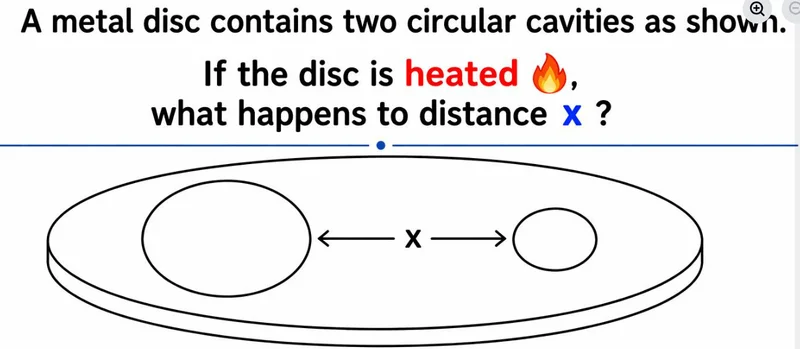
Does distance X
a. increase
b. decease
c. stay the same?
My rationale:
I did the simple version of this in grade 7 science class:
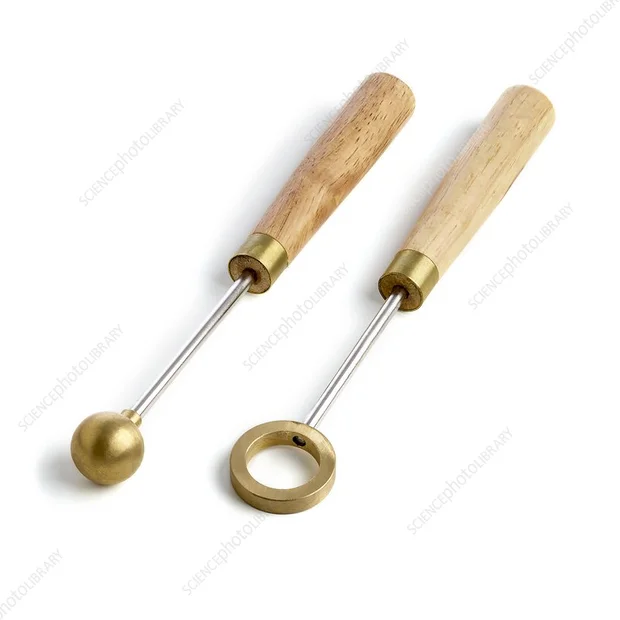
When both are in relative thermal equilibrium (say, room temperature) the ball does not fit through the ring.
Heat the ring and the ball slips through.
The experiment proves that, in this simple case at least, the ring expands uniformly, i.e. the inner edge of the ring expands outward, not inward.
(Or, perhaps more accurately, the metal near the inner edge of the ring might expand into the rings, but it is more than compensated for by the overall object's increase in dimensions, resulting in the actual final diameter of the ring increasing).
So, I am darned confident that the answer is: a. x increases.
But I could be wrong.
Some smartypantses have challenged this with a few spurious examples:
Yes?
Apologies for the lowest form of physics question: a quiz on social media.
Does distance X
a. increase
b. decease
c. stay the same?
My rationale:
I did the simple version of this in grade 7 science class:
When both are in relative thermal equilibrium (say, room temperature) the ball does not fit through the ring.
Heat the ring and the ball slips through.
The experiment proves that, in this simple case at least, the ring expands uniformly, i.e. the inner edge of the ring expands outward, not inward.
(Or, perhaps more accurately, the metal near the inner edge of the ring might expand into the rings, but it is more than compensated for by the overall object's increase in dimensions, resulting in the actual final diameter of the ring increasing).
So, I am darned confident that the answer is: a. x increases.
But I could be wrong.
Some smartypantses have challenged this with a few spurious examples:
- Heated by how much? Heat it till it's liquid and the holes will vanish.
- "Some" metal alloys (eg. Invar) under very specific manufacturing conditions, can exhibit negative thermal expansion
Yes?
Last edited:

