Uniform thermal expansion of metals

  • Context: High School 
  • Thread starter Thread starter DaveC426913
  • Start date Start date
DaveC426913
Gold Member
2025 Award
Messages
24,488
Reaction score
8,752
TL;DR
Under uniform heating, what happens to distance X?
(What? No Grade School prefix? :) )

Apologies for the lowest form of physics question: a quiz on social media.
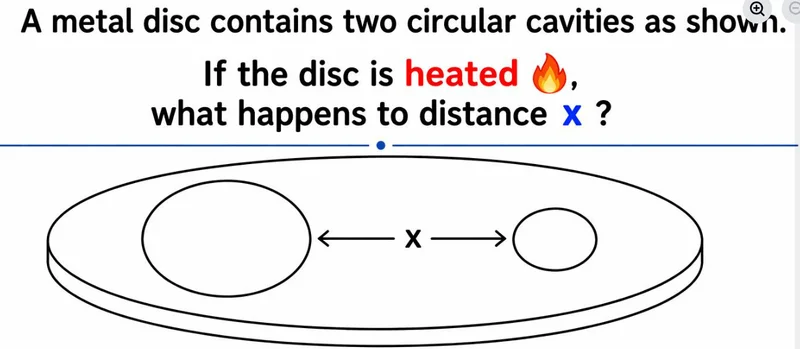

1777153500982.webp


Does distance X
a. increase
b. decease
c. stay the same?


My rationale:

I did the simple version of this in grade 7 science class:

1777153648370.webp

When both are in relative thermal equilibrium (say, room temperature) the ball does not fit through the ring.
Heat the ring and the ball slips through.

The experiment proves that, in this simple case at least, the ring expands uniformly, i.e. the inner edge of the ring expands outward, not inward.
(Or, perhaps more accurately, the metal near the inner edge of the ring might expand into the rings, but it is more than compensated for by the overall object's increase in dimensions, resulting in the actual final diameter of the ring increasing).

So, I am darned confident that the answer is: a. x increases.

But I could be wrong.


Some smartypantses have challenged this with a few spurious examples:

  • Heated by how much? Heat it till it's liquid and the holes will vanish.
  • "Some" metal alloys (eg. Invar) under very specific manufacturing conditions, can exhibit negative thermal expansion
But the "most correct" answer is: a.

Yes?
 
Last edited:
Physics news on Phys.org
Uniform expansion means that all distances increase. So if you assume that, the answer is a.
 
  • Agree
Likes   Reactions: berkeman
A.T. said:
Uniform expansion means that all distances increase. So if you assume that, the answer is a.
The only place it is assumed is in my answer. It is not in the problem.

So, the question remains unanswered.

Am I correct in my rationale (i.e. is my assumption warranted, as I apply it to the stated problem)?
 
DaveC426913 said:
So, the question remains unanswered.

Am I correct in my rationale (i.e. is my assumption warranted, as I apply it to the stated problem)?
Which rationale explicitly? Sorry that I was confused a bit by your thread start.

My answer:
Uniform thermal expansion is the same as doing CTRL-scroll_in with your keyboard and mouse on a diagram or picture of the metal piece. All dimensions increase.
 
  • Like
Likes   Reactions: Lnewqban
berkeman said:
Which rationale explicitly? Sorry that I was confused a bit by your thread start.
Right. Sorry. That's why it's so bad to quote from other sources without proper context.

Context: Some people (I won't call them fools) are arguing that X should decrease, because they think the metal surrounding the cavities will expand into the ... void.

[ EDIT ] Wait. That makes zero sense, even to any non-scientist! It's contradictory! Even if the metal expanded inward, that would still result in X increasing! I must have misinterpreted what they're saying!

I have posted prematurely.

Humble apologies. Please lock and delete. This whole thread makes no sense.

berkeman said:
Uniform thermal expansion is the same as doing CTRL-scroll_in with your keyboard and mouse on a diagram or picture of the metal piece. All dimensions increase.
You know that and I know that, but that's a metaphor, not an explanation.
 
DaveC426913 said:
Please lock and delete. This whole thread makes no sense.
No, no, no. The thread question is valid and comes up all the time. :smile:
 
  • Agree
Likes   Reactions: Bystander
DaveC426913 said:
It is not in the problem.
That's a problem of the problem. It's vague, so people can argue about it forever.
 
Every one-dimensional measurement increases by the same ratio. Put two marks anywhere on the disk and the distance between them will increase as described by ##\Delta L=L_o\alpha \Delta T##. The holes in the disk are a distraction.
 
DaveC426913 said:
You know that and I know that, but that's a metaphor, not an explanation.
Make the radii of the holes tend to zero: we have a body tending to look close to a coin.
If all the molecules of coin increase at once (uniform heating), its shape expands uniformly.

Make the radii of the holes tend to the radius of the disc: we have a body tending to look close to the ring shown in post 1.
If all the molecules of ring increase at once (uniform heating), its shape expands uniformly (increasing its internal diameter.
 
  • Like
Likes   Reactions: Gavran and DaveC426913
  • #10
The point i am now trying to establish is why did ANYONE think x would decrease?

At first I thought they had a point, but i cant even make it make sense.

Since the only answer is a, why do I need to verify?
 
  • #11
Herman Trivilino said:
The holes in the disk are a distraction.
Something I noticed many people assumed: nowhere does it say they're "holes" they're "cavities", which does not suggest they cut all the way through. That is verified by the diagram, which does not indicate the inner circles have any substantial depth. They are depressions , not holes.
 
  • #12
From a fundamental materials point of view, if the metal is isotropic and the sample in not constrained or loaded mechanically (essentially isotropic state of stress) in any way, then the sample experiences a homogenous isotropic strain, with, for small temperature changes, the strain being proportional to the temperature change.
 
  • #13
DaveC426913 said:
Something I noticed many people assumed: nowhere does it say they're "holes" they're "cavities", which does not suggest they cut all the way through.
My point is, they are a distraction. Doesn't matter how deep they are. The distance ##x## will increase.

Put two marks on the disk and measure the distance ##x## between them. The value of ##x## will increase regardless if there are holes or cavities next to the points, between the points, or anywhere else; or even if one or both of them is not there.
 
  • #14
DaveC426913 said:
The point i am now trying to establish is why did ANYONE think x would decrease?
There is no single reason that would be valid for everyone. You would need to design a question that would probe that issue. You would likely get a distribution of different reasons. This is the kind of thing physics education researchers (PER) might do to try to improve instructional strategies.

Just like a physics researcher would do experiments to determine an outcome instead of trying to use reasoning to find out how Nature behaves, PER would do experiments to find out how learners behave.
DaveC426913 said:
Since the only answer is a, why do I need to verify?
Because that's physics. If you don't need to verify Nature's behavior you don't need physics.
 
  • #15
Herman Trivilino said:
Because that's physics. If you don't need to verify Nature's behavior you don't need physics.
If someone tried to claim a volume of air should cool when it's compressed I wouldn't need to verify that it's wrong. :wink:
 
  • #16
DaveC426913 said:
The point i am now trying to establish is why did ANYONE think x would decrease?
You should ask people who think so, to draw what they think the heated shape looks like, over the initial shape for comparison.
 
  • #17
DaveC426913 said:
The point i am now trying to establish is why did ANYONE think x would decrease?
I would imagine the reasoning is that the holes get bigger, as exemplified by the ball and ring in your OP, so ##x## must decrease. Obviously the flaw is not noting that everything gets bigger.
 
  • Like
Likes   Reactions: Lnewqban
  • #18
DaveC426913 said:
If someone tried to claim a volume of air should cool when it's compressed I wouldn't need to verify that it's wrong. :wink:
That's because you already have or others have done so for you. My point is that conclusions like that cannot be arrived at by reasoning alone. Experimental or observational evidence is a requirement.
 
  • #19
Ibix said:
I would imagine the reasoning is that the holes get bigger, as exemplified by the ball and ring in your OP, so ##x## must decrease. Obviously the flaw is not noting that everything gets bigger.
Yes, I think the double hole case is a good follow up question to ask after explaining the single hole case, in order to check if the explanation was correctly understood.
 
  • Like
Likes   Reactions: DaveC426913, Ibix and Herman Trivilino
  • #20
Herman Trivilino said:
That's because you already have or others have done so for you.
Exactly.
 
  • #21
Ibix said:
I would imagine the reasoning is that the holes get bigger, as exemplified by the ball and ring in your OP, so ##x## must decrease. Obviously the flaw is not noting that everything gets bigger.
That's gotta be it.

I drew some diagrams for them. Let em chew on those.

The real takeaway here is: don't argue with people on social media.
 
  • Agree
Likes   Reactions: Bystander
  • #22
DaveC426913 said:
That's gotta be it.
The thing is, without data to support that conclusion we have, well, no data to support it!
 
  • Like
Likes   Reactions: Ibix
  • #23
Herman Trivilino said:
The thing is, without data to support that conclusion we have, well, no data to support it!
It would definitely be interesting to see those people defending their belief. It may be just a fraction of the population tossing a coin to decide their answer.
 
  • #24
Ibix said:
It would definitely be interesting to see those people defending their belief. It may be just a fraction of the population tossing a coin to decide their answer.
Yes. That, and Poe's Law.

There's no credibility quotient on social media, so there's no disincentive to troll, or merely just have a little fun. It's def not conducive to debate-like discussion.


Poe's Law: it is impossible to create a parody of extreme views that someone will not mistake for a sincere expression of those views, unless a clear indicator of intent (like a smiley face or "/s" tag) is used.
 
  • #25
An easy way to view (and teach) such problems is to consider the missing material. Here is what I mean.
  1. Start with two identical metal disks. Disk A is the control and disk B the object of investigation.
  2. Allow disks A and B to reach equilibrium at common temperature T1.
  3. Cut out of disk B two coin-like smaller disks which may or may not leave cavities or holes behind; it doesn't matter.
  4. Cut out a wire along distance "x"; again it doesn't matter whether a slit or cavity is left behind.
  5. Note that you can remove and reinsert any of the cut-out disks and the wire "x" in disk B. When all pieces are in, disks A and B look identical.
  6. Raise the common temperature of disks A and B (including the cut outs) to T2.
  7. Note that you can remove and reinsert any of the cut-out disks and the wire "x" in disk B. When all pieces are in, disks A and B look identical and have increased diameters at the new, increased temperature.
  8. Draw your conclusions.
I think that problems of this type illustrate what I call the "window" preconception. We are used to observing the world through windows, television screens, computer monitors, etc. where depicted objects appear larger when they move closer whilst the plane of the frame through which we observe them remains fixed in size.

So when we are asked what happens to the hole in the disk when the disk is heated, we know that the material of the disk has to expand because it is heated, but since we impulsively assume that the disk circumference is fixed (just like a ship's porthole), the hole in the disk must get smaller, no?

(Edited for typos and clarity)
 
Last edited:
  • Like
Likes   Reactions: Ibix and DaveC426913

Similar threads

  • · Replies 1 ·
Replies
1
Views
3K
  • · Replies 5 ·
Replies
5
Views
3K
  • · Replies 5 ·
Replies
5
Views
24K
  • · Replies 19 ·
Replies
19
Views
6K
  • · Replies 4 ·
Replies
4
Views
9K
  • · Replies 2 ·
Replies
2
Views
13K
  • · Replies 15 ·
Replies
15
Views
3K
  • · Replies 4 ·
Replies
4
Views
2K
Replies
7
Views
8K
  • · Replies 5 ·
Replies
5
Views
2K