Units in Z_m .... Anderson and Feil, Theorem 8.6 .... ....

  • Context: Undergrad 
  • Thread starter Thread starter Math Amateur
  • Start date Start date
  • Tags Tags
    Theorem Units
Click For Summary
SUMMARY

The discussion centers on Theorem 8.6 from "A First Course in Abstract Algebra" by Anderson and Feil, specifically addressing the conditions under which the inequalities \( m > r > 1 \) and \( m > s > 1 \) hold true. The participants clarify that the correct interpretation is \( m > r > 1 \) and \( m > s \), with the latter not necessarily needing \( s > 1 \). The proof hinges on the properties of the greatest common divisor (gcd) and the implications of \( d = \gcd(x, m) \) being greater than 1, leading to the conclusion that \( r < m \) and \( s < m \) establish \( [x] \) as a zero divisor in \( \mathbb{Z}_m \.

PREREQUISITES
  • Understanding of gcd (greatest common divisor) in number theory
  • Familiarity with the structure of integral domains and fields
  • Knowledge of modular arithmetic, specifically \( \mathbb{Z}_m \)
  • Basic proficiency in mathematical proofs and inequalities
NEXT STEPS
  • Study the properties of gcd and its applications in number theory
  • Explore the structure and properties of integral domains and fields
  • Learn about zero divisors in modular arithmetic, particularly in \( \mathbb{Z}_m \)
  • Review the proof techniques used in abstract algebra, focusing on inequalities and divisibility
USEFUL FOR

Students of abstract algebra, mathematicians focusing on number theory, and educators teaching modular arithmetic and integral domains will benefit from this discussion.

Math Amateur
Gold Member
MHB
Messages
3,920
Reaction score
48
I am reading Anderson and Feil - A First Course in Abstract Algebra.

I am currently focused on Ch. 8: Integral Domains and Fields ...

I need some help with an aspect of the proof of Theorem 8.6 ...

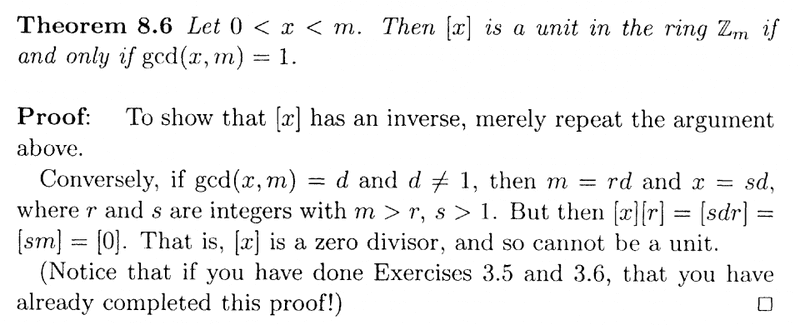
Theorem 8.6 and its proof read as follows:
?temp_hash=4cad108bde00c38f1acae6d92c8cf1dc.png

In the above text, Anderson and Feil write the following:

" ... ... Conversely, if ##gcd(x,m) = d## and ##d \neq 1##, then ##m = rd## and ##x = sd##, where ##r## and ##s## are integers with ##m \gt r, s \gt 1##. ... ... "I cannot see exactly why/how ##m \gt r, s \gt 1## ... can someone help me to prove that ##m \gt r## and ##s \gt 1## ... ... ?
Help will be appreciated ...

Peter
 

Attachments

  • Anderson and Feil - Theorem 8.6  ... ....png
    Anderson and Feil - Theorem 8.6 ... ....png
    26.9 KB · Views: 755
Physics news on Phys.org
First off, you should note that the author doesn't mean to write $m>r$ and $s>1$. What he means is that $m>r>1$ and $m>s>1$.

Now, there is nothing fancy going on here. If $d=\gcd(x,m)$, then $d$ divides both $x$ and $m$, so we can write $m=rd$ and $x=sd$ for some integers $r,s$. Now, since we're assuming $d\neq1$, i.e. $d>1$, then we must have $r<m$ because if $r\ge m$, then we'd have $m=rd\ge md>m$, which is a contradiction. Similarly, $s<x$, and $x<m$ by assumption so $s<m$.

Now actually, I believe there is a typo here from the author. You don't necessarily need $s>1$, you could have $s=1$. Note the fact that $s>1$ isn't actually used in the rest of the proof, so it doesn't matter.

Edit: sorry for the poor formatting, this is my first time using this forum to answer a math question and I assumed it would use TeX commands.
 
  • Like
Likes   Reactions: Math Amateur
mathers101 said:
Edit: sorry for the poor formatting, this is my first time using this forum to answer a math question and I assumed it would use TeX commands.
It does, but the syntax varies a bit from editor to editor. Here you have to use [\itex] or double # # for inline tex and [\tex] or double $ $ for single line tex. See &lt;a href=&quot;https://www.physicsforums.com/help/latexhelp/&quot; class=&quot;link link--internal&quot;&gt;https://www.physicsforums.com/help/latexhelp/&lt;/a&gt;
 
Thanks mathers101 ... just worked through what you have said ...

Your argument is VERY clear and helpful ...

Thanks again ...

Peter
 
Hi mathers101 ...

Just realized that I am unsure of where m > r > 1 is used in the rest of the proof ...

Can you help with this matter ...

Peter
 
Math Amateur said:
Hi mathers101 ...

Just realized that I am unsure of where m > r > 1 is used in the rest of the proof ...

Can you help with this matter ...

Peter
r > 1 is again not used at all, and r < m tells you that [r] is a nonzero element of Z_m, so since [x][r] = 0, we see [x] is a zero divisor.
 
  • Like
Likes   Reactions: Math Amateur

Similar threads

  • · Replies 2 ·
Replies
2
Views
1K
  • · Replies 7 ·
Replies
7
Views
2K
  • · Replies 3 ·
Replies
3
Views
3K
  • · Replies 3 ·
Replies
3
Views
2K
  • · Replies 1 ·
Replies
1
Views
1K
Replies
2
Views
2K
  • · Replies 6 ·
Replies
6
Views
2K
  • · Replies 10 ·
Replies
10
Views
3K
  • · Replies 23 ·
Replies
23
Views
3K
  • · Replies 5 ·
Replies
5
Views
2K