Use of Lagrange's equations in classical mechanics

Click For Summary

Discussion Overview

The discussion revolves around the application of Lagrange's equations in classical mechanics, particularly focusing on the method of Lagrange multipliers and its relevance to variational calculus. Participants explore the differences between finding stationary points of functions and functionals, especially in the context of constraints.

Discussion Character

  • Technical explanation
  • Conceptual clarification
  • Debate/contested

Main Points Raised

  • One participant expresses confusion about the relevance of Lagrange multipliers in deriving functions that extremize a particular integral, noting a difference between finding points and functions.
  • Another participant suggests skipping the chapter in Goldstein regarding non-holonomic constraints, labeling it as flawed, while affirming that the concept of Lagrange multipliers is consistent between variational calculus and functions under constraints.
  • A later reply reiterates the previous suggestion to skip the chapter and requests recommendations for better resources on the topic.
  • Another participant recommends Landau & Lifshitz as a proper treatment of the subject.
  • One participant elaborates on the connection between Lagrange multipliers and variational calculus, explaining that the function space in this context is infinite-dimensional and drawing parallels with discretization of integrals.
  • This participant argues that the principles of the Lagrange multiplier method in finite-dimensional spaces can be applied to function spaces without modification.

Areas of Agreement / Disagreement

Participants express disagreement regarding the treatment of non-holonomic constraints in Goldstein's text, with some suggesting it is flawed. There is no consensus on the best approach to understanding Lagrange's equations in this context, as multiple perspectives and resources are proposed.

Contextual Notes

Some limitations are noted regarding the treatment of non-holonomic constraints and the applicability of Lagrange multipliers in different dimensional spaces. The discussion highlights the complexity of transitioning from finite-dimensional to infinite-dimensional contexts without resolving the underlying assumptions.

PrathameshR
Messages
35
Reaction score
3
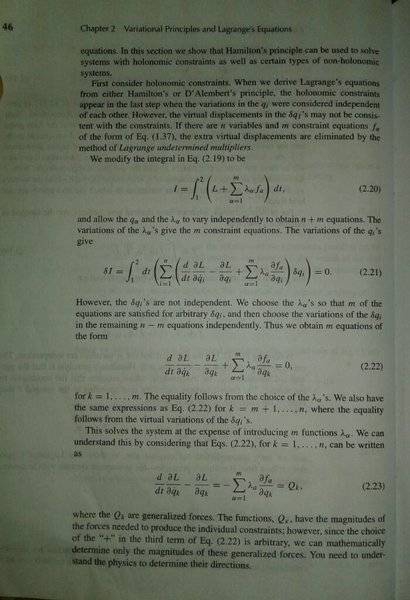
I have been studying classical mechanics for a while from Goldstein book and can't go ahead of the following derivation. I understand the method of Lagrange's multipliers for getting extrima of a function subjected to equality constraints but can't understand it's relevance here because in that method we find "points" which give extremum value but here we want to find "function" which extrimizes a perticular integral.
20170913_195431-1.jpeg

In the 4rth line of 2nd paragraph it says that delta a 'subscript I ' may not be consistent with contraints , how is that possible?

In the title I ment use of Lagrange's "multipliers"
 
Physics news on Phys.org
Skip this chapter from Goldstein, at least if it comes to non-holonomous constraints since this is awfully flawed. Otherwise the idea of Lagrange multipliers is precisely the same in variational calculus (finding stationary points of functionals) as in finding stationary points of functions under constraints.
 
vanhees71 said:
Skip this chapter from Goldstein, at least if it comes to non-holonomous constraints since this is awfully flawed. Otherwise the idea of Lagrange multipliers is precisely the same in variational calculus (finding stationary points of functionals) as in finding stationary points of functions under constraints.
Can you suggest any good place where I can read a proper treatment of this topic?
 
It's in Landau&Lifshitz vol. I.
 
PrathameshR said:
but can't understand it's relevance here because in that method we find "points" which give extremum value but here we want to find "function" which extrimizes a perticular integral.
As @vanhees71 mentioned, it is just the same idea. In fact, the only difference is that your function space is infinite-dimensional whereas you have likely only seen the Lagrange multiplier method applied to finite-dimensional vector spaces before. As a heuristic argument, consider a discretisation of your integral
$$
\mathcal F = \int f(\phi(x),\phi'(x)) dx \to \Delta x \sum_{i = 1}^N f(\phi(x_i),[\phi(x_{i+1})-\phi(x_i)]/\Delta x) \equiv F(\vec \phi)
$$
where ##F## is some function of the function values ##\phi_i = \phi(x_i)##. Now think of the ##\phi_i## as the coordinates in ##\mathbb R^N##. It is rather easy to convince yourself that the partial derivative ##\partial F/\partial\phi_i## is just the discretisation of the functional derivative ##\delta \mathcal F/\delta\phi(x_i)## at ##x_i##. Furthermore, you therefore also have that the discretisation of the variation
$$
\delta \mathcal F = \int \frac{\delta F}{\delta \phi(x)} \delta\phi(x) dx
$$
is on the form
$$
\Delta x \sum_i \delta\phi_i \frac{\partial F}{\partial\phi_i} \propto \delta\vec \phi \cdot \nabla F,
$$
where ##\nabla## is the gradient in the space with coordinates ##\phi_i## and ##\delta\vec \phi## is a variation in that space.

If you are considering a vector space of functions, the entire argument for the Lagrange multiplier method that is used in a finite-dimensional vector space goes through without modification to the function space.
 
  • Like
Likes   Reactions: vanhees71

Similar threads

  • · Replies 3 ·
Replies
3
Views
2K
  • · Replies 25 ·
Replies
25
Views
3K
  • · Replies 1 ·
Replies
1
Views
1K
  • · Replies 17 ·
Replies
17
Views
3K
  • · Replies 14 ·
Replies
14
Views
8K
  • · Replies 12 ·
Replies
12
Views
2K
  • · Replies 1 ·
Replies
1
Views
1K
  • · Replies 5 ·
Replies
5
Views
2K
  • · Replies 3 ·
Replies
3
Views
4K
  • · Replies 3 ·
Replies
3
Views
1K