Using a simple pendulum to determine g

Click For Summary

Homework Help Overview

The discussion revolves around an experiment using a simple pendulum to determine the acceleration due to gravity (g). Participants are measuring the time for multiple oscillations and plotting the relationship between the length of the pendulum and the square of the time period.

Discussion Character

  • Exploratory, Conceptual clarification, Mathematical reasoning, Assumption checking

Approaches and Questions Raised

  • Participants discuss the relationship between the length of the pendulum and the period, questioning whether to use the period squared instead of the total time squared in their calculations. There is also confusion regarding the correct setup of their equations and the implications of their measurements.

Discussion Status

Some participants have offered clarifications regarding the distinction between total time for multiple oscillations and the period of a single oscillation. There is acknowledgment of confusion around the correct application of formulas and the need to ensure accurate measurements. Multiple interpretations of the data and equations are being explored.

Contextual Notes

Participants are working under the constraints of a classroom experiment, with specific requirements for data collection and analysis. There is mention of potential errors in measurements and calculations, as well as the need to express results in terms of percentage error.

Celer
Messages
13
Reaction score
0
Using a simple pendulum to determine "g"

1. Using a simple pendulum to determine "g"
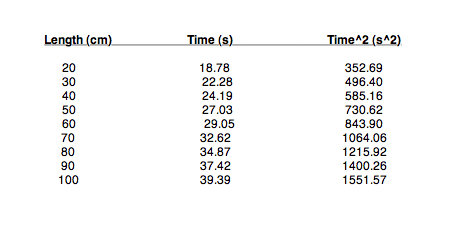
Basically, we were asked to do an experiment where we measured with a stopwatch for 20 complete oscillations for a pendulum bob swinging through a small arc (10 degrees). We increased the length of the string attached to the bob by 10 cm every time from 20cm to 1m.
Then, we were supposed to graph length to time^2 and figure out a value of "g" and give a straight line graph in the form of y=mx + c

Basically, i recorded data like this
attachment.php?attachmentid=15248&d=1220182782.png


Using Time^2, and Length, I plot the graph and drew a line of best fit in the form of y=mx + c. I got a slope (m) of 14.371

Homework Equations


I used g = 4pi^2 / m

Where m is the slope of the graph.

The Attempt at a Solution


Using the above equation, I subbed in all the numbers to find "g" for the first point of data.

So, g = 4pi^2/14.371
g = 2.747

My question is, as we all know "g" should be 9.8 meters per second ^2. I am getting a figure of 2.747 meters per second ^2. Which is awfully off what it should be right?

I am wondering if one of my equations are set up wrong, or did I measure something wrong?
 

Attachments

  • Picture 2.png
    Picture 2.png
    3.9 KB · Views: 9,697
Physics news on Phys.org


Celer said:

Homework Equations


I used g = 4pi^2 / m
What's the actual relationship in terms of length and period?

How does your measured value of "time" relate to the period of the pendulum?


Well, I know that length and period are used in this equation:

T^2 = 4pi^2L / g.

my measure of Time (s) is of 20 oscilliations of the pendulum.

and Period = time / # of cycles.

So is it what I am supposed to do is use Period ^2 instead of Time^2 ?

Am I supposed to use T^2 = 4pi^2L / g and bring it over to y = mx + c, where Period^2 is at the y-axis, Length at the x-axis?

Sorry, I'm still a little confused as to how to do this question.


Celer said:
Well, I know that length and period are used in this equation:

T^2 = 4pi^2L / g.
Right. Here, T is the period, not your measured 20 oscillations.

my measure of Time (s) is of 20 oscilliations of the pendulum.

and Period = time / # of cycles.

So is it what I am supposed to do is use Period ^2 instead of Time^2 ?
Yep. Or rewrite the equation above in terms of measured time, instead of period.


In my school i am doing an experiment on pendulum to plot a l-t^2 graph.


Uh yeah, I think I was confused over using Time and Period. It should be period.

I got 1088.48 cm / s^2

I was wondering how to calculate the percentage error?

Is it ( 1 - (980 / 1088.48) ) * 100

Anyways, thanks for your clarification and help Doc Al


Celer said:
I was wondering how to calculate the percentage error?

Is it ( 1 - (980 / 1088.48) ) * 100

It's best to express your error as a percentage of the correct value.


Parandroid said:
In my school i am doing an experiment on pendulum to plot a l-t^2 graph.
I damn confused i have to make a L-T graph. which will be a parabola but with my readings a staright line is coming...
 

Similar threads

  • · Replies 20 ·
Replies
20
Views
2K
  • · Replies 32 ·
2
Replies
32
Views
3K
  • · Replies 9 ·
Replies
9
Views
3K
  • · Replies 14 ·
Replies
14
Views
2K
  • · Replies 20 ·
Replies
20
Views
3K
  • · Replies 15 ·
Replies
15
Views
2K
  • · Replies 5 ·
Replies
5
Views
1K
  • · Replies 27 ·
Replies
27
Views
2K
  • · Replies 7 ·
Replies
7
Views
6K
  • · Replies 5 ·
Replies
5
Views
2K