Using a simple pendulum to determine g

Click For Summary
SUMMARY

The forum discussion centers on using a simple pendulum to determine the acceleration due to gravity (g). The experiment involved measuring the time for 20 oscillations of a pendulum bob with varying string lengths from 20 cm to 1 m. The user initially calculated a slope (m) of 14.371 from a length vs. time squared graph, leading to a calculated g value of 2.747 m/s², significantly lower than the expected 9.8 m/s². Clarifications revealed that the user should use the period of the pendulum instead of total time for oscillations when plotting the graph.

PREREQUISITES
  • Understanding of simple harmonic motion and pendulum mechanics
  • Familiarity with graphing linear relationships in the form of y=mx+c
  • Knowledge of the formula T² = 4π²L/g for pendulum motion
  • Basic skills in calculating percentage error
NEXT STEPS
  • Learn how to accurately measure the period of a pendulum
  • Study the derivation of the formula T² = 4π²L/g
  • Explore methods for calculating and interpreting percentage error in experiments
  • Investigate the effects of air resistance and friction on pendulum motion
USEFUL FOR

Students conducting physics experiments, educators teaching concepts of pendulum motion, and anyone interested in experimental methods for determining gravitational acceleration.

Celer
Messages
13
Reaction score
0
Using a simple pendulum to determine "g"

1. Using a simple pendulum to determine "g"
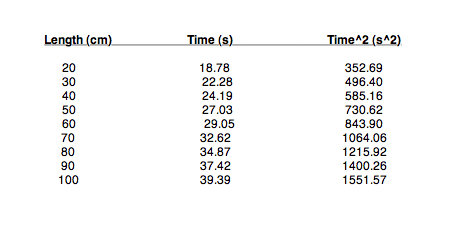
Basically, we were asked to do an experiment where we measured with a stopwatch for 20 complete oscillations for a pendulum bob swinging through a small arc (10 degrees). We increased the length of the string attached to the bob by 10 cm every time from 20cm to 1m.
Then, we were supposed to graph length to time^2 and figure out a value of "g" and give a straight line graph in the form of y=mx + c

Basically, i recorded data like this
attachment.php?attachmentid=15248&d=1220182782.png


Using Time^2, and Length, I plot the graph and drew a line of best fit in the form of y=mx + c. I got a slope (m) of 14.371

Homework Equations


I used g = 4pi^2 / m

Where m is the slope of the graph.

The Attempt at a Solution


Using the above equation, I subbed in all the numbers to find "g" for the first point of data.

So, g = 4pi^2/14.371
g = 2.747

My question is, as we all know "g" should be 9.8 meters per second ^2. I am getting a figure of 2.747 meters per second ^2. Which is awfully off what it should be right?

I am wondering if one of my equations are set up wrong, or did I measure something wrong?
 

Attachments

  • Picture 2.png
    Picture 2.png
    3.9 KB · Views: 9,686
Physics news on Phys.org


Celer said:

Homework Equations


I used g = 4pi^2 / m
What's the actual relationship in terms of length and period?

How does your measured value of "time" relate to the period of the pendulum?


Well, I know that length and period are used in this equation:

T^2 = 4pi^2L / g.

my measure of Time (s) is of 20 oscilliations of the pendulum.

and Period = time / # of cycles.

So is it what I am supposed to do is use Period ^2 instead of Time^2 ?

Am I supposed to use T^2 = 4pi^2L / g and bring it over to y = mx + c, where Period^2 is at the y-axis, Length at the x-axis?

Sorry, I'm still a little confused as to how to do this question.


Celer said:
Well, I know that length and period are used in this equation:

T^2 = 4pi^2L / g.
Right. Here, T is the period, not your measured 20 oscillations.

my measure of Time (s) is of 20 oscilliations of the pendulum.

and Period = time / # of cycles.

So is it what I am supposed to do is use Period ^2 instead of Time^2 ?
Yep. Or rewrite the equation above in terms of measured time, instead of period.


In my school i am doing an experiment on pendulum to plot a l-t^2 graph.


Uh yeah, I think I was confused over using Time and Period. It should be period.

I got 1088.48 cm / s^2

I was wondering how to calculate the percentage error?

Is it ( 1 - (980 / 1088.48) ) * 100

Anyways, thanks for your clarification and help Doc Al


Celer said:
I was wondering how to calculate the percentage error?

Is it ( 1 - (980 / 1088.48) ) * 100

It's best to express your error as a percentage of the correct value.


Parandroid said:
In my school i am doing an experiment on pendulum to plot a l-t^2 graph.
I damn confused i have to make a L-T graph. which will be a parabola but with my readings a staright line is coming...
 

Similar threads

  • · Replies 20 ·
Replies
20
Views
2K
  • · Replies 32 ·
2
Replies
32
Views
2K
  • · Replies 9 ·
Replies
9
Views
2K
  • · Replies 14 ·
Replies
14
Views
2K
  • · Replies 20 ·
Replies
20
Views
3K
  • · Replies 15 ·
Replies
15
Views
2K
  • · Replies 5 ·
Replies
5
Views
1K
  • · Replies 27 ·
Replies
27
Views
2K
  • · Replies 7 ·
Replies
7
Views
5K
  • · Replies 5 ·
Replies
5
Views
2K