Using integration find the volume of cutted cone

Click For Summary
SUMMARY

The discussion focuses on calculating the volume of a truncated cone using integration, specifically revolving the shape around the y-axis. The formula presented involves the integral V = \pi \int_{0}^{h} \left(\frac{r-R}{h} y + R\right)^2 dy, which simplifies to V = \frac{h}{r-R} \pi \int_{R}^{r} u^2 du through substitution. The participants confirm the correctness of the approach and suggest using substitution for simplification. This method effectively calculates the volume of the cut cone.

PREREQUISITES
  • Understanding of calculus, specifically integration techniques.
  • Familiarity with the concept of volumes of revolution.
  • Knowledge of substitution methods in integration.
  • Basic geometry of cones and their properties.
NEXT STEPS
  • Study the method of volumes of revolution in calculus.
  • Learn about integration techniques, focusing on substitution.
  • Explore applications of integration in geometric problems.
  • Investigate the properties of conic sections and their volumes.
USEFUL FOR

Mathematics students, educators, and professionals involved in engineering or physics who require a solid understanding of integration techniques for calculating volumes of geometric shapes.

Amer
Messages
259
Reaction score
0
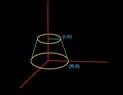
if we cut a right cone parallel to the base having a two radius r and R The picture
View attachment 407

I want to use the volume of revolution around the y-axis
we have the line

y - 0 = \dfrac{h}{r-R} (x - R)
x = \frac{r-R}{h} y +R

The volume will be
\pi \int_{0}^{h} \left(\frac{r-R}{h} y + R\right)^2 dy
\pi \int_{0}^{h} \frac{(r-R)^2y^2}{h^2} + \frac{2R(r-R)y}{h} + R^2 dy
now i just have to evaluate the integral, did i miss something ?
 

Attachments

  • Mas.jpg
    Mas.jpg
    10.8 KB · Views: 94
Physics news on Phys.org
Looks correct to me, however, I would use a substitution to simplify matters:

$\displaystyle V=\pi\int_0^h\left(\frac{r-R}{h}y+R \right)^2\,dy$

Let:

$\displaystyle u=\frac{r-R}{h}y+R\,\therefore\,du=\frac{r-R}{h}\,dy$

hence:

$\displaystyle V=\frac{h}{r-R}\pi\int_{R}^{r}u^2\,du$
 

Similar threads

  • · Replies 4 ·
Replies
4
Views
4K
  • · Replies 3 ·
Replies
3
Views
2K
  • · Replies 2 ·
Replies
2
Views
3K
  • · Replies 29 ·
Replies
29
Views
5K
  • · Replies 20 ·
Replies
20
Views
4K
  • · Replies 3 ·
Replies
3
Views
3K
  • · Replies 8 ·
Replies
8
Views
3K
  • · Replies 4 ·
Replies
4
Views
2K
  • · Replies 5 ·
Replies
5
Views
3K
  • · Replies 2 ·
Replies
2
Views
3K