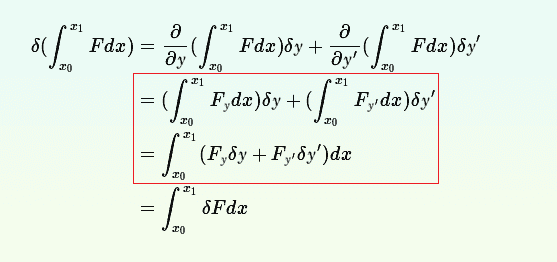
To answer your direct question, it is really a matter of the reverse, moving the [itex]\delta y, \delta y'[/itex] outside the integral from the inside which would be a mistake. In point of fact, it's the very first step that has questionable validity.
Again it is a question of conflating the meaning of [itex]y[/itex], at one level as a variable with respect to which one can take a partial derivative when it appears inside a function an at another level as a function of [itex]x[/itex] which may occur within a definite integral.
As an exercise try evaluating each step in this derivation sequence for specific examples. Say let [itex]F(x,y,y')=x^2\cdot y^2\cdot y'[/itex] and let [itex]x_0 = 0, x_1=1[/itex]. For the initial functional and then the first derivation step one must evaluate the definite integral before considering variations or partial derivatives. To integrate you can't leave [itex]y[/itex] and [itex]y'[/itex] independent variables. They must be assigned some functional dependency on [itex]x[/itex]. Let's choose one, say [itex]y=x^3, y'=3x^2[/itex]. Then when you evaluate the definite integral you get a constant value. What does it mean to take the partial derivative of that with respect to [itex]y[/itex] or [itex]y'[/itex].
Alternatively if you treat [itex]y[/itex] and [itex]y'[/itex] as independent variables, then the integration would be:
[tex]\int_0^1 F(x,y,y')dx = \int_0^1 x^2 y^2 y' dx = \left[\frac{x^3}{3}\right]^1_0 y^2 y' = \frac{1}{3}y^2 y'[/tex]
That is most definitely not what is intended here.
Phrased properly the partial derivatives of the first step should be a single functional derivative of the integral as a functional on [itex]y[/itex]
[tex]= \frac{\delta }{\delta y}\left(\int_I F(x,y(x),y'(x))dx\right)[\delta y] = *...[/tex]
The functional derivative should yield a (linear) functional acting on the variation of [itex]y[/itex] the function.
But you can then, for the purposes of expanding in terms of partial derivatives, consider [itex]y[/itex] and [itex]y'[/itex] independent functions of [itex]x[/itex] (and here I'm going to go greek to emphasize these functions) and expand this in terms of partial functional derivatives:
[tex]*=\left. \frac{\delta}{\delta \phi}\left(\int_I F(x,\phi(x),\psi(x))dx\right)\right\rvert_{(\phi,\psi)=(y,y')}[\delta y] ...[/tex]
[tex]+\frac{\delta}{\delta \psi}\left(\int_I F(x,\phi(x),\psi(x))dx\right)\rvert_{(\phi,\psi)=(y,y')}[\delta y'][/tex]
The next step would then be to internalize the partial functional derivative which would then manifest as an integral of standard partial derivatives of the integrand function F.
It's bulky to express this correctly. What is happening is that each "partial functional derivative" of a functional is yielding a linear functional valued functional which is evaluated at a functional differential. e.g.
[tex]A[y]= \int_a^b F(x,y(x))dx,\quad \frac{\delta}{\delta y}A[y]=B[y], \quad (B[y])[z]=\int_a^b F_2(x,y(x))\cdot z(x) dx[/tex]
Here [itex]x[/itex] is a variable, and [itex]y,z[/itex] are functions (function valued variables to be precise). Also btw [itex]F_2(u,v)=\frac{\partial}{\partial v}F(u,v)[/itex]. I'm here again using [] to indicate evaluation of a functional in analogy to but distinguished from standard function notation's ().