Alpha Scope
- 4
- 0
What's the matter:
So, I think I have some skills when it comes to differentiation after taking calculus 2 last semester, but when it starts to intertwine with physics, and interpreting physical phenomenon through equations, It appears I could use some help. Anyway, the problem that I got hung up on is admittedly simple by anyone's standards; introductory classical physics, more specifically dealing with waves.
If you take the dy/dt of position function, in this case a sinusoidal wave function, you find it's velocity function.
y(x,t)=xmsin(xk(0)-ωt) you should get:
U=-xmωcos(-ωt)
However, that's not what happens.
BTW. Two different sources attest to this being the right answer.
http://[URL=http://s172.photobucket.com/user/Alpha_Scope/media/Derivative%20Question_zpsryocyscm.jpg.html][PLAIN]http://i172.photobucket.com/albums/w15/Alpha_Scope/Derivative%20Question_zpsryocyscm.jpg
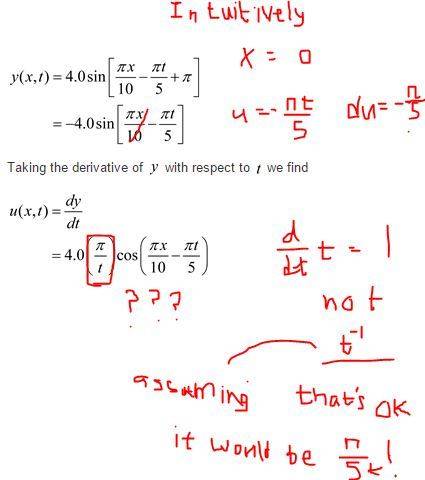
It's counter-intuitive to me since this seems like a simple derivative, and I'm unable justify it through the logic that one uses when manipulating mathematics to fit physical interpretation. As I mentioned previously, I'm still getting the hang of all this. Perhaps a little sooner with your help.
Anyone care to shed some light?
So, I think I have some skills when it comes to differentiation after taking calculus 2 last semester, but when it starts to intertwine with physics, and interpreting physical phenomenon through equations, It appears I could use some help. Anyway, the problem that I got hung up on is admittedly simple by anyone's standards; introductory classical physics, more specifically dealing with waves.
If you take the dy/dt of position function, in this case a sinusoidal wave function, you find it's velocity function.
y(x,t)=xmsin(xk(0)-ωt) you should get:
U=-xmωcos(-ωt)
However, that's not what happens.
BTW. Two different sources attest to this being the right answer.
http://[URL=http://s172.photobucket.com/user/Alpha_Scope/media/Derivative%20Question_zpsryocyscm.jpg.html][PLAIN]http://i172.photobucket.com/albums/w15/Alpha_Scope/Derivative%20Question_zpsryocyscm.jpg
It's counter-intuitive to me since this seems like a simple derivative, and I'm unable justify it through the logic that one uses when manipulating mathematics to fit physical interpretation. As I mentioned previously, I'm still getting the hang of all this. Perhaps a little sooner with your help.
Anyone care to shed some light?
Last edited by a moderator: