Velocity Derivative of a Sinusoidal Wave (Counter-Intuitive)

Click For Summary

Discussion Overview

The discussion revolves around the differentiation of a sinusoidal wave function to derive its velocity function. Participants explore the relationship between mathematical differentiation and physical interpretation, particularly in the context of classical physics and wave motion.

Discussion Character

  • Exploratory
  • Technical explanation
  • Debate/contested
  • Mathematical reasoning

Main Points Raised

  • One participant expresses confusion about deriving the velocity function from the sinusoidal wave function, suggesting that the expected result does not align with their calculations.
  • Another participant points out that the derivative provided is missing the term related to the wave number (kx), indicating a potential error in the original differentiation.
  • A later reply clarifies that if x is set to 0, the derivative can yield a correct expression for velocity, but emphasizes that this is contingent on the specific value of x.
  • One participant mentions a potential typo in the derivative and questions the understanding of why the derivative represents velocity at x=0, referencing the definition of velocity in the context of oscillation.
  • Another participant reflects on the initial confusion, suggesting that the issue may not be as significant as first thought, and expresses gratitude for the clarification provided by others.
  • A final comment raises concerns about the prevalence of a specific mistake in various sources, questioning how such an error could be reproduced across different references.

Areas of Agreement / Disagreement

Participants do not reach a consensus on the initial confusion regarding the derivative. While some clarify and correct earlier claims, the discussion reveals multiple viewpoints and interpretations without a definitive resolution.

Contextual Notes

There are indications of missing assumptions and potential typos in the mathematical expressions discussed. The reliance on specific values of x and the implications for the velocity function remain unresolved.

Alpha Scope
Messages
4
Reaction score
0
What's the matter:
So, I think I have some skills when it comes to differentiation after taking calculus 2 last semester, but when it starts to intertwine with physics, and interpreting physical phenomenon through equations, It appears I could use some help. Anyway, the problem that I got hung up on is admittedly simple by anyone's standards; introductory classical physics, more specifically dealing with waves.

If you take the dy/dt of position function, in this case a sinusoidal wave function, you find it's velocity function.
y(x,t)=xmsin(xk(0)-ωt) you should get:
U=-xmωcos(-ωt)
However, that's not what happens.
BTW. Two different sources attest to this being the right answer.
http://[URL=http://s172.photobucket.com/user/Alpha_Scope/media/Derivative%20Question_zpsryocyscm.jpg.html][PLAIN]http://i172.photobucket.com/albums/w15/Alpha_Scope/Derivative%20Question_zpsryocyscm.jpg
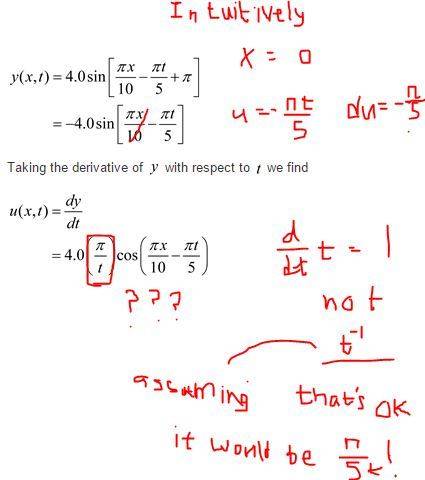
Derivative%20Question_zpsryocyscm.jpg


It's counter-intuitive to me since this seems like a simple derivative, and I'm unable justify it through the logic that one uses when manipulating mathematics to fit physical interpretation. As I mentioned previously, I'm still getting the hang of all this. Perhaps a little sooner with your help.

Anyone care to shed some light?
 
Last edited by a moderator:
Physics news on Phys.org
Your image does not show, you cannot link to things which are in your yahoo account and expect them to be visible to others.

Furthermore, your derivative is missing the kx of the cosine argument.
 
Okay, should I expect it to appear now? I did so intentionally because x is said to equal 0.
 
Alpha Scope said:
y(x,t)=xmsin(xk(0)-ωt) you should get:
U=-xmωcos(-ωt)
This is the correct derivative if x = 0 (or a multiple of pi/k).
 
Apparently this is a typo, can't have ##\pi/t## there but the correct is ##\pi/5##. I am not sure though what you don't understand. Why dy/dt is the velocity of the point of matter at x=0? It is by the definition of velocity, we know that the point of matter at x=0 does an oscillation given by ##y_0=f(0,t)=-4sin(-\pi t/5)##, hence the velocity of this oscillation is ##\frac{dy_0}{dt}=\frac{df(0,t)}{dt}=-4(-\frac{\pi}{5})cos(-\frac{\pi t}{5})##.
 
Okay, maybe there ain't a problem here after all. I found this solution (if I should even call it one) to this problem reiterated a couple different times, so I thought I made a mistake. I guess nothing's the matter, since this ain't my bad.

THANKS GUYS!
 
Ok i see now the term ##\pi/t## if it was correct it would mean that the velocity goes to zero as time grows larger (goes to infinity) which we know it isn't correct for an oscillating point of matter. I wonder how can it be that many different sources reproduce this obvious(both mathematically and physically) mistake.
 
Last edited:

Similar threads

  • · Replies 18 ·
Replies
18
Views
2K
  • · Replies 3 ·
Replies
3
Views
2K
Replies
7
Views
3K
  • · Replies 39 ·
2
Replies
39
Views
4K
  • · Replies 1 ·
Replies
1
Views
2K
  • · Replies 2 ·
Replies
2
Views
5K
  • · Replies 2 ·
Replies
2
Views
2K
  • · Replies 10 ·
Replies
10
Views
1K
  • · Replies 4 ·
Replies
4
Views
3K
  • · Replies 4 ·
Replies
4
Views
3K