Viscous work and dissipation of energy

Click For Summary
SUMMARY

The discussion centers on the interaction between a moving upper plate and a stationary lower plate in a viscous fluid system. The participants clarify that the upper plate exerts work on the fluid, increasing its internal energy, while the fluid simultaneously exerts negative work on the surroundings. The work done by the environment on the fluid does not cancel out with the work done by the fluid on the environment due to the established sign conventions in thermodynamics. Ultimately, the internal energy of the fluid increases as a result of the work done on it by the upper plate.

PREREQUISITES
  • Understanding of thermodynamic principles, specifically the first law of thermodynamics.
  • Familiarity with concepts of work and energy in fluid dynamics.
  • Knowledge of Newton's third law of motion regarding action and reaction forces.
  • Basic grasp of internal energy and its relation to work and heat transfer.
NEXT STEPS
  • Study the first law of thermodynamics in detail, focusing on energy transfer mechanisms.
  • Explore viscous fluid dynamics and the role of shear stress in energy dissipation.
  • Learn about sign conventions in thermodynamics and how they apply to work and energy calculations.
  • Investigate real-world applications of viscous flow, such as lubrication and fluid transport systems.
USEFUL FOR

Students of physics, engineers working with fluid dynamics, and professionals involved in thermodynamic systems will benefit from this discussion.

Est120
Messages
54
Reaction score
3
TL;DR
viscous dissipation of mechanical energy into internal energy
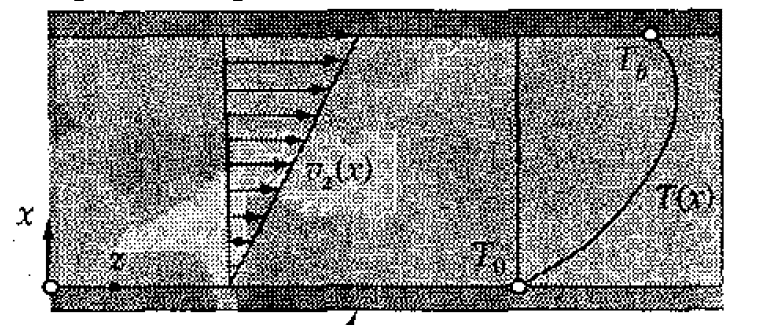
imagine two flat plates, the upper one moving with speed v in the +z direction, the lower one is stationary
is the upper plate inserting work (per unit time) on the fluid system or the system exerting work on the plate?
or both? why they don't cancel each other e.g if the fluid is receiving work from the upper plate then its internal energy is increasing, but if the fluid exerts work too then the works cancel (?)
1611372230595.png
 
Engineering news on Phys.org
Est120 said:
then the works cancel
In what sense ? Do you have the same problem with a block that is dragged over a surface ?
 
  • Like
Likes russ_watters
Would the molecules of the viscous fluid move without the movement of the upper plate?
If yes, the fluid would be receiving energy from an external source (pump or gravity), which would be transferred onto the upper plate.
If not, the upper plate would be receiving energy from an external source (force along z-axis) which would be transferred into the fluid.
 
the fluid is moving because of not split condition with the upper plate so its the second case
 
  • Like
Likes Lnewqban
in this case, the surroundings are doing work on the fluid. The force of the surrounding and its displacement are both positive. The fluid is doing negative work on the surroundings (the force of the fluid and its displacement are in opposite directions). So, if you write ##\Delta U=Q-W##, where W is the work the fluid does on the surroundings, or ##\Delta U=Q+W##, where W is the work done by the surroundings of the fluid, the result is exactly the same; the internal energy increases.
 
Chestermiller said:
in this case, the surroundings are doing work on the fluid. The force of the surrounding and its displacement are both positive. The fluid is doing negative work on the surroundings (the force of the fluid and its displacement are in opposite directions). So, if you write ##\Delta U=Q-W##, where W is the work the fluid does on the surroundings, or ##\Delta U=Q+W##, where W is the work done by the surroundings of the fluid, the result is exactly the same; the internal energy increases.
so that's why the work doesn't cancel? the signs convention already takes into account the dual work issue (work environment→ system and work system→environment)
 
Est120 said:
so that's why the work doesn't cancel? the signs convention already takes into account the dual work issue (work environment→ system and work system→environment)
It doesn't cancel for the same reason that, if A is exerting a force on B, and B is exerting an equal and opposite reaction force on A, if you do a force balance on A, you only include the force that B exerts on A, not the force that A exerts on B. Didn't they teach you this in freshman Physics?
 
i know that... but it seems no body understands my doubt
if the environment is exerting work on the system, then the system internal energy ↑ increases
but if the system is exerting work on the environment then, energy must come out of the system (in order to deliever work) and that energy decreases internal energy ↓ so internal energy decreases
so if the system is receiving work and also delivering work no net work inflow comes into the system so internal energy stays constant

i know that internal energy must increase but i don't know what i am thinking wrong about work
 
  • Skeptical
Likes weirdoguy
Est120 said:
i know that... but it seems no body understands my doubt
if the environment is exerting work on the system, then the system internal energy ↑ increases
but if the system is exerting work on the environment then, energy must come out of the system (in order to deliever work) and that energy decreases internal energy ↓ so internal energy decreases
so if the system is receiving work and also delivering work no net work inflow comes into the system so internal energy stays constant

i know that internal energy must increase but i don't know what i am thinking wrong about work
Apparently, you don't understand what I said. If the system does positive work on the surroundings, then the surroundings do a negative amount of work on the system, so the two are equivalent. But, if you are doing an energy balance on the system, then you only include one of these, just as, when you do a force balance, you only include one force of the reaction pair.
 
  • #10
i got it now, thank's for all the advice
 
  • Like
Likes Lnewqban

Similar threads

Replies
31
Views
4K
Replies
11
Views
3K
  • · Replies 48 ·
2
Replies
48
Views
5K
  • · Replies 1 ·
Replies
1
Views
4K
  • · Replies 18 ·
Replies
18
Views
2K
  • · Replies 1 ·
Replies
1
Views
3K
  • · Replies 21 ·
Replies
21
Views
3K
  • · Replies 3 ·
Replies
3
Views
2K
Replies
8
Views
2K
Replies
3
Views
2K