Sorry for the late reply, I've been caught up writing some DSP software for this project. I paid attention to both vk6kro and sophiecentaur in relation to harmonics and band pass filters and decided to run some tests.
My sound card provides an internal loopback that allows me to listen to the output without connecting a cable between the speaker output to the line in. This allows me to evaluate the signal quality without introducing noise or artifacts external to my machine.
In this first diagram, I am playing a PCM at 440Hz. Without any sound, this spectrum would be entirely black. As we can see, the harmonics are extensive and propagate all the way up to 20Khz.
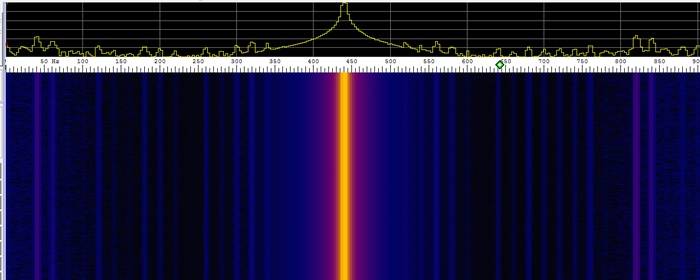
In this second diagram, we narrow in on our area of interest which is below 1Khz. We can see how the carrier wave at 440Hz is clearly defined and that the signal is well above the surrounding harmonics. What is clear is that sophiecentaur was correct and a band pass filter is required on the output stage. The source of the harmonics is the card's circuitry and internal crosstalk. If we look at the signal stability, we can see that the steep roll-off begins after 10-20 Hertz and a shallower roll-off of about 100-150Hz. This means that we can do FDM with about 25-30Hz separation from the main carrier frequency.
In this final diagram I test vk6kro's statement that due to the harmonics, the original frequencies would be unrecoverable. This signal is from a PCM that uses additive synthesis of two sine waves, 440Hz and 261.626Hz, which were each reduced by -6db to prevent clipping. As we can see, the harmonics are dreadful, but the two original carriers are clearly stronger by a detectable amount.
This analysis reveals that there are two ways to approach this problem. The easy route would be to ignore the harmonics and focus on selecting the strongest signals at the receiver. Its not a great solution, but it will work and more importantly will continue to function even if we change frequency. That said, we would need to inform the receiver of the number of frequencies to lock on to. In the case above, selecting the two strongest signals would achieve a link on our carriers of interest.
The second solution is a variable bandpass filter. This is a complex setup as it must function across the entire range of frequencies and be capable of controlled by computer. The upshot is that we can eliminate the harmonics and even narrow the bandwidth of the output signal. This provides more channels in our FDM setup.
Anyone got comments, good ideas, or schematics for a good variable band pass filter?