Alfreds9
- 28
- 1
Hi,
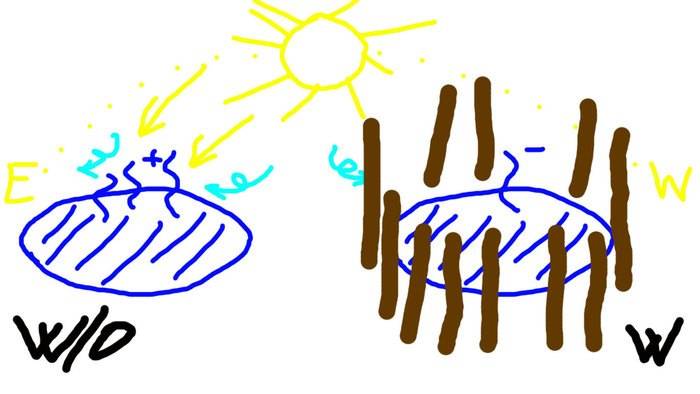
I'd like to know how I'd put together, either elegantly or at least in physical terms, that surely water evaporation in a large pool of V volume and S surface is influenced by wind (increased by it as opposed to having side barriers), temperature (increased by direct sunlight as opposed to shading due to the very same barriers shielding wind laterally) and water's heat capacity not being constant across its temperature range.
I am thinking about Penman's equation (or Shuttleworth's) fitting above needs however I am not sure if it'd still stand true for my example, since I don't fully grasp how much would superficial water heated more by sunlight than its shaded counterpart rise up the vapor pressure and hence speed up evaporation of water and also how to put that a wind side barrier would decrease the net evaporation by decreasing wind on water surface and also having sunrays hit directly water only about at zenith.
I apologize for the awful teeny drawings, I am on mobile without any graphic tablet or computer.
Thank you
Allison
I'd like to know how I'd put together, either elegantly or at least in physical terms, that surely water evaporation in a large pool of V volume and S surface is influenced by wind (increased by it as opposed to having side barriers), temperature (increased by direct sunlight as opposed to shading due to the very same barriers shielding wind laterally) and water's heat capacity not being constant across its temperature range.
I am thinking about Penman's equation (or Shuttleworth's) fitting above needs however I am not sure if it'd still stand true for my example, since I don't fully grasp how much would superficial water heated more by sunlight than its shaded counterpart rise up the vapor pressure and hence speed up evaporation of water and also how to put that a wind side barrier would decrease the net evaporation by decreasing wind on water surface and also having sunrays hit directly water only about at zenith.
I apologize for the awful teeny drawings, I am on mobile without any graphic tablet or computer.
Thank you
Allison