Engineering Wedges problem -- When will the two wedges start sliding?

  • Thread starter Thread starter mingyz0403
  • Start date Start date
  • Tags Tags
    Sliding
Click For Summary
SUMMARY

The correct angle for the wedges problem is established at 28.1 degrees. The analysis involves understanding the relationship between the normal force (## F_N ##) acting on wedge B and the frictional forces at play. By considering wedge B as massless, the solution simplifies to the expression ## \tan{\theta}=\sin{\theta}/\cos{\theta} ##. Additionally, excluding gravity and the masses of the wedge and block can clarify the problem, particularly when visualizing the system on a horizontal frictionless table.

PREREQUISITES
  • Understanding of basic trigonometric functions (sine, cosine, tangent)
  • Familiarity with Newton's laws of motion
  • Knowledge of frictional forces and their maximum values (## F_F = \mu F_N ##)
  • Concept of normal force in physics
NEXT STEPS
  • Research the implications of massless objects in physics problems
  • Study the effects of friction on inclined planes
  • Learn about the application of trigonometric identities in physics
  • Explore the concept of systems on frictionless surfaces in classical mechanics
USEFUL FOR

Students and educators in physics, particularly those focusing on mechanics and friction, as well as anyone solving problems related to inclined planes and forces.
mingyz0403
Messages
12
Reaction score
1
Homework Statement
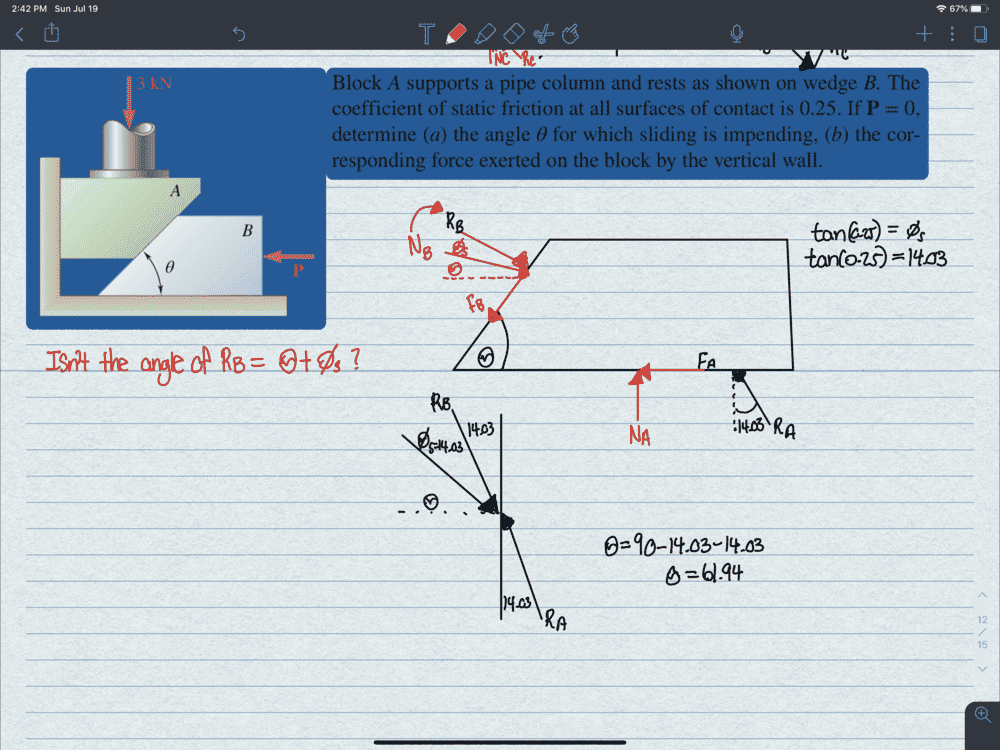
Block A supports a pipe column and rests as shown on wedge B. the coefficient of static friction at all surfaces of contact is 0.25. if p = 0, determine (a) the angle θ for which sliding is impending, (b) the corresponding force exerted on the block by the vertical wall.
Relevant Equations
Free body diagram
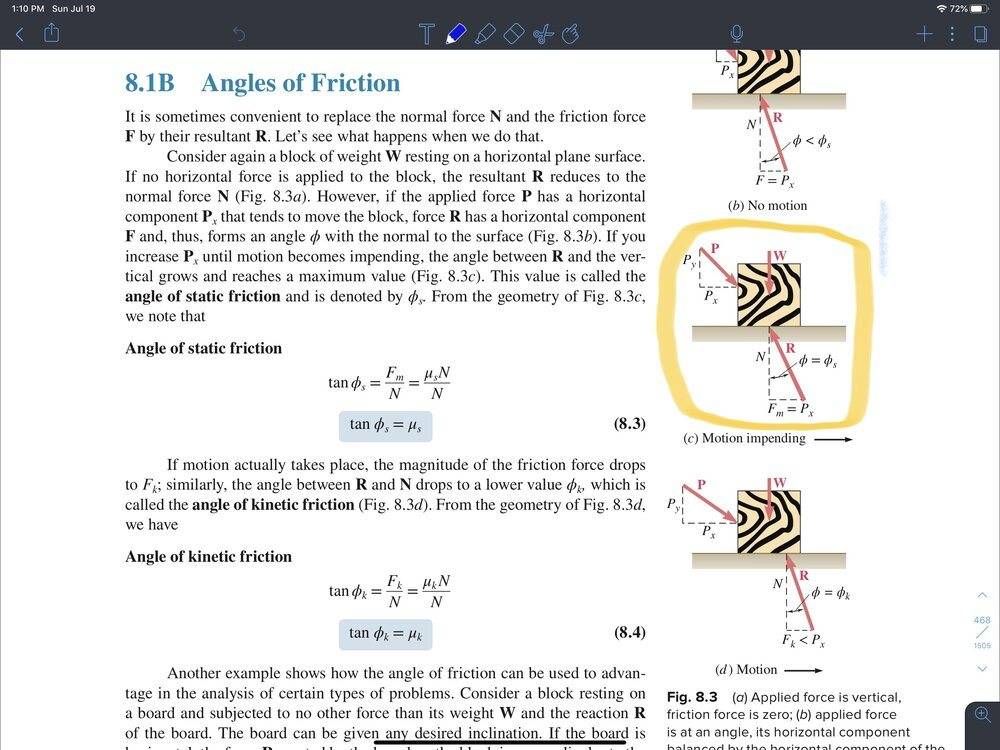
The correct angle is 28.1 degree.I understand ∅=arctan(m). Isn’t R should be angled ∅ degree away from the normal force.
9942FC39-8A91-42AF-A569-5610FD0EF093.jpeg
5BE72652-1BF7-448D-AC62-01B652CEAD14.png
 
Last edited:
Physics news on Phys.org
I have what I presently would call a somewhat sloppy solution that gets the correct answer to the angle.

If you just look at the wedge B, and consider it massless, you can assume a normal force ## F_N ## acts on it from the block. The downward forces on the wedge consist of the vertical component of ## F_N ##, along with a downward component of the frictional force between the block and the wedge. These create a horizontal frictional force at the base, that balance the combination of the horizontal component of the normal force (pushing to the right) and the horizontal component of the frictional force on the wedge from the block (which points to the left=thereby a minus sign).

The ## F_N ## drops out from both sides of this expression, and you solve for ## \tan{\theta}=\sin{\theta}/\cos{\theta} ##. I'll be glad to supply additional detail on this expression if you get stuck, but you should be able to write out the expression from the info I provided.
 
Last edited by a moderator:
To add to the above, and make the solution of the problem a little more complete, it may really be better to exclude gravity (and masses of the wedge and block) in this problem=e.g. letting the system be on a horizontal frictionless table. In this case it is clear that the mass B can be ignored, as was done to get the answer given by the textbook.
 
We haven't heard back from the OP on this one, but I'd like to add something that the OP and anyone else may find of interest:
*
The frictional force reaches its maximum value ## F_F =\mu F_N ## when motion is imminent, and is opposite the direction of motion. Otherwise, the frictional force can even be zero with a large normal force=e.g. a book resting on a horizontal table has zero frictional force unless there is an applied force that attempts to move the book. The frictional force will then be opposite the applied force, and its maximum value is ## F_F=\mu F_N ##. ## \\ ##
*
With this additional input, the "algebraic" solution I came up with above becomes more complete.
 
  • Like
Likes Lnewqban

Similar threads

  • · Replies 9 ·
Replies
9
Views
3K
Replies
5
Views
9K
  • · Replies 6 ·
Replies
6
Views
4K
  • · Replies 8 ·
Replies
8
Views
2K
  • · Replies 1 ·
Replies
1
Views
3K
  • · Replies 20 ·
Replies
20
Views
4K
  • · Replies 12 ·
Replies
12
Views
2K
Replies
7
Views
2K
  • · Replies 24 ·
Replies
24
Views
4K
  • · Replies 4 ·
Replies
4
Views
1K