What Are Effective Methods for Mounting a Cylinder Microlens?

  • Context: Graduate 
  • Thread starter Thread starter pavel_ivanov
  • Start date Start date
Click For Summary

Discussion Overview

The discussion centers on effective methods for mounting a cylinder microlens for fast-axis collimation of a laser diode beam. Participants explore various mounting techniques and materials suitable for precise alignment and protection of the microlens.

Discussion Character

  • Technical explanation
  • Debate/contested
  • Experimental/applied

Main Points Raised

  • One participant suggests using a needle to attach the microlens to the laser diode, seeking alternative mounting ideas.
  • Another participant mentions the challenges of using cylindrical lenses due to their additional degree of freedom and proposes specific lens mounts from Thorlabs and Newport, but notes potential size issues.
  • A later reply agrees with the need for a custom solution and proposes machining a slot through a disc to create a mount, highlighting the protective benefits of such a design.
  • Another approach is introduced involving femtosecond laser two-photon polymerization to fix a microlens on various surfaces, producing optical quality lenses with specific refractive indices.

Areas of Agreement / Disagreement

Participants express differing views on the practicality of existing lens mounts and the feasibility of custom solutions. No consensus is reached on the best method for mounting the microlens.

Contextual Notes

Participants discuss various mounting techniques without resolving the limitations of each method, such as the size compatibility of commercial mounts and the technical challenges of custom fabrication.

pavel_ivanov
Messages
3
Reaction score
0
Dear All,

I would like to use a cylinder microlens for fast-axis collimation of a laser diode beam. The length of the lens is 1.06 mm and its diameter is 0.5 mm.
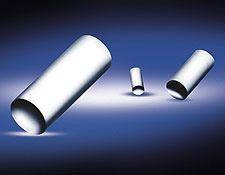
3145.jpg


its working distance is 0.06 mm. How to mount the microlens in the front of the laser facet?

I want to use a needle with the lens attached to its end. Any better ideas please?

thank you


PS: I am posting this question in the Physics forum, because physicist frequently use lenses and microlenses.
 
Science news on Phys.org
If I understand how you are using the lens, it's tricky using cylinders because of the additional degree of freedom. There are a couple of mounts that may work:

http://www.thorlabs.com/newgrouppage9.cfm?objectgroup_id=718
http://search.newport.com/count/24/i/1/nav/1/q2/Opto-Mechanics/q3/Lens%2520Mounts/q4/LABasix/q5/%2524100%2520-%2520%2524200/q6/Adjustable%2520Cylindrical%2520Lens%2520Mount/x2/section/x3/chapter/x4/promo_nonprice/x5/curr.pricerange/x6/family

But the trick is going to be able to accommodate the size and positioning of the optic relative to the diode. You may have to home-brew a mount (like a slot machined through a disc) and stick that into a proper optomechanical mount.
 
Last edited by a moderator:
Andy Resnick said:
If I understand how you are using the lens, it's tricky using cylinders because of the additional degree of freedom. There are a couple of mounts that may work:

http://www.thorlabs.com/newgrouppage9.cfm?objectgroup_id=718
http://search.newport.com/count/24/i/1/nav/1/q2/Opto-Mechanics/q3/Lens%2520Mounts/q4/LABasix/q5/%2524100%2520-%2520%2524200/q6/Adjustable%2520Cylindrical%2520Lens%2520Mount/x2/section/x3/chapter/x4/promo_nonprice/x5/curr.pricerange/x6/family

these mounts look too big for the lens.

Andy Resnick said:
But the trick is going to be able to accommodate the size and positioning of the optic relative to the diode. You may have to home-brew a mount (like a slot machined through a disc) and stick that into a proper optomechanical mount.

I like this idea. I can easily etch a trench through a disk using a focused ion beam system. Such kind of mount can also protect the lens and the laser from mechanical damage.
thank you very much
 
Last edited by a moderator:
Hi,

there is another approach of fixing a micro lens on virtually any surface. That is femtosecond laser two-photon polymerization process, where you get optical quality lenses with refractive indices of 1.4-1.6 .

Examples:
http://www.wophotonics.com/en/Micro-optics
 

Similar threads

  • · Replies 7 ·
Replies
7
Views
3K
  • · Replies 19 ·
Replies
19
Views
5K
  • · Replies 10 ·
Replies
10
Views
3K
  • · Replies 2 ·
Replies
2
Views
6K
  • · Replies 5 ·
Replies
5
Views
5K
  • · Replies 2 ·
Replies
2
Views
3K
  • · Replies 10 ·
Replies
10
Views
8K
  • · Replies 0 ·
Replies
0
Views
841
Replies
1
Views
4K
  • · Replies 5 ·
Replies
5
Views
3K