What are the essential precalculus concepts for success in calculus 1?

  • Context: MHB 
  • Thread starter Thread starter mathdad
  • Start date Start date
Click For Summary

Discussion Overview

The discussion revolves around identifying essential precalculus concepts necessary for success in Calculus 1, specifically focusing on the application of the distance formula and its implications in geometric contexts.

Discussion Character

  • Technical explanation
  • Homework-related
  • Conceptual clarification
  • Debate/contested

Main Points Raised

  • One participant sets up a problem to find values of t such that two points are a specific distance apart, using the distance formula.
  • Another participant points out an error in the application of the distance formula and provides the correct formulation.
  • A later reply questions whether the distance should be squared, indicating a potential misunderstanding of the problem setup.
  • One participant acknowledges their error and discusses their challenging schedule, suggesting fatigue may have contributed to the mistake.
  • Another participant rephrases the problem in terms of geometry, relating it to the intersection of a circle and a line, and provides a quadratic equation derived from this context.
  • There is a request for clarification about visualizing the line y = 1 in relation to the circle, indicating a need for graphical understanding.
  • Participants suggest sketching the problem to better visualize the relationship between the circle and the line.
  • One participant expresses a decision to focus on key precalculus questions rather than posting every question from their textbook, indicating a strategic approach to learning.

Areas of Agreement / Disagreement

Participants generally agree on the importance of the distance formula but have differing views on its application and the correct setup of the problem. The discussion includes corrections and clarifications, indicating some unresolved misunderstandings.

Contextual Notes

Participants express varying levels of familiarity with the distance formula and its geometric implications, highlighting potential gaps in understanding that may affect their approach to calculus.

Who May Find This Useful

Students preparing for Calculus 1, educators looking for examples of common misconceptions in precalculus, and individuals interested in the application of geometric concepts in mathematics.
mathdad
Messages
1,280
Reaction score
0
Find values of t such that the points (-2, 3) and (t, 1) are 6 units apart.

The set up is:

6 = sqrt{(t + 1)^2 + {(1 - 3)^2}

I now square both sides to solve for t.

Correct?
 
Mathematics news on Phys.org
RTCNTC said:
Find values of t such that the points (-2, 3) and (t, 1) are 6 units apart.

The set up is:

6 = sqrt{(t + 1)^2 + {(1 - 3)^2}

I now square both sides to solve for t.

Correct?

You have the right idea to use the distance formula, however you haven't applied it correctly. What you want is:

$$6=\sqrt{(t-(-2))^2+(1-3)^2}$$

You see, the distance formula states that the distance $d$ between the points $\left(x_1,y_1\right)$ and $\left(x_2,y_2\right)$ is given by:

$$d=\sqrt{\left(x_2-x_1\right)^2+\left(y_2-y_1\right)^2}$$
 
MarkFL said:
You have the right idea to use the distance formula, however you haven't applied it correctly. What you want is:

$$6=\sqrt{(t-(-2))^2+(1-3)^2}$$

You see, the distance formula states that the distance $d$ between the points $\left(x_1,y_1\right)$ and $\left(x_2,y_2\right)$ is given by:

$$d=\sqrt{\left(x_2-x_1\right)^2+\left(y_2-y_1\right)^2}$$

Are you saying that 6 should be squared?
 
RTCNTC said:
Are you saying that 6 should be squared?

You will want to square both sides to solve for $t$, but do you see how the equation you stated is incorrect?
 
I see my error in the radicand. I usually post my questions after work between 1:30am and 3am. I am tired after midnight. I have a split days off schedule. On such a schedule, I must take advantage of every minute to get things done. I am off on Tuesday and Friday. It's a horrible schedule but what can I do?
 
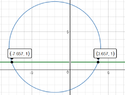
The problem is equivalent to saying:

Consider the circle centered at (-2,3) with radius 6 and the line y = 1. What are the x-coordinates of the point(s) of intersection between the circle and the line?

Let's look at a graph:

View attachment 6650

We have the following equation in $t$:

$$(t+2)^2+2^2=6^2$$

Arrange in standard quadratic form:

$$t^2+4t-28=0$$

Applying the quadratic formula, we obtain:

$$t=-2\pm4\sqrt{2}$$
 

Attachments

  • circleline.png
    circleline.png
    5.7 KB · Views: 82
MarkFL said:
The problem is equivalent to saying:

Consider the circle centered at (-2,3) with radius 6 and the line y = 1. What are the x-coordinates of the point(s) of intersection between the circle and the line?

Let's look at a graph:
We have the following equation in $t$:

$$(t+2)^2+2^2=6^2$$

Arrange in standard quadratic form:

$$t^2+4t-28=0$$

Applying the quadratic formula, we obtain:

$$t=-2\pm4\sqrt{2}$$

Sorry but I cannot see the line y = 1.
 
RTCNTC said:
Sorry but I cannot see the line y = 1.

If your browser isn't rendering images well, you can sketch the circle and line pretty easily. Plot the point (-2,3) then one at a time move up, right, down, left 6 units from the center and plot points there and then connect the 4 points with a circle. Then draw the horizontal line y = 1 to get an idea where the values of t will be, as they will be the x-coordinates of the points of intersection between the circle and line.
 
MarkFL said:
The problem is equivalent to saying:

Consider the circle centered at (-2,3) with radius 6 and the line y = 1. What are the x-coordinates of the point(s) of intersection between the circle and the line?

Let's look at a graph:
We have the following equation in $t$:

$$(t+2)^2+2^2=6^2$$

Arrange in standard quadratic form:

$$t^2+4t-28=0$$

Applying the quadratic formula, we obtain:

$$t=-2\pm4\sqrt{2}$$

Ok. I can now see the entire circle and the line y = 1.

- - - Updated - - -

MarkFL said:
If your browser isn't rendering images well, you can sketch the circle and line pretty easily. Plot the point (-2,3) then one at a time move up, right, down, left 6 units from the center and plot points there and then connect the 4 points with a circle. Then draw the horizontal line y = 1 to get an idea where the values of t will be, as they will be the x-coordinates of the points of intersection between the circle and line.

Mark,

Thank you for your help. I've decided not to post every question from the David Cohen precalculus textbook. This task will take forever to accomplish. I will instead focus on the questions every student should know how to solve before going to calculus 1. I love my precalculus textbook but it is simply too lengthy.
 

Similar threads

  • · Replies 4 ·
Replies
4
Views
2K
  • · Replies 6 ·
Replies
6
Views
2K
  • · Replies 1 ·
Replies
1
Views
1K
  • · Replies 10 ·
Replies
10
Views
3K
  • · Replies 11 ·
Replies
11
Views
3K
  • · Replies 5 ·
Replies
5
Views
1K
  • · Replies 3 ·
Replies
3
Views
2K
  • · Replies 6 ·
Replies
6
Views
3K
  • · Replies 2 ·
Replies
2
Views
2K
  • · Replies 55 ·
2
Replies
55
Views
6K