What are the geological features surrounding the recent Australian earthquake?

  • Thread starter Thread starter davenn
  • Start date Start date
  • Tags Tags
    Earthquake
Click For Summary
SUMMARY

The recent earthquake in Australia, recorded as a magnitude 6.1 by Geoscience Australia, occurred on May 21, 2023, at 04:14:02 EST in the SW corner of the Northern Territory. The event was located approximately 80 km west of Yulara, near Uluru, with a depth of 9 km. Following the main quake, 16 aftershocks were recorded, with magnitudes ranging from 2.5 to 4.1. Local organizations like Geoscience Australia provide more reliable magnitude estimates compared to USGS for this region due to their higher density of recording stations.

PREREQUISITES
  • Understanding of seismic activity and earthquake measurement
  • Familiarity with Geoscience Australia and its role in monitoring earthquakes
  • Knowledge of Australian geological features, specifically the Central Ranges
  • Ability to interpret seismic data and aftershock sequences
NEXT STEPS
  • Research the geological characteristics of the Central Ranges in Australia
  • Study the methods used by Geoscience Australia for earthquake monitoring
  • Explore the relationship between the Mann and Petermann ranges and seismic activity
  • Investigate the impact of earthquakes on surface faulting and geological formations
USEFUL FOR

Geologists, seismologists, and anyone interested in earthquake monitoring and geological features of Australia will benefit from this discussion.

davenn
Science Advisor
Gold Member
Messages
9,715
Reaction score
11,711
Hi guys and gals

The Australian doesn't get too may quakes M5 and up. On average one every approx. 4-5 years
The latest occurred this morning, 04:14:02 EST, 21st May ( local time) recorded as a M 6.1 by
Geoscience Australia ( GA is the Australian Govt. Institute for monitoring such activity.. equiv of the USGS)

The even is located in the SW corner of the Northern Territory state and some 2250 km from my location

20 May 2016 @ 18:14:02 Lat -25.474, Long 129.780 and 9 km deep

location map shows it approx. 80 km west of the tourist town of Yulara near the rock formation of Uluru ( Ayers Rock) so far in the 12 hours following the event, there have been 16 aftershocks measuring between M 2.5 and M 3.8 recorded
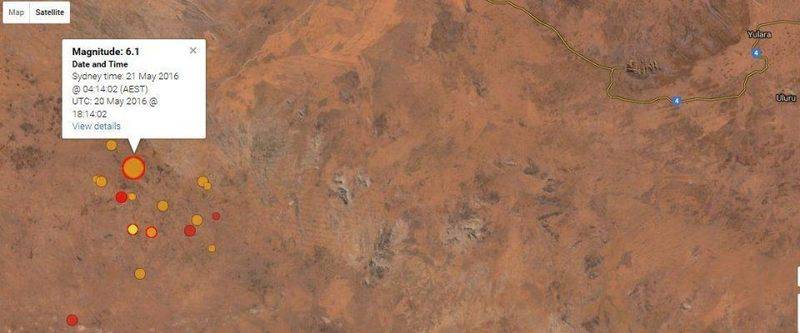
160520 1814UT M 6.0 and ashks SW Nthrn Territory. Australia.JPG


the long period seismogram from my recorder ( this event was well recorded on all my sensors
long and short period ones
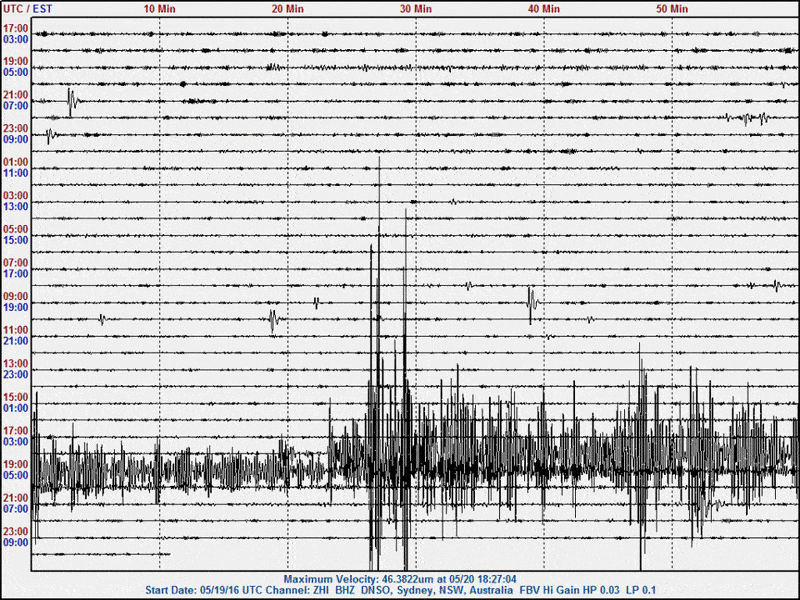
160520 1814UT M6.0 SW Nthrn Territory Australia zhi.gif

cheers
Dave
 
  • Like
Likes   Reactions: 1oldman2, Astronuc and Drakkith
Earth sciences news on Phys.org
Interesting. http://earthquake.usgs.gov/earthquakes/eventpage/us10005iyk#general
USGS puts it at Mag 5.9, with aftershocks of 4.2 and 4.4

Location: Lat 25.534°S, Long 129.805°E
Depth: 10.0 km (6.2 mi)

  • 329.0 km (204.4 mi) E of Warburton, Australia
  • 460.0 km (285.8 mi) WSW of Alice Springs, Australia
  • 1001.0 km (622.0 mi) ENE of Kalgoorlie, Australia
  • 1091.0 km (677.9 mi) NW of Port Augusta West, Australia
  • 1341.0 km (833.3 mi) NW of Adelaide, Australia
There is no summary for the region. I wonder if there is some elevation change out there.
 
  • Like
Likes   Reactions: davenn
Astronuc said:
Interesting. http://earthquake.usgs.gov/earthquakes/eventpage/us10005iyk#general
USGS puts it at Mag 5.9, with aftershocks of 4.2 and 4.4

yeah, I'm starting to have less and less trust in the USGS/NEIC for magnitude determinations of late
The magnitude estimates seem to be really screwball for events that are well outside their main monitoring regions

The M6.7 and 6.8 events in Ecuador last week are a prime example of complete inconsistence in their magnitude estimates
For places like Australia and New Zealand ( where there are excellent local organisations) I will always prefer to go with their
posted magnitudes as those local organisations have high densities of recording stations to draw data from.

Now, back to the Australian event and its aftershocks. Geoscience Australia has reported only one aftershock reaching or exceeding M4
and that was a M 4.1. Three other events reached M 3.8

Here's a list of aftershocks for the first 24 hours .. a reasonably active sequence

160520 1814UT M 6.0 and ashks SW Nthrn Territory. Australia1.jpg
Astronuc said:
There is no summary for the region. I wonder if there is some elevation change out there.

It would be interesting to see if the main event caused any surface faulting. If there is any, it wouldn't be too difficult to see across the desert floor from a low level helicopter flight over the area.
The pic below is typical of the look of the region. This is Uluru ( Ayres Rock) and the quake was around 80km west of here

2014_12_28_2481sm.jpg
Dave
.
 
So, the earthquakes have been occurring in the Central Ranges region.
https://en.wikipedia.org/wiki/Central_Ranges

Information on the area is sparse - as is the population. I was wondering how the range(s) relate to the Petermann, Mann, Musgrave and McDonnell ranges.
https://en.wikipedia.org/wiki/Petermann_Ranges_(Australia)

Mt. Whinham is to the south, and Mt. Woodroffe to the southeast.

I'm guessing that the Musgrave range splits into the Mann and Petermann ranges as one goes NW. The earthquakes seem to be in a basin between Mann and Petermann ranges. What are the features east of the earthquakes? I can't find names on any map.
 

Similar threads

  • · Replies 2 ·
Replies
2
Views
2K
  • · Replies 8 ·
Replies
8
Views
3K
  • · Replies 2 ·
Replies
2
Views
2K
  • · Replies 1 ·
Replies
1
Views
3K
  • · Replies 4 ·
Replies
4
Views
2K
  • · Replies 3 ·
Replies
3
Views
3K
  • · Replies 3 ·
Replies
3
Views
3K
Replies
1
Views
2K
  • · Replies 4 ·
Replies
4
Views
7K
  • · Replies 6 ·
Replies
6
Views
4K