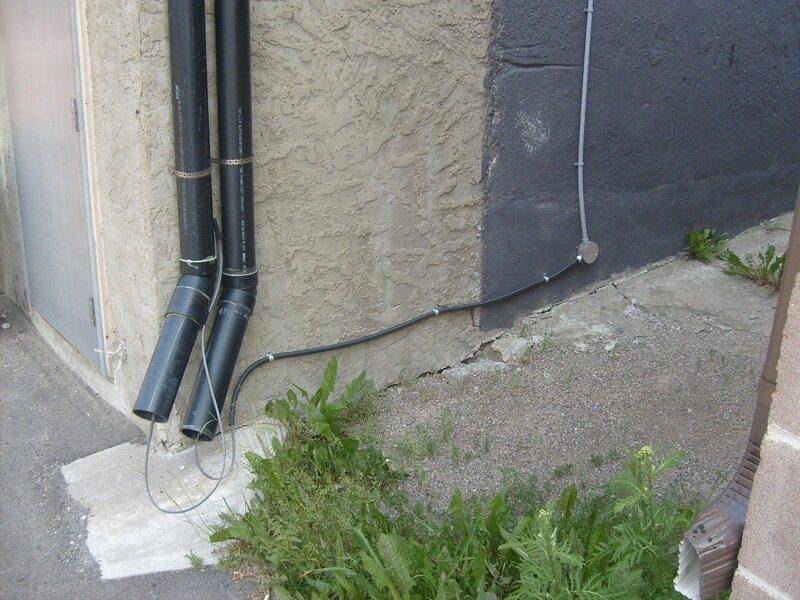
What are these DWV pipes with cables inside for?

  • Thread starter Thread starter Keith_McClary
  • Start date Start date
  • Tags Tags
    Cables Pipes
Join the discussion
Ask a follow-up here, or get your own question answered by working scientists, mathematicians and engineers — people, not an autocomplete.
Real named experts · corrections over time · the nuance an AI answer skips
17 replies · 2K views
Keith_McClary
Messages
752
Reaction score
1,507
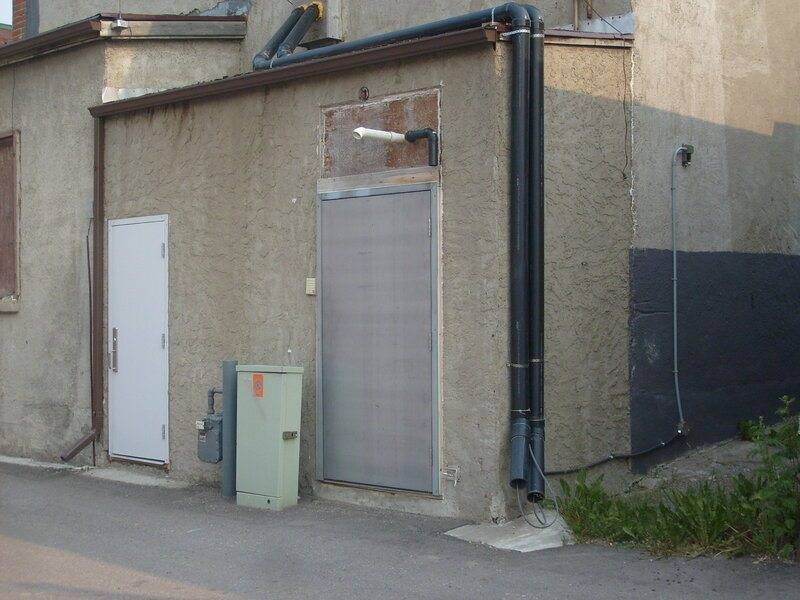
The main floor is an office. The second floor might be an apartment.
S6300560.JPG


S6300564.JPG
 
Engineering news on Phys.org
What is a DWV pipe? And is that a permanent practical joke (PPJ) pipe over the door?
 
  • Like
Likes   Reactions: davenn
berkeman said:
What is a DWV pipe?
PVC drain waste vent pipe.
berkeman said:
And is that a permanent practical joke (PPJ) pipe over the door?
The white one could be an exhaust for a built-in vacuum system.
 
Baluncore said:
What country, what city?
Crowsnest Pass, Alberta, Canada.
 
Keith_McClary said:
Crowsnest Pass, Alberta, Canada.
At first I thought protection of cables from ice or animals, but that did not add up.

My guess is that the conduit above the door was for a light when there was a cover over the doorway. Many older buildings in Crowsnest have a lamp high on the wall. That probably relates to the long winter nights in the period before the installation of the street lighting.

The drain pipes may freeze up in winter. The wires are probably electrical resistance wires that will thaw sufficient of the ice to allow the discharge to flow again.
Why there are two pipes I do not know, maybe two quite separate systems discharge meltwater.
 
  • Like
Likes   Reactions: russ_watters
Baluncore said:
The drain pipes may freeze up in winter. The wires are probably electrical resistance wires that will thaw sufficient of the ice to allow the discharge to flow again.
A worthy thought, knowing how cold it gets in Alberta during winter
 
Baluncore said:
The drain pipes may freeze up in winter. The wires are probably electrical resistance wires that will thaw sufficient of the ice to allow the discharge to flow again.
The roof drains are usually aluminum like the brown downpipe on the left of the white door, and I have not heard of them freezing up or needing heating (If it is warm enough to melt the snow on roofs, then the downpipe is also warm.). The black pipes come from inside the building - I can't think what they could (legally) be draining onto the roadway. There are basement sump pumps that drain through (usually smaller) DWV pipe, but not from the second floor.
 
+1 for roof drain, heat trace.
Keith_McClary said:
The roof drains...and I have not heard of them freezing up or needing heating (If it is warm enough to melt the snow on roofs, then the downpipe is also warm.).
Roofs are warmer because of the sun. This is what causes icicles.

The heat trace thing is pretty much 100% certainty. That's what it looks like when you heat trace piping that discharges to outside. The heat trace has to loop/extend past the downspout because icicles. That's just how it's done:
https://www.heattracespecialists.co...tal-Roofs/HTS-Roof-and-Gutter-Manual-2-12.pdf
 
  • Like
Likes   Reactions: Borek and hutchphd
russ_watters said:
Roofs are warmer because of the sun. This is what causes icicles.
It's poorly insulated ceilings, causing warm attics, according to your source. With well insulated ceilings and well vented (=>cold) attics, you only get melt in warm weather, so your gutters and downspouts don't ice up. Physics!

In any case, the black pipes come from inside the structure, very unusual for downpipes.

And the heating wires, if that's what they are, look unprotected at ground level. What voltage are these wires?
 
You will probably get better answers if you knock on the door and ask them.
 
  • Like
Likes   Reactions: berkeman
If I were to guess it looks like an antifreezing warming system, similar to the one I have here.
kabel_grzewczy.jpg


The cable is quite sophisticated - inside there are two copper wires connected with some kind of a semiconductor. That means two things: first, no matter what their length is, they heat with a constant power per unit length (I don't remember details, I believe mine are something in the 20W per meter range). Second, they don't warm up above some temperature (the resistance grows as they heat up). They are connected on one side only, directly to the mains.
 
  • Informative
Likes   Reactions: berkeman
Keith_McClary said:
It's poorly insulated ceilings, causing warm attics, according to your source. With well insulated ceilings and well vented (=>cold) attics, you only get melt in warm weather, so your gutters and downspouts don't ice up. Physics!
Ok. Doesn't really change the issue at hand. The point is, icicles are a thing.
In any case, the black pipes come from inside the structure, very unusual for downpipes.
Not really. It may be unusual that they don't stay in the building (and get piped into a storm drain system), but whether they have to start in the building depends on where the roof drains are. You may be able to verify that configuration with an aerial/satellite photo.

But if they aren't roof drains, then the potential for icicles may be worse, not better, depending on what they are.
And the heating wires, if that's what they are, look unprotected at ground level. What voltage are these wires?
They are insulated, line voltage (varies).
 
I'm going with the heating cable theory. What I thought was a second storey seems to be an attic under a roof sloping to the front of the building, so the water from the roof is drained from the front back to the alley through the cold attic.
 
If we had the full address, we could use Google Earth street view to see the building.
 
  • Like
Likes   Reactions: jim mcnamara
Baluncore said:
street view
It is the left third of the former pharmacy.
From the rear you can see how the roof slopes down towards the front (most of these buildings slope towards the back). The openings are louvered vents, so the attic space is cold in winter. The pipes are different, possibly related to renovation from pharmacy to office.
 
Last edited: