What Causes Electrons to Move Directionally in a Wire within a Magnetic Field?

Click For Summary

Discussion Overview

The discussion centers around the behavior of electrons in a wire moving through a magnetic field, specifically addressing why electrons move in a particular direction when the wire is pushed downwards. The scope includes theoretical explanations, the application of the Lorentz force, and the implications of magnetic fields on electron movement.

Discussion Character

  • Exploratory
  • Technical explanation
  • Conceptual clarification
  • Debate/contested

Main Points Raised

  • One participant questions the underlying reasons for the directional movement of electrons in a wire moving downwards within a magnetic field.
  • Another participant cites the Lorentz force equation, stating that a charged particle experiences a force when moving through a magnetic field, which may explain the electron's behavior.
  • A different participant explains that the current flowing through the conductor creates a magnetic field, which interacts with the external magnetic field, potentially influencing the motion of the wire and the electrons within it.
  • A hypothetical scenario is posed regarding the movement of a single electron in the wire and whether it would still follow the left-hand rule, prompting further inquiry into the mechanics of electron movement.
  • There is a question about whether arrows in a diagram represent the direction of electric current or the flow of electrons, indicating a need for clarification on this distinction.
  • Another participant reiterates the relevance of the Lorentz force equation in determining the force on the electron.

Areas of Agreement / Disagreement

Participants express various viewpoints regarding the mechanics of electron movement in a magnetic field, with no consensus reached on the specific reasons for the directional movement of electrons or the implications of the Lorentz force in this context.

Contextual Notes

Some assumptions regarding the behavior of electrons in magnetic fields and the application of the Lorentz force may not be fully explored or agreed upon, leaving certain aspects of the discussion unresolved.
mo0nfang
Messages
13
Reaction score
0
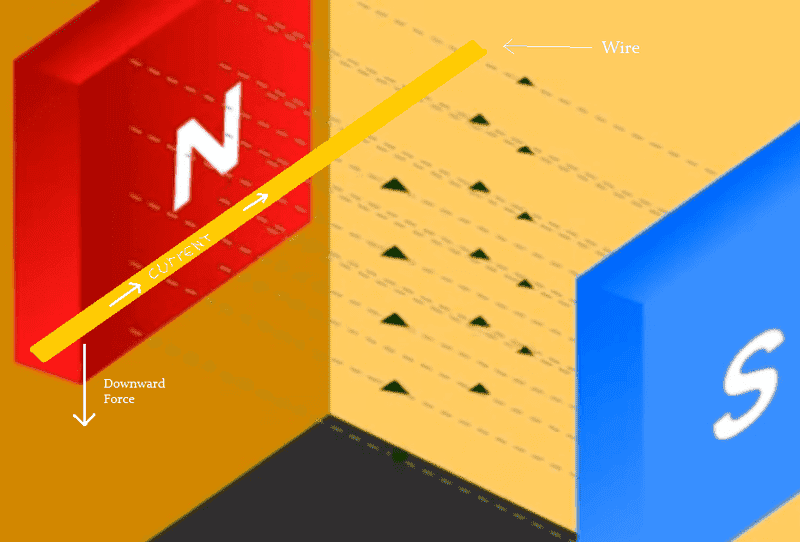
What exactly is happening to the electrons inside the wire while it is moving quickly downwards within the Magnetic field?

Why do electrons move in one direction if the wire is being push down?

I don't care what direction electrons move... I want to know WHY they move in one direction?

xmNVP.png
 
Physics news on Phys.org
A charged particle with a charge 'q' moving in a magnetic field 'B' with a velocity 'v' experiences a force given by F=q(vxB).
Look up Lorentz Force.
 
1. Whenever current flows via a conductor it creates magnetic field given by Maxwell's cork screw law, which in your case is clockwise rotation around the wire (looking from the screen ).
2. This induced magnetic field will oppose permanent magnet's magnetic field at the bottom of the wire (cancelling out) and will be along the direction of PM's magnetic field above the wire (adding up).
3. Because of this the concentration of magnetic field is more above the wire and less below it, this magnetic potential gradient pushes the wire/charge downwards.
 
Suppose that only a single electron can fit in a metal wire is moving downward within the magnetic field, will a single electron still going to move to the direction base on left hand rule? If YES... Why does a single electron move there while the wire is moving down?
2SoUo.png
 
Are the arrows indicating the direction of the electric current or the electrons?
 
DrClaude said:
Are the arrows indicating the direction of the electric current or the electrons?
two arrows inside the wire indicates the direction of electron flow
 
As @cnh1995 said, the force on the electron can be obtained from the Lorentz force equation.
 

Similar threads

  • · Replies 6 ·
Replies
6
Views
2K
  • · Replies 5 ·
Replies
5
Views
2K
  • · Replies 2 ·
Replies
2
Views
2K
  • · Replies 1 ·
Replies
1
Views
2K
  • · Replies 15 ·
Replies
15
Views
2K
  • · Replies 20 ·
Replies
20
Views
5K
  • · Replies 1 ·
Replies
1
Views
2K
  • · Replies 7 ·
Replies
7
Views
3K
  • · Replies 5 ·
Replies
5
Views
2K
  • · Replies 23 ·
Replies
23
Views
5K