What causes the divergence of acceleration in the parallel plate system?

  • Context: Graduate 
  • Thread starter Thread starter johne1618
  • Start date Start date
  • Tags Tags
    Electromagnetic Paradox
Click For Summary

Discussion Overview

The discussion revolves around the divergence of acceleration in a system of oppositely charged parallel plates connected by a rigid rod, focusing on the effects of electromagnetic forces and the implications of relativistic treatment. Participants explore the theoretical underpinnings, potential feedback mechanisms, and the role of retardation in electromagnetic fields.

Discussion Character

  • Exploratory
  • Technical explanation
  • Debate/contested
  • Mathematical reasoning

Main Points Raised

  • One participant proposes that the system experiences increased acceleration due to the cumulative effect of electromagnetic forces, leading to a potential divergence in acceleration.
  • Another participant suggests that a relativistic treatment is necessary, questioning whether the argument can be conducted in a comoving frame.
  • Concerns are raised about the neglect of the retarded nature of electromagnetic fields, which may introduce additional terms affecting the forces on the plates.
  • Some participants argue that the iterative approach to calculating acceleration may lead to incorrect conclusions about divergence, suggesting that a more straightforward application of Newton's second law could suffice.
  • There is a discussion about the equivalence principle and how it relates to the forces acting on the plates in a gravitational field.
  • Participants express uncertainty about the definition of a comoving frame and its implications for the analysis of forces in the system.

Areas of Agreement / Disagreement

Participants do not reach a consensus on the nature of the forces involved or the validity of the iterative approach to calculating acceleration. Multiple competing views remain regarding the treatment of electromagnetic forces and the implications of relativistic effects.

Contextual Notes

Limitations include the dependence on definitions of frames of reference, unresolved mathematical steps in the iterative approach, and the complexity introduced by considering gravitational effects alongside electromagnetic forces.

johne1618
Messages
368
Reaction score
0
Consider the system below comprising a pair of oppositely charged parallel plates, connected by a rigid rod of length [itex]r[/itex], constrained to move in the x-direction.
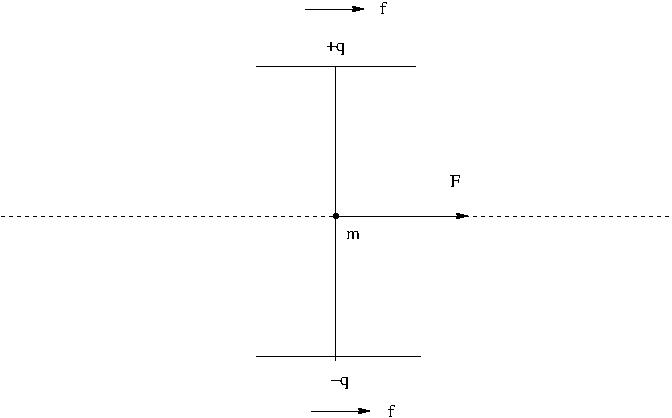
aVhRr.jpg


The forces on the plates from the Coulomb electric fields and the magnetic forces are all in the vertical direction so that they do not affect the motion of the system.

The only fields that do affect the system are the horizontal radiation fields due to the acceleration of the charged plates.

Let us assume that we initially apply a force [itex]F_0[/itex] so that we have:

[tex]F_0 = m a_0[/tex]

As charge [itex]+q[/itex] has an acceleration [itex]a_0[/itex] then it will produce a horizontal electric field at the negative plate given by:

[tex]E_+ = \frac{-qa_0}{4 \pi \epsilon_0 c^2 r}[/tex]

This will lead to a horizontal force [itex]f_0[/itex] on the negative plate, pointing towards the right, given by:

[tex]f_0 = \frac{q^2a_0}{4 \pi \epsilon_0 c^2 r}[/tex]

Likewise as charge [itex]-q[/itex] has an acceleration [itex]a_0[/itex] then it will produce a horizontal electric field at the positive plate given by:

[tex]E_- = \frac{qa_0}{4 \pi \epsilon_0 c^2 r}[/tex]

Again this will lead to a horizontal force [itex]f_0[/itex] on the positive plate, pointing towards the right, given by:

[tex]f_0 = \frac{q^2a_0}{4 \pi \epsilon_0 c^2 r}[/tex]

Thus the total force on the system is now given by:

[tex]F_1 = F_0 + 2f_0[/tex]

Therefore the system has an increased acceleration given by:

[tex]a_1 = \frac{F_1}{m}[/tex]
[tex]a_1 = a_0 \left(1+\frac{q^2}{2\pi\epsilon_0c^2rm}\right)[/tex]

The argument can be repeated indefinitely leading to the calculated acceleration diverging exponentially.

What's gone wrong?

There are no [itex]\dot{a}[/itex] terms in the calculation so I don't think the Abraham-Lorentz reaction force due to the production of electromagnetic radiation can save the day. A positive feedback involving forces and accelerations seems to preclude a consistent initial value for the acceleration.

Here's my (rather radical) solution: perhaps the mass has to change to ensure that the acceleration stays constant.

Perhaps we have:

[tex]F_0 = m_0 a_0[/tex]
[tex]F_1 = m_1 a_0[/tex]
Therefore:

[tex]\frac{m_1}{m_0} = \frac{F_1}{F_0}[/tex]
[tex]\frac{m_1}{m_0} = \frac{1}{m_0a_0}\left(m_0a_0+\frac{q^2a_0}{2\pi\epsilon_0c^2r}\right)[/tex]
[tex]m_1 = m_0 + \frac{q^2}{2\pi\epsilon_0c^2r}[/tex]
 
Last edited:
Physics news on Phys.org
These are not static fields unless you are in the comoving frame.

A relativistic treatment is required ... try it with a constant acceleration and see what you get.
 
UltrafastPED said:
These are not static fields unless you are in the comoving frame.

A relativistic treatment is required ... try it with a constant acceleration and see what you get.

Can I just conduct the argument in a comoving frame then?

I don't know how to do the argument relativistically with a constant acceleration.
 
Your calculation of the EM force neglects retarded character of EM field. If you calculate with exact expression for the retarded EM field, you will get many new terms that will influence the value of the EM force on the plates. In the first instant of period when the force is applied, the EM force has no acceleration component, so the acceleration is determined by F/m. The acceleration field kicks in only after time delay r/c.

After this delay, the acceleration field acts on the plates, but then there is also the velocity dependent field, which has opposite direction. Perhaps it is this velocity field that prevents the acceleration to get too high.
 
  • Like
Likes   Reactions: 1 person
Jano L. said:
Your calculation of the EM force neglects retarded character of EM field. If you calculate with exact expression for the retarded EM field, you will get many new terms that will influence the value of the EM force on the plates. In the first instant of period when the force is applied, the EM force has no acceleration component, so the acceleration is determined by F/m. The acceleration field kicks in only after time delay r/c.

After this delay, the acceleration field acts on the plates, but then there is also the velocity dependent field, which has opposite direction. Perhaps it is this velocity field that prevents the acceleration to get too high.

Thanks for the reply.

I don't think the retardation time changes the effect. Also I think one could make the argument in a comoving frame where the velocities of the plates are zero.

I think the best way to imagine the experiment is to simply drop the system in a gravitational field. The induced electric forces would cause the system to accelerate faster than gravity which of course is forbidden by the equivalence principle.
 
Note that the comoving frame is stationary wrt the plates ... so you would both fall together.

Then by the equivalence principle what would you expect to see?
 
UltrafastPED said:
Note that the comoving frame is stationary wrt the plates ... so you would both fall together.

Then by the equivalence principle what would you expect to see?

To be honest I'm not quite sure of the definition of comoving frame actually.

Is it an inertial frame that has the same instantaneous velocity as the plates or is it a frame that has both the same velocity and the same acceleration as the plates?

If it's the later then I expect the gravitational force + electromagnetic force on the plates to be balanced by an inertial force due to the plates' standard mass + an extra inertial force due to the plates' "electromagnetic mass".
 
Last edited:
I don't think the retardation time changes the effect. Also I think one could make the argument in a comoving frame where the velocities of the plates are zero.
The retardation does not change the acceleration field much if the acceleration is constant, but it plays role in the other, velocity-dependent terms. You have to consider them thoroughly. When you do, you will most likely find that there is no such run away behaviour.


Adding gravitational field means adding theory of gravity (you mention equivalence principle), which means things will get more unnecessarily complicated. It is better to consider your problem in an inertial frame, with external force F acting on the system.


The other part of the problem in your consideration is, I think, the iterative way you use to find the acceleration. Consider this equation:

$$
ma = F + ka,
$$

which suggests this iterative equation:

$$
a_{n+1} = a_{n} + ca_{n}
$$
with ##a_0 = F/m##, ##c = k/m.##

Using your iterative procedure, we would get

$$
a_1 = a_0 + c a_0 = a_0(1+c)
$$
$$
a_2 = a_1 + ca_1 = a_0(1+c)^2
$$
...

and obviously sequence ##a_{n}## goes to infinity.

However, the correct solution of the original equation is ##a = F/(m-k)##.

Obviously the iterative way does not lead to correct solution.
 
  • #10
johne1618 said:
The argument can be repeated indefinitely leading to the calculated acceleration diverging exponentially.
Why would you think that?

You don't have any sort of indefinite number of forces to repeat anything with. You have two forces, the mechanical force and the EM force. So your net force has two terms, one of which is a function of the acceleration. Plug in your net force on one side and ma on the other side and you have one equation in one unknown, a. Solve for a.

That is it. No diverging exponential acceleration. This is no different from any other f=ma problem except that solving for a involves a little more algebra than simply dividing both sides by m.
 
Last edited:
  • #11
Jano L. said:
The other part of the problem in your consideration is, I think, the iterative way you use to find the acceleration.

The argument can be repeated indefinitely leading to the calculated acceleration diverging exponentially.

DaleSpam said:
Why would you think that?

If the effect was instantaneous then as Jano says one would just solve the equation:
[tex]m a = F + k a.[/tex]
I think there is an iterative, positive feedback, effect here because of the time delay [itex]dt[/itex] between the plates accelerating and the subsequent electromagnetic force on the plates.

[tex]F(t+dt) = F(t) + k a(t)[/tex]
[tex]F(t) = m a(t)[/tex]
[tex]F(t+dt) = m a(t+dt)[/tex]
Thus we have
[tex]a(t+dt) = a(t)(1+k/m)[/tex]
[tex]\int da/a = \int k/m dt[/tex]
[tex]a(t)=a_0e^{kt/m}[/tex]
 
  • #12
The acceleration is uniform, is it not (it must be given the expression you used for the field)? Then the delay time is not important because nothing has changed during the propagation.

Again, you don't have any sort of indefinite number of forces to repeat anything with. You have two forces, the mechanical force and the EM force. So your net force has two terms, one of which is a function of the acceleration. Plug in your net force on one side and ma on the other side and you have one equation in one unknown, a. Solve for a.

That is it. No diverging exponential acceleration. This is no different from any other f=ma problem except that solving for a involves a little more algebra than simply dividing both sides by m.
 
Last edited:
  • #13
this is an interesting 'problem'... The slight nudge will cause a slight change in the electric field so at a time ##r/c## later, each charge will feel (for a short time) an acceleration in the horizontal direction. and this acceleration causes another slight change in the electric field, which causes another acceleration at time ##r/c## later. So the charges will keep doing these little accelerations at every ##r/c## time interval.

I think maybe the answer is simply that in the case when there is only one charge, when you give it a nudge, some of that energy just gets radiated outwards, and never comes back. But when you have the two charges in this set-up, some of that radiated energy will not escape to infinity, and it is this that causes the little 'hops' forward. I don't think the accelerations will diverge. I suspect the accelerations will slowly die down with time.

Anyway, I'm not sure if any of this is right. It is just my first guess.
 
  • #14
I think there is an iterative, positive feedback, effect here because of the time delay dt between the plates accelerating and the subsequent electromagnetic force on the plates.

F(t+dt)=F(t)+ka(t)

Aha, so you do consider delays. That is better, but the above equation is not correct. You simply have to take the full expression for the electromagnetic force and then justify any particular simplification. The EM force is not just ka(t).
 
  • #15
BruceW said:
I don't think the accelerations will diverge. I suspect the accelerations will slowly die down with time.
We are guaranteed that the accelerations will not diverge by Poynting's theorem.

Under the steady acceleration case you have simply a f=ma where f is a function of a. One equation in one unkown. Obviously no diverging.

In the impulsive acceleration case you will have to solve more complicated equations, but you are guaranteed that they will not diverge either.
 
  • #16
Jano L. said:
Aha, so you do consider delays. That is better, but the above equation is not correct. You simply have to take the full expression for the electromagnetic force and then justify any particular simplification. The EM force is not just ka(t).

Having read your post about delays I now think they are an essential part of the argument. The delay between acceleration and electromagnetic force is what causes the positive feedback.

I think my analysis is ok for non-relativistic velocities - I admit I don't know how to make a more accurate calculation.
 
  • #17
If you want to do it iteratively, you need to consider that with the new acceleration you only need to add the extra force coming from the field from the extra acceleration, but you added the whole force due to the field after every step, while you should have added just the extra force.
So it is like [itex]a_{1}=a_{0}+a_{0}\times k/m[/itex], then [itex]a_{2}=a_{1}+(a_{1}-a_{0})\times k/m[/itex] and not [itex]a_{2}=a_{1}+a_{1}\times k/m[/itex], then [itex]a_{3}=a_{2}+(a_{2}-a_{1})\times k/m[/itex] etc and see where the values converge. Or the easier way is to do it the way as was pointed out before, [itex]a=a_{0}+a\times k/m[/itex] and solve for a.
It does seem weird that the system seems to push itself. I think that if the charges give away radiation and energy, then this needs to be accounted for and would result in additional forces. However googling the radiation of an uniformly accelerating charge I get conflicting answers and it gets over my head into general relativity and stuff.
 
  • #18
chingel said:
If you want to do it iteratively, you need to consider that with the new acceleration you only need to add the extra force coming from the field from the extra acceleration, but you added the whole force due to the field after every step, while you should have added just the extra force.
So it is like [itex]a_{1}=a_{0}+a_{0}\times k/m[/itex], then [itex]a_{2}=a_{1}+(a_{1}-a_{0})\times k/m[/itex] and not [itex]a_{2}=a_{1}+a_{1}\times k/m[/itex], then [itex]a_{3}=a_{2}+(a_{2}-a_{1})\times k/m[/itex] etc and see where the values converge. Or the easier way is to do it the way as was pointed out before, [itex]a=a_{0}+a\times k/m[/itex] and solve for a.
It does seem weird that the system seems to push itself. I think that if the charges give away radiation and energy, then this needs to be accounted for and would result in additional forces. However googling the radiation of an uniformly accelerating charge I get conflicting answers and it gets over my head into general relativity and stuff.

Maybe I can just say that I start with an initial acceleration [itex]a_0[/itex] so that we have

$$m a_n = k a_{n-1}$$
$$a_n = (k/m)a_{n-1}$$
$$a_n = (k/m)^n a_0$$

Each time step takes a time [itex]r/c[/itex] so that we can write:
$$a(t)=\left(\frac{k}{m}\right)^{ct/r}a_0$$
 
Last edited:
  • #19
Just to make sure, 'k' is
##k=\frac{q^2}{2\pi\epsilon_0c^2r}##
right? yeah, the iterative law ##a_n=(k/m)^na_0## looks right. But I am not sure about your last equation. I guess you are assuming the two charges are very close or something?

Anyway, your equation ##a_n=(k/m)^na_0## is very insightful. If you think about it, to have a non-relativistic limit, we must have k<<m, so therefore the accelerations will get smaller and smaller. And if we have k to be the same order as m, then we have the relativistic case, and in that case, the equation
##E_+ = \frac{-qa_0}{4 \pi \epsilon_0 c^2 r}##
Is not correct anyway, so the equation ##a_n=(k/m)^na_0## is also likely to be incorrect in the relativistic case.

edit: to be clear, in the relativistic case, the relativistic mass of the charges will change, and other weird stuff will happen, so we would not be allowed to use the nice assumptions that we have been using. Although, maybe the equation
##E_+ = \frac{-qa_0}{4 \pi \epsilon_0 c^2 r}##
will still work... It assumes that the change in velocity is small compared to the speed of light. So I guess this equation can still be true even when k>m
 
Last edited:
  • #20
johne1618 said:
Maybe I can just say that I start with an initial acceleration [itex]a_0[/itex] so that we have

$$m a_n = k a_{n-1}$$
$$a_n = (k/m)a_{n-1}$$
$$a_n = (k/m)^n a_0$$

Each time step takes a time [itex]r/c[/itex] so that we can write:
$$a(t)=\left(\frac{k}{m}\right)^{ct/r}a_0$$

If you are using iteration, then it should go something like this: the force [itex]m\times a_{0}[/itex] pushes the system, assume it to start accelerating with [itex]a_{0}[/itex]. But since the acceleration causes extra force which is proportional to the acceleration, you have an additional extra force [itex]k\times a_{0}[/itex]. Combining these forces you have a new acceleration [itex]a_{1}[/itex]. Now considering the system accelerating at [itex]a_{1}[/itex], you must now not add an entire new force from the electric field with magnitude [itex]k\times a_{1}[/itex], instead you have to add only the extra force that comes from the increased acceleration, so that it's magnitude is [itex]k\times (a_{1}-a_{0})[/itex]. You have to account for the increased force from the electric field, not add a whole new force, because otherwise you would count the same force many times.
If you solve it, it is equivalent to solving this equation for a [itex]m\times a=m\times a_{0}+k\times a[/itex].

However this whole analysis is problematic, because energy and momentum seem to not be conserved if it simply pushes itself. You have to account for the radiated energy and momentum as well, which should cause extra forces.
 
  • #21
BruceW said:
Just to make sure, 'k' is
##k=\frac{q^2}{2\pi\epsilon_0c^2r}##
right? yeah, the iterative law ##a_n=(k/m)^na_0## looks right. But I am not sure about your last equation. I guess you are assuming the two charges are very close or something?

Anyway, your equation ##a_n=(k/m)^na_0## is very insightful. If you think about it, to have a non-relativistic limit, we must have k<<m, so therefore the accelerations will get smaller and smaller. And if we have k to be the same order as m, then we have the relativistic case, and in that case, the equation
##E_+ = \frac{-qa_0}{4 \pi \epsilon_0 c^2 r}##
Is not correct anyway, so the equation ##a_n=(k/m)^na_0## is also likely to be incorrect in the relativistic case.

edit: to be clear, in the relativistic case, the relativistic mass of the charges will change, and other weird stuff will happen, so we would not be allowed to use the nice assumptions that we have been using. Although, maybe the equation
##E_+ = \frac{-qa_0}{4 \pi \epsilon_0 c^2 r}##
will still work... It assumes that the change in velocity is small compared to the speed of light. So I guess this equation can still be true even when k>m

Yes ##k=\frac{q^2}{2\pi\epsilon_0c^2r}##

I assume that during each step an electromagnetic influence travels across the system from an accelerating charge to a receiving charge . This will take a time ##\Delta t = r/c## where ##r## is the distance between the charges.

Thus in a time ##t## the number of steps ##n## will be given by:

$$n = t / \Delta t = ct /r$$

I don't think ##k \sim m## or even ##k>m## is a relativistic case. To attain it you just need a large charge ##q## and a small distance ##r##.

I think the equation ##E_+ = \frac{-qa_0}{4 \pi \epsilon_0 c^2 r}## is already relativistically correct.

To sum up I don't think relativity cures the problem.

Perhaps though one needs to include the effects of a radiation reaction force as the acceleration changes. The Abraham-Lorentz reaction force depends on the rate of change of acceleration ##\dot{a}##. If we put such a term into the recurrence relation we get:

$$m\ a_n = k\ a_{n-1} - b\ \dot{a}_n$$

We can write the rate of change on acceleration as:

$$\dot{a}_n = \frac{a_n - a_{n-1}}{\Delta t}$$

Using ##\Delta t = r/c## as the time interval between steps we have:

$$\dot{a}_n = \frac{c}{r}\left(a_n - a_{n-1}\right)$$

Therefore substituting into the recurrence relation we have:

$$m\ a_n = k\ a_{n-1} - \frac{bc}{r}\left(a_n - a_{n-1}\right)$$

$$(m + \frac{bc}{r})a_n = (k + \frac{bc}{r})a_{n-1}$$

$$a_n = \left(\frac{k+bc/r}{m+bc/r}\right)^na_0$$

Thus if the ratio in brackets is greater than ##1## then the acceleration will diverge.

$$k+bc/r > m+bc/r$$
$$k > m$$

This is the same result as we have without the radiation reaction force.
 
  • #22
johne1618 said:
To sum up I don't think relativity cures the problem.
What problem? Poynting's theorem guarantees that there is no problem if you actually use Maxwell's equations to do this. The only problem arises if you use a numerical method that is bad.
 
  • #23
DaleSpam said:
What problem? Poynting's theorem guarantees that there is no problem if you actually use Maxwell's equations to do this. The only problem arises if you use a numerical method that is bad.

Well you do the calculation using Maxwell's equations then.
 
  • #24
I might do so on Sunday if I have time, but this is your topic and your interest, not mine. The effort properly should come from you.

The fact is that we are guaranteed that there is no diverging acceleration by Poynting's theorem. Poynting's theorem follows directly from Maxwell's equations and the Lorentz force law. Therefore, if you are using some other method to calculate the force and you get a diverging acceleration then you know that your calculation method is flawed.

It isn't an issue of any paradox in EM. It is simply a bad calculation, and lack of a good calculation doesn't make a bad calculation good.
 
  • #25
DaleSpam said:
I might do so on Sunday if I have time, but this is your topic and your interest, not mine. The effort properly should come from you.

The fact is that we are guaranteed that there is no diverging acceleration by Poynting's theorem. Poynting's theorem follows directly from Maxwell's equations and the Lorentz force law. Therefore, if you are using some other method to calculate the force and you get a diverging acceleration then you know that your calculation method is flawed.

It isn't an issue of any paradox in EM. It is simply a bad calculation, and lack of a good calculation doesn't make a bad calculation good.

ok - sorry for my last post.
 
  • #26
Hi all,

An acquaintence has pointed me towards "An electric dipole in self-accelerated transverse motion" by F. H. J. Cornish. Unfortunately you have to pay for the article or rent it for free for 5 mins.

http://ajp.aapt.org/resource/1/ajpias/v54/i2/p166_s1?isAuthorized=no&ver=pdfcov

A detailed relativistic calculation shows that the dipole should move with a constant proper acceleration given by:

$$a = \left(\frac{2c^2}{d}\right)\left[\left(\frac{e^2}{2mc^2d}\right)^{2/3}-1\right]^{1/2}$$

where ##e## and ##-e## are the charges, each charge has mass ##m##, ##d## is the distance between them and ##d < e^2/2mc^2## (cgs units used).

As the acceleration is constant the author states that the Lorentz-Dirac radiation reaction forces on each charge vanish and therefore do not contribute to the motion.
 
Last edited by a moderator:
  • #27
Considering conservation of momentum, how can one charge push another without feeling an opposite reaction force? If it simply does that then momentum wouldn't be conserved.
 
  • #28
chingel said:
Considering conservation of momentum, how can one charge push another without feeling an opposite reaction force? If it simply does that then momentum wouldn't be conserved.

True.

That's why I think it is not enough just to consider a retarded electromagnetic interaction from an accelerated charge to another that is instantaneously at rest. I think there must also be an advanced electromagnetic interaction that travels backwards in time from the stationary charge to the accelerated one producing a counter-balancing force.
 
  • #29
chingel said:
Considering conservation of momentum, how can one charge push another without feeling an opposite reaction force? If it simply does that then momentum wouldn't be conserved.

The charges aren't pushing against each other, they're pushing against the electromagnetic field in their immediate neighborhood. That field has momentum associated with it, and if you include its momentum you'll find that momentum is conserved at every step of the interaction between the particles.
 
  • #30
Nugatory said:
The charges aren't pushing against each other, they're pushing against the electromagnetic field in their immediate neighborhood. That field has momentum associated with it, and if you include its momentum you'll find that momentum is conserved at every step of the interaction between the particles.

Does that mean that light would be emitted with such momentum so that conservation of momentum would hold?
What about energy conservation? The system has more kinetic energy than was put in and then there is also the energy of the light.
 

Similar threads

  • · Replies 19 ·
Replies
19
Views
2K
  • · Replies 9 ·
Replies
9
Views
2K
  • · Replies 6 ·
Replies
6
Views
1K
  • · Replies 29 ·
Replies
29
Views
2K
  • · Replies 3 ·
Replies
3
Views
956
  • · Replies 2 ·
Replies
2
Views
2K
  • · Replies 1 ·
Replies
1
Views
2K
  • · Replies 2 ·
Replies
2
Views
2K
Replies
6
Views
1K
  • · Replies 1 ·
Replies
1
Views
2K