Discussion Overview
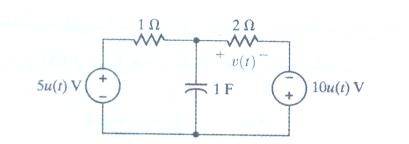
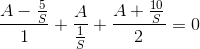
The discussion revolves around the implications of specific values (A=0 and S=-3/2) in the context of Laplace transform analysis applied to a circuit involving a capacitor and resistors. Participants explore the behavior of voltages across circuit components and the interpretation of these values in terms of circuit response, steady state, and initial conditions.
Discussion Character
- Technical explanation
- Conceptual clarification
- Debate/contested
- Mathematical reasoning
Main Points Raised
- One participant questions the meaning of A=0, suggesting it indicates no voltage drop across the capacitor, which simplifies finding the voltage across the resistor.
- Another participant argues that S=-3/2 should not be considered a solution, emphasizing that node equations must hold for all values of S, and reiterates that A=0 is the only consistent outcome.
- Suggestions are made to replace circuit sources with arbitrary values to analyze the behavior of A(s) under different conditions, noting that balanced sources lead to A=0.
- Participants discuss the steady state behavior of the capacitor, with one suggesting that at t=∞, the capacitor behaves like an open circuit, affecting voltage calculations.
- Questions arise about determining voltage jumps across capacitors using Laplace transforms, with references to impulse sources and initial conditions.
- One participant explains how to model initial capacitor voltage as an impulse current source, providing a mathematical framework for understanding voltage jumps.
Areas of Agreement / Disagreement
Participants express differing views on the implications of A=0 and S=-3/2, with some agreeing on the interpretation of A=0 while others contest the validity of S=-3/2 as a solution. The discussion remains unresolved regarding the broader implications of these values in circuit analysis.
Contextual Notes
Participants reference the final value theorem and steady state analysis, but there is no consensus on how these concepts apply to the specific circuit in question. The discussion includes various assumptions about circuit behavior and initial conditions that are not fully resolved.