What Happens to a Pendulum's Height at a 90-Degree Angle?

Join the discussion
Registration is free. Ask a follow-up in this thread, or start your own.
5 replies · 2K views
eddiepi2012
Messages
6
Reaction score
0
1.2. If a ball and string pendulum is pulled and lifted to a height = 10 cm and the length of the string is 1 m what will be the value of h when the string makes an angle of 90 degree with the vertical? Please ignore the 0.5 m it should be a h = 10 cm or 0.1 m the diagram is to provide a description of how this question is worded.
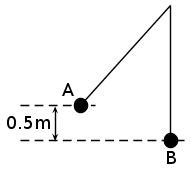
PG10C3_006.png


2.c2 = a2 + b2 = b2 = c2 – a2, T sin theta – mg = 0


3. 1 m – 0.1 m = 0.9 m
c2 = a2 + b2 = b2 = c2 – a2
b2 = 12 – 0.92
b2 = 1 – 0.81
b2 = 0.19
b = √(0.19) = 0.4
= cos-1 (0.4) = 66 degrees
 
Last edited:
Physics news on Phys.org
Is that really how the question is worded? It's very confusing. A pendulum with a ball and string, or the pendulum isa ball and string? What exactly is lifted to a height of 10cm, and relative to what? I assume h is the height of the ball (relative to the same baseline). 90 degrees to the vertical? So the string goes horizontal somehow? Won't it need to be pushed to do that?
 
1.2. If a pendulum with a ball and string is lifted to a height = 10 cm and the length of the string is 1 m what will be the value of h when the string makes an angle of 90 degree with the vertical?


Very badly worded question. Doubly confusing because it asks for a dimension "h" but your final answer is an angle in degrees.

The only way I can get an answer from the question is to assume it's really simple...

First the pendulum starts hanging vertically. h = height of ball = 0?
Then the ball, string, and pivot is lifted 10cm vertically? h = 0+0.01m
Then the ball is swung up to the horizontal. h = 0+0.01+1.0
In which case ball and pivot end up at h = 1.01m.

Clearly that's not right?
 
A chain is being yanked.
 
OK, the diagram helps, but there's still something unclear. Why will the string ever be 90 deg to the vertical? If you let the ball go, it won't get there. So I assume it is lifted further, keeping the string taut. But in that case it becomes a trivial geometry problem, there's no kinetic interest, and the initial h = 0.1m is irrelevant.
 
Our problem is that the question is either very easy/trivial or missing some information.

If the ball is simply released from 0.1m the ball won't (and can't) swing up to the horizontal.

If the ball is lifted by hand until the string is horizontal then the starting value (0.1m) is irrelevant to the problem.
 

Attachments

  • PG10C3_006.jpg
    PG10C3_006.jpg
    5.2 KB · Views: 444