Ulysees
- 515
- 0
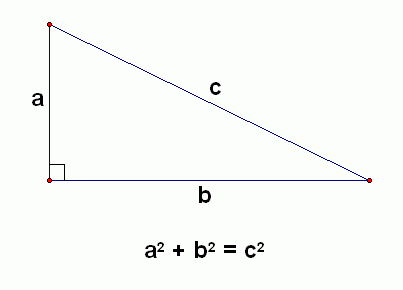
Does the theorem still hold true, but triangle sides are curves?
Ulysees said:
Ulysees said:

tiny-tim said:If you put cos ~ 1 + ( ^2)/2, you get … ?
tiny-tim said:ooh … sorry … my ~ meant "is approximately", and the whole thing was shorthand for:
"cosA ~ 1 + (A^2)/2, where A is a very small angle (length, in radians), and the same for B and C".
Ulysees said:I guess some approximation of the expansion of cos might yield the pythagorean theoreom.
But I'm pondering, what are we doing here, we're mapping an abstract 2D curved space into ordinary euclidean space. General relativity is doing something analogous?
Could it be that a 3D or 4D curved space is just a mathematical trick, and in fact we can match experimental measurements with euclidean geometry too and the right formulation of relativity's equations?
Ulysees said:Can someone tell me, is it possible to match experimental measurements explained with GR but without including the concept of curved space and instead using relativistic equations in euclidean space?
MeJennifer said:The term Euclidean is, unfortunately, used for two distinct things, one refers to the metric signature and the other to the curvature of a space.
One can say unambiguously that any space that has an indefinite or a definite negative metric signature is not Euclidean even if that space is flat. Also any space that has a definite positive metric signature and is flat is Euclidean. However a space that has a definite positive metric signature and is not flat is sometimes also called Euclidean.
experimental measurements involving triangles cannot match a Euclidean theory