What has been done here to simplify the integration

  • Context:
  • Thread starter Thread starter nacho-man
  • Start date Start date
  • Tags Tags
    Integration Simplify
Join the discussion
Registration is free. Ask a follow-up in this thread, or start your own.
4 replies · 2K views
nacho-man
Messages
166
Reaction score
0
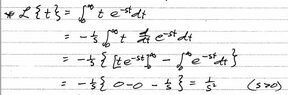
Please refer to the attached image.

My lecturer seems to have re-written $e^{-st}$ as $\frac{d}{dt}e^{-st}$ and taken out the $(-\frac{1}{s}$ which I do see is equivalent, but i am unsure how he goes from there onwards.

Although, e is the derivative of itself. how does he split the integral into two, despite there being a multiplication of the terms?
 

Attachments
  • Untitled.jpg
    Untitled.jpg
    26.7 KB · Views: 133
Physics news on Phys.org
nacho said:
Please refer to the attached image.

My lecturer seems to have re-written $e^{-st}$ as $\frac{d}{dt}e^{-st}$ and taken out the $(-\frac{1}{s}$ which I do see is equivalent, but i am unsure how he goes from there onwards.

Although, e is the derivative of itself. how does he split the integral into two, despite there being a multiplication of the terms?

Your lecturer has applied the 'integration by parts' rule...

Kind regards

$\chi$ $\sigma$
 
hah. thanks..
that was mildly embarrassing.

i didn't closely to see if he had done so. when he was talking in the lecture he mentioned that there was a 'trick' way to integrate this w/o integrating by parts or something along those lines.
 
nacho said:
hah. thanks..
that was mildly embarrassing.

i didn't closely to see if he had done so. when he was talking in the lecture he mentioned that there was a 'trick' way to integrate this w/o integrating by parts or something along those lines.

I would ask him again what it was he said. By-parts is certainly the standard way to integrate this, and it's not all that difficult, once you know how. I suppose you could set up tabular integration, but that's just a unified way of keeping track of by-parts. It wouldn't be worth it for only one application of by-parts.
 
The first step depends upon the fact that [tex]\frac{d(e^{-st})}{dt}= -s e^{-st}[/tex] so that, dividing both sides by -s, [tex]e^{-st}= -\frac{1}{s}\frac{d(e^{-st})}{dt}[/tex].

Of course, since "s" is independent of the integration variable, t, we can take [tex]-\frac{1}{s}[/tex] out of the integral.