What Is Gain Narrowing in Lasers?

  • Context: Graduate 
  • Thread starter Thread starter unscientific
  • Start date Start date
  • Tags Tags
    Gain Laser Lasers
Click For Summary
SUMMARY

Gain narrowing in lasers occurs when the gain bandwidth of the medium is smaller than the input beam bandwidth, resulting in a narrower output beam centered around the frequency ω0. The small-signal gain coefficient is defined by the equation α21(ω−ω0) = N*σ21(ω−ω0), where N* represents the population inversion and σ21 is the stimulated emission cross-section. This phenomenon leads to nonuniform amplification across the beam's spectrum, with frequencies near ω0 receiving significantly stronger gain. Consequently, while all parts of the spectrum are amplified, the output pulse duration increases due to the reduced bandwidth.

PREREQUISITES
  • Understanding of laser physics and amplification principles
  • Familiarity with the small-signal gain coefficient and its components
  • Knowledge of spectral intensity and its mathematical representation
  • Basic concepts of frequency filtering in optical systems
NEXT STEPS
  • Study the mathematical derivation of the small-signal gain coefficient in laser systems
  • Explore the effects of gain narrowing on pulse duration and bandwidth in laser applications
  • Investigate the role of population inversion in laser performance
  • Learn about different types of laser gain media and their characteristics
USEFUL FOR

Laser physicists, optical engineers, and researchers focused on laser design and performance optimization will benefit from this discussion on gain narrowing.

unscientific
Messages
1,728
Reaction score
13
A laser is amplified exponentially, with spectral intensity

I (\omega,z) = I (\omega,0) e^{\alpha z}

The small-signal gain coefficient is given by
\alpha_{21}(\omega-\omega_0) = N^* \sigma_{21}(\omega-\omega_0) = N^* \frac{\hbar \omega_0}{c}B_{21} g_B(\omega-\omega_0) = N^* \frac{\hbar \omega_0}{c}B_{21} \frac{1}{\pi} \frac{(\frac{\Delta \omega_L}{2})}{(\omega-\omega_0)^2+(\frac{\Delta \omega_L}{2})^2}

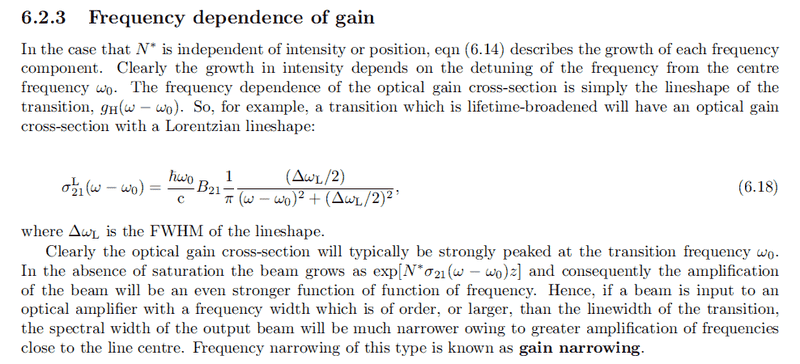
So obviously, the gain will be the strongest when ##\omega=\omega_0##. But I don't understand the concept of 'Gain narrowing' as described:
gainnarrowing.png
 
Physics news on Phys.org
An alternative way to understand power density amplification is to think the gain medium as a frequency filter. If the width of the filter, or the gain bandwidth, is smaller than the input beam bandwidth, the output will obviously be cut off by some fraction resulting in narrower bandwidth, which termed as gain narrowing.
 
blue_leaf77 said:
An alternative way to understand power density amplification is to think the gain medium as a frequency filter. If the width of the filter, or the gain bandwidth, is smaller than the input beam bandwidth, the output will obviously be cut off by some fraction resulting in narrower bandwidth, which termed as gain narrowing.

So you're saying: Input wide beam, only part of beam that is close to ##\omega_0## gets amplified exponentially. Then output beam: narrow close to ##\omega_0##.
 
unscientific said:
So you're saying: Input wide beam, only part of beam that is close to ω0\omega_0 gets amplified exponentially. Then output beam: narrow close to ω0\omega_0.
For small signal case, every part in the beam's spectrum will get amplified exponentially. It's just that the amount of amplification is nonuniform such that frequencies near ##\omega_0## experience much stronger gain than those farther from ##\omega_0##.
Actually the main reason of why people arouse this issue of gain narrowing is due to the fact that the laser pulse duration is insensitive to the absolute magnitude of the spectrum, it's only sensitive to the normalized profile of the field spectrum (imagine two Gaussian profile spectra with equal FWHM but different max values, then their time domain fields will have the same FWHM). Therefore even if all parts in the spectrum get amplified, but the output pulse will be longer in time compared to the input due to the narrowing the output.bandwidth.
 

Similar threads

  • · Replies 0 ·
Replies
0
Views
2K
Replies
8
Views
3K
Replies
3
Views
2K
  • · Replies 9 ·
Replies
9
Views
2K
Replies
4
Views
2K
  • · Replies 1 ·
Replies
1
Views
3K
  • · Replies 2 ·
Replies
2
Views
2K
  • · Replies 1 ·
Replies
1
Views
1K
  • · Replies 8 ·
Replies
8
Views
3K
Replies
1
Views
2K