Discussion Overview
The discussion centers around the ambiguity of the term "strength" in materials science, particularly in the context of mechanical engineering. Participants explore its various interpretations, such as yield strength, ultimate strength, and other forms of strength, and how these relate to materials like titanium and steel.
Discussion Character
- Debate/contested
- Conceptual clarification
- Technical explanation
Main Points Raised
- Some participants note that "strength" can refer to different types of strength, including yield strength, ultimate strength, shear strength, and fatigue strength, leading to confusion.
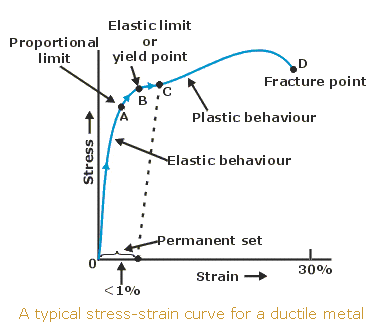
- One participant suggests that in everyday usage, "strength" may correspond to the ultimate strength as indicated on the engineering stress-strain diagram.
- Another participant emphasizes the importance of qualifiers like "yield" or "ultimate" when discussing strength to avoid ambiguity.
- It is mentioned that while titanium's yield strength may not be impressive, certain alloys can significantly enhance its yield strength to weight ratio, making it advantageous in specific applications.
- Participants discuss that ultimate strength is typically not used for design purposes due to the permanent damage incurred once yield strength is exceeded.
- There is a comparison of titanium's properties to those of steel and aluminum, highlighting that properly designed titanium components can be lighter while maintaining or exceeding strength.
Areas of Agreement / Disagreement
Participants generally agree that "strength" is an ambiguous term that requires clarification, but there is no consensus on a singular definition or usage. Multiple competing views regarding the interpretation of strength remain present.
Contextual Notes
Participants express uncertainty regarding the specific definition of strength in different contexts, and there are limitations in the discussion regarding the assumptions made about material properties and their applications.