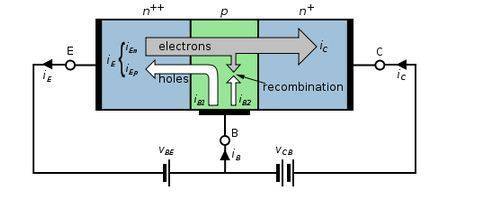
What is the difference in mechanisms in which IB1 and IB2 are formed?

  • Context: Graduate 
  • Thread starter Thread starter anhnha
  • Start date Start date
  • Tags Tags
    Difference
Click For Summary
SUMMARY

The discussion focuses on the mechanisms of IB1 and IB2 formation in bipolar junction transistors (BJTs). IB1 involves hole injection from the base to the emitter, where holes recombine with free electrons in the emitter. In contrast, IB2 describes the process where electrons from the emitter recombine with holes in the base, effectively becoming valence electrons. The participants clarify that both processes are interconnected, yet they represent distinct paths of charge carrier movement within the transistor.

PREREQUISITES
  • Understanding of bipolar junction transistor (BJT) operation
  • Knowledge of charge carriers: holes and electrons
  • Familiarity with semiconductor physics
  • Basic concepts of recombination and injection in semiconductors
NEXT STEPS
  • Study the operation principles of bipolar junction transistors (BJTs)
  • Learn about charge carrier dynamics in semiconductors
  • Explore the concept of recombination and its effects on transistor performance
  • Investigate the role of base current in transistor amplification
USEFUL FOR

Electronics students, semiconductor physicists, and engineers working with bipolar junction transistors who seek to deepen their understanding of charge carrier mechanisms in BJTs.
anhnha
Messages
179
Reaction score
1
Hi,
Can anyone help me? What is the difference in mechanisms in which IB1 and IB2 are formed in the picture below?
attachment.php?attachmentid=61717&stc=1&d=1378970406.jpg

http://en.wikipedia.org/wiki/File:NPN_BJT_Basic_Operation_(Active).svg
Thanks.
 

Attachments

  • base current.JPG
    base current.JPG
    10.3 KB · Views: 524
Physics news on Phys.org
valence electrons or free electrons

Hi,
I am a bit confused about base current in BJT transistor. Please help.
Here is a picture from a lecture.
attachment.php?attachmentid=61732&stc=1&d=1379002791.jpg

I want to ask about iB1 (hole injection from B to E).
Holes in base are injected into emitter and then they recombined with electrons in emitter.
Are electrons in emitter that recombine with holes from base valence electrons?
If, for example, all electrons in emitter that recombine with holes from base are free electrons then
hole injected from B to E iEp will not exist, right?
 

Attachments

  • base current 1.JPG
    base current 1.JPG
    50.2 KB · Views: 509
Hi, can anyone help?
 
iB1: holes in Base move from Base to Emitter
This is same as electrons from emitter, recombining with holes in Base to become valance electrons and they continue move to B.
iB2: electrons from emitters recombining with holes in Base and continue move to B
I don't see any difference. Please help.
 

Similar threads

  • · Replies 1 ·
Replies
1
Views
2K
  • · Replies 33 ·
2
Replies
33
Views
3K
  • · Replies 1 ·
Replies
1
Views
2K
  • · Replies 5 ·
Replies
5
Views
2K
  • · Replies 1 ·
Replies
1
Views
2K
  • · Replies 1 ·
Replies
1
Views
3K
  • · Replies 14 ·
Replies
14
Views
3K
  • · Replies 6 ·
Replies
6
Views
3K
  • · Replies 2 ·
Replies
2
Views
995
  • · Replies 6 ·
Replies
6
Views
2K