What is the Geodesic Equation for FRW Metric's Time Component?

Click For Summary

Discussion Overview

The discussion centers around the geodesic equation for the time component of the Friedmann-Robertson-Walker (FRW) metric, particularly in the context of photons and massive particles. Participants explore the implications of the metric components and the behavior of four-velocities in this framework.

Discussion Character

  • Technical explanation
  • Debate/contested
  • Mathematical reasoning

Main Points Raised

  • One participant presents the FRW metric and the geodesic equation, asserting that for massive particles, the temporal component ##\dot t = 1##.
  • Another participant challenges the assertion that ##u_0 u^0 = 0##, suggesting that it is not true and referencing the Einstein summation convention.
  • A subsequent reply reiterates the point about photons, stating that for a photon, the four-velocity is a null vector, which leads to ##u_0 u^0 = 0##.
  • Participants discuss the implications of the equation ##u^\mu u_\mu = 0##, with one asserting that it does not imply ##u^0 u_0 = 0##.
  • There is a question about the sum of the products of the four-velocities, leading to a confirmation that the equation holds.

Areas of Agreement / Disagreement

Participants express disagreement regarding the interpretation of the four-velocity components and their relationships, particularly in the context of photons versus massive particles. The discussion remains unresolved with multiple competing views on the implications of the equations presented.

Contextual Notes

There are unresolved assumptions regarding the treatment of four-velocities and the implications of the null vector condition for photons. The discussion also reflects differing interpretations of the Einstein summation convention.

unscientific
Messages
1,728
Reaction score
13
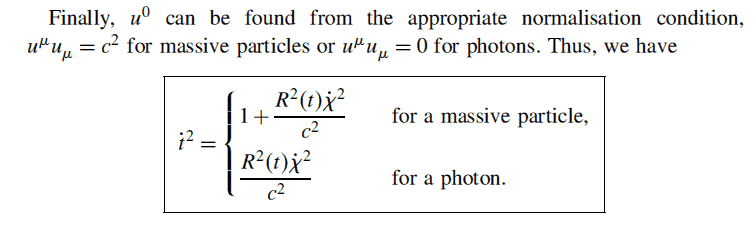
Taken from Hobson's book:

frw2.png


Metric is given by
ds^2 = c^2 dt^2 - R^2(t) \left[ d\chi^2 + S^2(\chi) (d\theta^2 + sin^2\theta d\phi^2) \right]

Thus, ##g_{00} = c^2, g_{11} = -R^2(t), g_{22} = -R^2(t) S^2(\chi), g_{33} = -R^2(t) S^2(\chi) sin^2 \theta##.

Geodesic equation is given by:
\dot u_\mu = \frac{1}{2} \left( \partial_\mu g_{v\sigma} \right) u^v u^\sigma

The coordinates are given by ##u^0 = \dot t, u^1 = \dot \chi, u^2 = \dot \theta, u^3 = \dot \phi##.

For the temporal component,
\dot u_0 = \frac{1}{2} (\partial_0 g_{v\sigma})u^v u^\sigma

Photons

u^0u_0 = 0
u^0 g_{00} g^0 = 0
g_{00}\dot t^2 = 0
\dot t = 0

This doesn't make any sense. For massive particles, ##\dot t = 1##.
 
Physics news on Phys.org
Why do you think ##u_0 u^0 = 0##? It is not true. Remember the Einstein summation convention.
 
Orodruin said:
Why do you think ##u_0 u^0 = 0##? It is not true. Remember the Einstein summation convention.

For a photon, it is 0, as shown in the text. (null vector)
 
unscientific said:
For a photon, it is 0, as shown in the text. (null vector)

No, it is not ##u^\mu u_\mu = 0## does not imply ##u^0 u_0 = 0##.
 
Orodruin said:
No, it is not ##u^\mu u_\mu = 0## does not imply ##u^0 u_0 = 0##.

So, ##u^0u_0 + u^1u_1 + u^2u_2 + u^3u_3 = 0##?
 
unscientific said:
So, ##u^0u_0 + u^1u_1 + u^2u_2 + u^3u_3 = 0##?

Yes.
 
  • Like
Likes   Reactions: unscientific

Similar threads

  • · Replies 8 ·
Replies
8
Views
2K
  • · Replies 13 ·
Replies
13
Views
2K
  • · Replies 11 ·
Replies
11
Views
2K
  • · Replies 14 ·
Replies
14
Views
3K
  • · Replies 76 ·
3
Replies
76
Views
4K
  • · Replies 1 ·
Replies
1
Views
1K
  • · Replies 10 ·
Replies
10
Views
3K
  • · Replies 16 ·
Replies
16
Views
2K
  • · Replies 1 ·
Replies
1
Views
910
  • · Replies 5 ·
Replies
5
Views
2K