What Is the Minimum Height for a Block to Complete a Frictionless Loop?

Click For Summary

Homework Help Overview

The discussion revolves around determining the minimum height from which a block must be released to successfully navigate a frictionless loop-the-loop track. The problem involves concepts of energy conservation and forces acting on the block at different points along the loop.

Discussion Character

  • Exploratory, Conceptual clarification, Mathematical reasoning, Assumption checking

Approaches and Questions Raised

  • Participants explore different methods of applying conservation of energy to find the minimum height, with some questioning the validity of initial setups and assumptions. There is a discussion about the kinetic energy required at the top of the loop to maintain contact with the track.

Discussion Status

Participants are actively engaging with the problem, offering various interpretations and methods. Some have provided hints and guidance, while others are still clarifying their understanding of the conditions necessary for the block to remain on the track.

Contextual Notes

There are conflicting interpretations of the energy equations used, and participants are questioning the assumptions about initial conditions and the necessary speed at the top of the loop. The discussion reflects a mix of correct and incorrect reasoning, with no clear consensus reached yet.

nightshade123
Messages
82
Reaction score
0
[SOLVED] Loop the Loop


1. Homework Statement

A block slides on the frictionless loop the lopp track shown in this img, what is the min height at which it can start from rest and still make it around the loop
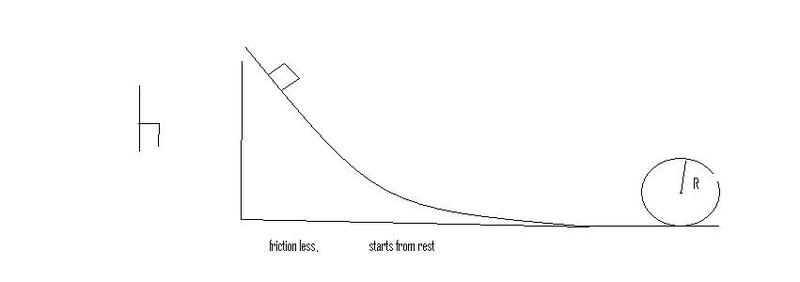
46.jpg


The Attempt at a Solution


I haev solved this problem TWO ways, and i can't decide which way is correct

the eqn...

U0+K0 = K+U

where U = potential energy and K = kinetic energy


first

m * g * h + (1/2) * m * v^2 >= m * g * 2 * R

final answer = h = 2R


the way my friend set it up and solved it


m * g * h >= (1/2) * m * v^2 + m * g * 2 * R


my friend solved it this way and got h = (5*R) / 2

but i can't seem to get what he got and i get h=h-2r+2r which says the min height has to be the min height of the radius aka h = 2R

any hints, tips, or advice?
 
Physics news on Phys.org
For one thing, the initial energy is completely potential since it starts from rest (KE = 0). So the first method doesn't make sense.

The trick is to figure out what KE the block must have at the top of the loop in order to maintain contact with the track.
 

m * g * h >= (1/2) * m * v^2 + m * g * 2 * R


you can solve for v^2 and get

v^2 = 2g(h-2R)

that would be what is required to stay on the track, so would u plug that back into


m * g * h >= (1/2) * m * v^2 + m * g * 2 * R


m * g * h >= (1/2) * m * (2g(h-2R)) + m * g * 2 * R


cancel mass, g cancels, .5 *2 =1

g*h >= (1/2)*(2g(h-2R)) + g*2*R


g*h >= g(h-2R)) + g*2*R


h >= h-2R + 2*R


would this be the correct eqn to solve for min height?
 
Last edited:
nightshade123 said:

m * g * h >= (1/2) * m * v^2 + m * g * 2 * R
This is conservation of energy. It's necessary but not sufficient to solve this problem. Hint: Apply Newton's 2nd law.
 
i guess you're still not understanding what's the condition to the block doesn't feel down from the loop...

what the block has in top of the look to don't fell down? first you need to understand that...
 
mg = (mv^2) /R

you can find min speed so it doesn't fall off the track this way

R*g = v^2
 
Last edited:

m * g * h >= (1/2) * m * v^2 + m * g * 2 * R
m * g * h >= (1/2) * m * R*g + m * g * 2 * R

h >=1/2 R + 2 R

h >= 2.5 R
 
Good!
 
thanks! i totally looked at that v^2 the wrong way
 

Similar threads

  • · Replies 13 ·
Replies
13
Views
2K
Replies
8
Views
4K
Replies
7
Views
3K
  • · Replies 12 ·
Replies
12
Views
13K
Replies
4
Views
2K
Replies
3
Views
2K
  • · Replies 5 ·
Replies
5
Views
2K
  • · Replies 25 ·
Replies
25
Views
5K
  • · Replies 5 ·
Replies
5
Views
5K
Replies
24
Views
7K