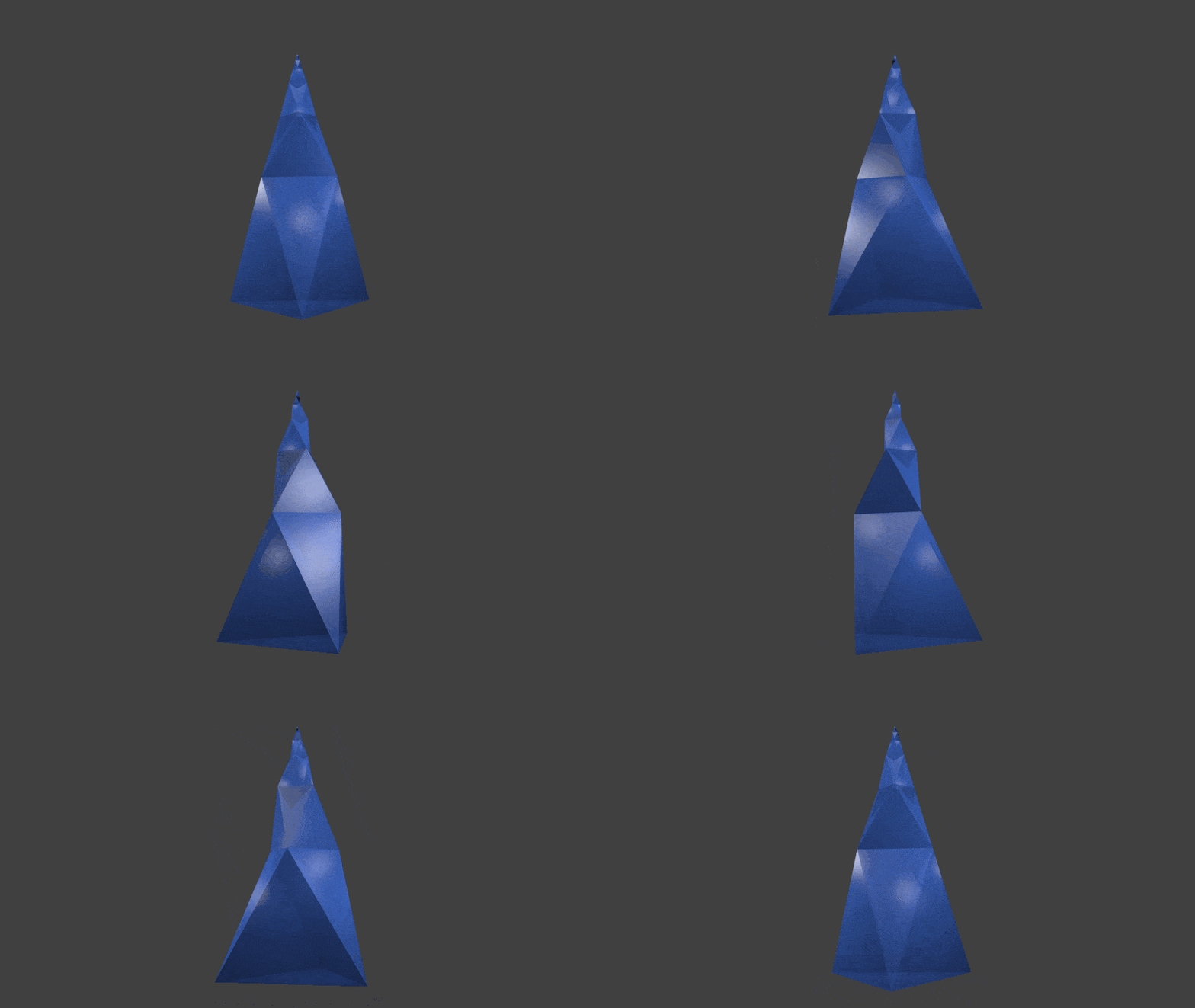
What is the name of this triangular geometric shape?

Click For Summary
SUMMARY

The geometric shape discussed is identified as an octahedral tower, characterized by its construction of equilateral triangles arranged at 90-degree angles to the edges, with each subsequent triangle rotated 60 degrees. This structure exhibits fractal properties, where each level reduces in height and surface area by a factor of four, creating an infinite series of surfaces. The tower's design parallels the three-dimensional Sierpinski Triangle, emphasizing exponential growth rather than uniform spacing. The discussion also references origami-inspired designs that relate to this geometric concept.

PREREQUISITES
  • Understanding of geometric shapes, specifically polyhedra
  • Familiarity with fractal geometry and its properties
  • Basic knowledge of origami design principles
  • Experience with geometric modeling software for visualization
NEXT STEPS
  • Research the properties of octahedra and their applications in architecture
  • Explore fractal geometry, focusing on the Sierpinski Triangle and its three-dimensional variations
  • Learn about geometric modeling software such as Blender or Rhino for creating complex shapes
  • Investigate origami techniques that can be applied to geometric design
USEFUL FOR

Mathematicians, architects, designers, and anyone interested in geometric structures and fractal patterns will benefit from this discussion.

shintashi
Messages
117
Reaction score
1
I used to think it was called Zeno's tower, but then realized I probably called it that because it reminded me of his paradox. I have been unable to find this shape on the internet, although I saw a small steel tower outside Stonybrook using this geometry.

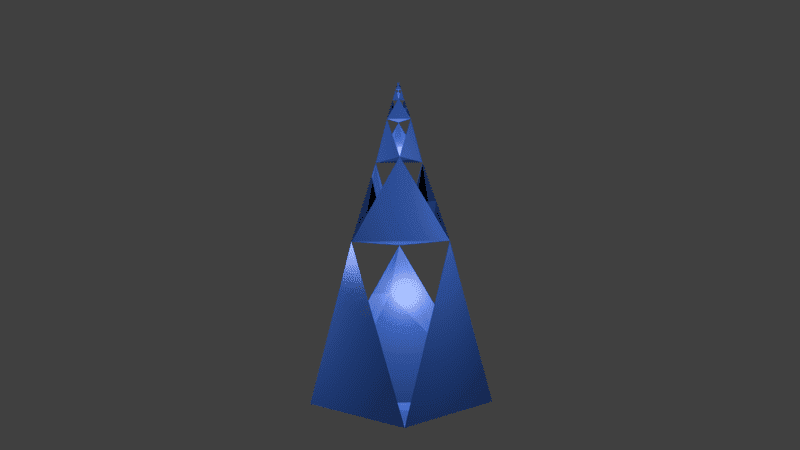
I have attached an image of the basic structure and an animated gif in rotation to show how the angles look from different sides.

The pattern is equilateral triangles at 90 degrees to the edges, where a new triangle at 60 degree rotation forms the next level. This repeats to infinity, getting 4 times less surface area each floor. From some angles, its quite crude, and at other angles, its seamless.

Again, I have no idea if there is a name for this pattern, which has a kind of fractal quality when you zoom into the top.
triangle tower.png
output_dlzjZE.gif
 

Attachments

  • output_dlzjZE.gif
    output_dlzjZE.gif
    688.8 KB · Views: 749
  • triangle tower.png
    triangle tower.png
    8.3 KB · Views: 585
  • Like
Likes   Reactions: andrewkirk
Mathematics news on Phys.org
jedishrfu said:
I think you’d call it an octehedral tower as each segment is an eight sided polyhedron ie an octahedron.

I found this related article of origami inspired designs

http://www.origamiheaven.com/macromodularorigami.htm

it is true that it has some octagonal properties, but what's really interesting is how it expresses an X^2 expansion using a 3/6 side. There's an infinite number of surfaces, as you go further and further up, each is half the height and 1/4 the surface area of the previous. From the top, if you look through it, each distance expands exactly at the same ratio as light diffusion. This should be mathematically obvious, but I made one of these out of wood in 2007 and that's how i figured it out. The octahedral tower is nice but its linear, while this tower follows an exponential change creating a repeating simple fractal pattern. In a lot of ways, this tower is similar to three dimensional Sierpenski Triangle, but expands differently with saturation of increased triangles focused ever closer to the top, rather than equidistant.
 

Similar threads

  • · Replies 1 ·
Replies
1
Views
2K
  • · Replies 14 ·
Replies
14
Views
2K
  • · Replies 7 ·
Replies
7
Views
3K
  • · Replies 13 ·
Replies
13
Views
21K
  • · Replies 96 ·
4
Replies
96
Views
12K
  • · Replies 1 ·
Replies
1
Views
4K
  • · Replies 5 ·
Replies
5
Views
6K
Replies
6
Views
5K
  • · Replies 67 ·
3
Replies
67
Views
15K
  • · Replies 3 ·
Replies
3
Views
4K