What is the Net Force on a Banked Curve?

Click For Summary

Discussion Overview

The discussion revolves around the net force acting on a car navigating a banked curve, focusing on the differences in interpretations of forces in various reference frames. Participants explore the implications of centrifugal force and its role in the analysis of forces in both inertial and non-inertial frames.

Discussion Character

  • Debate/contested
  • Conceptual clarification
  • Technical explanation

Main Points Raised

  • One participant asserts that the net force in the X direction is zero according to their professor's explanation, which includes a centrifugal force that cancels out other forces.
  • Another participant suggests that the net force depends on the reference frame: in an inertial frame, there is a net force, while in a non-inertial frame, an additional inertial force (centrifugal force) must be considered.
  • A later reply discusses a related scenario involving a rock tied to a string and its forces, indicating that the perspective of the observer affects the inclusion of centrifugal force.

Areas of Agreement / Disagreement

Participants express differing views on whether the net force in the X direction is zero, indicating that multiple competing interpretations exist based on the chosen reference frame.

Contextual Notes

The discussion highlights the dependence on reference frames and the implications for understanding forces, but does not resolve the differing interpretations of net force in the context of banked curves.

Abu
I understand why when deriving the formulas for cars on banked curves, the net force in the Y direction is zero. However, when I google how to derive them, people say that there is a net force greater than zero in the X direction. This is not what my professor says in his explanations however: he says that the net force in the X direction is also zero, and that this is because there is a centrifugal force equal to mv^2/r pointed to the left that cancels Fnsintheta..

I will attach the following diagram to better explain my question. Note the mv^2/r that is pointing to the left, where typically other diagrams do not include that.
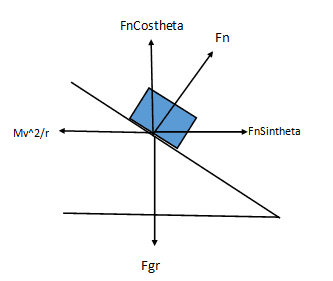
question1.PNG


All in all, why is the net force in the X direction for my professors explanation equal to zero, where other explanations say it is not?
 
Physics news on Phys.org
This depends on which reference frame you consider. If you consider the ground inertial frame, there is a net force. If you consider the car's accelerated reference frame there is an additional inertial force, the centrifugal force.
 
Orodruin said:
This depends on which reference frame you consider. If you consider the ground inertial frame, there is a net force. If you consider the car's accelerated reference frame there is an additional inertial force, the centrifugal force.

Oh okay, so let's say there is a string tied to rock spinning in a vertical motion. If I am looking at the scenario as an outside observer, the forces include the tension that acts as the centripetal force and the force of gravity (depending on where the rock is in its rotating motion), there is no centrifugal force that needs to be included. But if I am looking it at as if I am the rock, then there is a centrifugal force that will be equal to the tension? Am I correct in this regard?
 
In essence, yes.
 

Similar threads

  • · Replies 19 ·
Replies
19
Views
2K
  • · Replies 3 ·
Replies
3
Views
2K
  • · Replies 8 ·
Replies
8
Views
3K
  • · Replies 19 ·
Replies
19
Views
5K
  • · Replies 6 ·
Replies
6
Views
2K
  • · Replies 15 ·
Replies
15
Views
4K
  • · Replies 9 ·
Replies
9
Views
2K
  • · Replies 33 ·
2
Replies
33
Views
4K
  • · Replies 7 ·
Replies
7
Views
2K
  • · Replies 14 ·
Replies
14
Views
2K