What Is the Relationship Between Radius and Wavelength in Huygens' Wavelets?

  • Context: Undergrad 
  • Thread starter Thread starter Firewolffzc
  • Start date Start date
  • Tags Tags
    Huygens Radius Wavelet
Click For Summary

Discussion Overview

The discussion centers on the relationship between the radius of Huygens' wavelets and the wavelength of waves, exploring concepts related to wave propagation, diffraction patterns, and the implications of wavelet theory in modern optics.

Discussion Character

  • Exploratory
  • Debate/contested
  • Technical explanation
  • Conceptual clarification

Main Points Raised

  • Some participants propose that the radius of a wavelet is equal to the wavelength of the wave, suggesting that the maximum slit width for complete circular wavefronts should be twice the wavelength.
  • Others argue that the radius of a wavelet is not equal to the wavelength, stating that the radius depends on the distance the wavelet has propagated over time.
  • A participant questions whether Huygens provides a specific spacing for wavelets and suggests that they may be treated as point sources without a defined radius.
  • Another participant expresses confusion about the relationship between wavefront patterns and wavelength, seeking clarification on their connection.
  • Some participants discuss the modern interpretation of Huygens' wavelets in the context of linear systems theory and convolution operations in wave optics.
  • There is a mention of the dependence of diffraction patterns on the size of the aperture relative to the wavelength, with examples provided to illustrate this point.
  • One participant reflects on the historical context of Huygens' theory, questioning its current relevance and application in modern physics.

Areas of Agreement / Disagreement

The discussion remains unresolved, with multiple competing views on the relationship between the radius of wavelets and wavelength, as well as the relevance of Huygens' principles in contemporary wave optics.

Contextual Notes

Participants express uncertainty regarding the definitions and assumptions related to wavelets and their application in diffraction theory. The discussion highlights the complexity of the topic and the varying interpretations of Huygens' original ideas.

Firewolffzc
Messages
7
Reaction score
0
Huygens' belief was that every wave is made up of smaller wavelets, which are basically circles. I was wondering, is the radius of these wavelets equal to the length of the wavelength of its wave?
I have another related question: If a wave is passing through a slit, what is the maximum length the slit can have so that the waves-fronts coming out of the slit are complete circles?
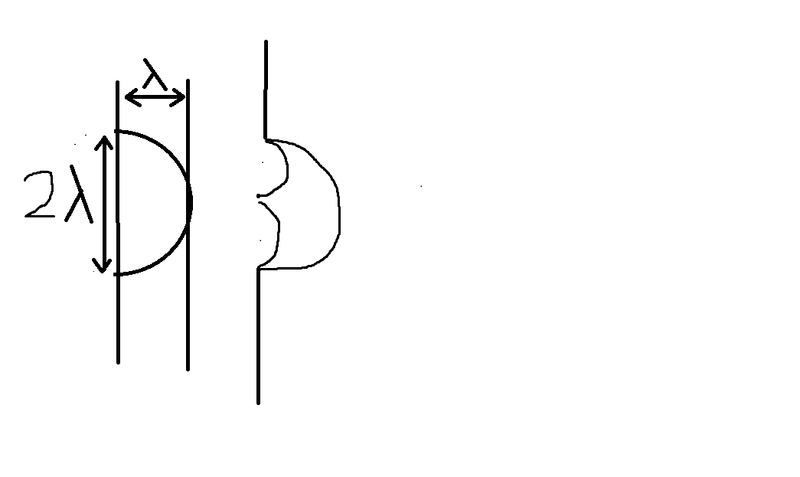
If the radius of a wavelet is equal to the wavelength of its wave, then doesn't that mean that the maximum the slit can be is twice the wavelength? It think it is twice the wavelength because if the middle of a slit is the center of a wavelet, then the circumference of the wavelet will cover the slit openings so long as the slit is smaller than the diameter, which will be twice the wavelength if the radius of the wavelet is the wavelength.
Sorry if the question is confusing. Here is a picture to help. The slit here is twice the wavelength.
Untitled.png
 
Science news on Phys.org
Hi.

No, the radius of a wavelet is not equal to the wavelength. The idea is that the wavelet expands outward from the point at which it is emitted. So the radius of the wavelet is going to depend on how far it has propagated, and will increase with time.

The wavelength would be the distance between successive wavelets.
 
cepheid said:
Hi.

No, the radius of a wavelet is not equal to the wavelength. The idea is that the wavelet expands outward from the point at which it is emitted. So the radius of the wavelet is going to depend on how far it has propagated, and will increase with time.

The wavelength would be the distance between successive wavelets.
Does Huygen actually give a 'spacing' for the wavelets? Surely the closer they are taken, the more accurate the prediction of the diffraction pattern. Are the wavelets not just point sources with the same wavelength as the wave that is being analysed? The only constraint must be that the integral of the power must be the same as the power entering the aperture. The wavelets do not have a "radius" because they can be regarded as going on for ever. To find the 'next step' in the construction you can choose any spatial interval you like, I think. I have a feeling that Huygen is really no more than a qualitative way of describing a process which, nowadays, would be done using diffraction integrals.
 
Sorry, I am confused. Isn't it true that different wave-front patterns are made from the aperture because of the wavelets? At the same time, the patterns of the wave-front are dependent on the wavelength. So I thought there was a connection between the two. Can someone please explain :)
 
Last edited:
I guess that building up the 'next' wave front by taking rings of one wavelength would make sense. But would anyone actually ever do it that way, these days? Is it not just a 'notion', based on a historical idea which has been superceded? (What do you mean by "because of the wavelets"?)
If you were trying to do the construction using specific spacing of the sources, you would need the aperture in question to be an integral number of wavelengths / sources. Have you actually looked at the dozens of pictures on the web which show the construction? They are all pretty approximate and hand waving about the actual workings of the system. Are you likely to be 'tested' on this in any detailed way?
 
Firewolffzc said:
Sorry, I am confused. Isn't it true that different wave-front patterns are made from the aperture because of the wavelets? At the same time, the patterns of the wave-front are dependent on the wavelength. So I thought there was a connection between the two. Can someone please explain :)

The pattern depends on the size of the aperture, relative to the wavelength. That is, a 1 micron aperture with a 1 micron wavelength has exactly the same pattern as a 1 km aperture with a 1 km wavelength.

The modern formulation of Huygen's wavelets is referred to as linear systems theory (or wave-optics). Essentially, one can describe a wavefront as an infinite array of point sources. If each point source behaves the same as the others (i.e. it has the same impulse response), then wavefronts at subsequent points in space (or time) can be calculated via a convolution operation. This is enormously useful as it permits the spatial frequency spectrum of two wavefronts to be related by via a product (with the optical transfer function) by way of the convolution theorem of Fourier transforms.

Claude.
 
Last edited:

Similar threads

  • · Replies 25 ·
Replies
25
Views
4K
  • · Replies 5 ·
Replies
5
Views
15K
  • · Replies 2 ·
Replies
2
Views
3K
  • · Replies 4 ·
Replies
4
Views
5K
  • · Replies 4 ·
Replies
4
Views
5K
  • · Replies 6 ·
Replies
6
Views
9K
  • · Replies 52 ·
2
Replies
52
Views
7K
Replies
3
Views
2K
  • · Replies 21 ·
Replies
21
Views
3K
  • · Replies 28 ·
Replies
28
Views
9K