Distance between fringes in an interference pattern?

Click For Summary

Discussion Overview

The discussion revolves around the characteristics of the diffraction pattern produced by a single slit, specifically addressing the distances between fringes, the width of the central maximum, and the conditions for minima and maxima in the interference pattern. Participants explore theoretical aspects, mathematical formulations, and intuitive understandings related to these phenomena.

Discussion Character

  • Exploratory
  • Technical explanation
  • Conceptual clarification
  • Debate/contested

Main Points Raised

  • Some participants question whether the distances between consecutive fringes are exactly equal, suggesting that they are not due to the nature of the diffraction pattern.
  • There is a discussion about the width of the central maximum, with one participant seeking clarification on why it is twice as wide as other fringes.
  • Participants debate the interpretation of the condition for minima, with one questioning why a path difference equal to a multiple of the wavelength would not lead to constructive interference.
  • Another participant expresses confusion about the mathematical implications of the diffraction pattern and seeks a more intuitive understanding of the phase differences involved.
  • One participant introduces the concept of Huygens sources and their role in determining the interference pattern, explaining how phase differences lead to zeros in the diffraction pattern.

Areas of Agreement / Disagreement

Participants do not reach a consensus on several points, particularly regarding the equality of fringe distances and the interpretation of minima and maxima conditions. Multiple competing views and uncertainties remain throughout the discussion.

Contextual Notes

Some participants express uncertainty about the mathematical derivations and their intuitive implications, indicating a potential gap in understanding the relationship between path differences and interference outcomes. The discussion also highlights the complexity of applying standard ray analysis to single slit diffraction.

NatFex
Messages
26
Reaction score
3
For the sake of simplicity let's suppose I'm talking about the diffraction of light through one slit.
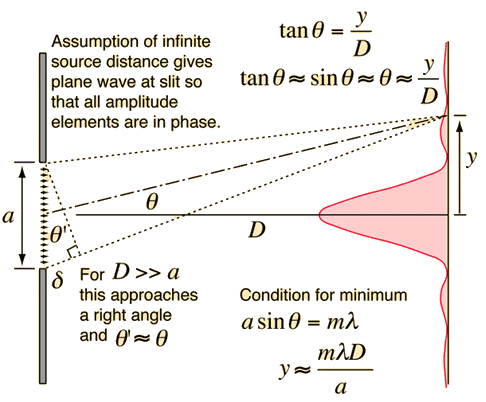
fraungeo.gif

Are the distances between any two consecutive fringes (apart from the central maximum) exactly equal? Assuming the wavelength, slit width, and distance between slit and screen do not change, that is. Or is it one of those cases of small angle approximation where the difference is so small it's negligible?

Why is the central maximum twice as wide?

Also, is the "distance between 2 consecutive fringes" equal to the width of a fringe? When talking about distance between fringes I assume we are talking about the distance between their centres (since there aren't really any gaps between them), which is the distance from crest to crest, which should be the same as the distance from trough to trough, which is the width of a fringe. Am I right?

Another question I have is why the image in the spoiler above and many others I have found say that the condition for a minimum is when a⋅sinθ = mλ. Assuming m is an integer value, if one ray of light is offset compared to another by a length equal to a multiple of the wavelength, then surely they're in phase, which means they interfere constructively? That should lead to a maximum, not a minimum. Where have I gone wrong in this thought process?
 
Last edited:
Science news on Phys.org
NatFex said:
Are the distances between any two consecutive fringes (apart from the central maximum) exactly equal?
No, they are not. The diffraction pattern from a single slit has the form
$$
I(y) = I_0 \left( \frac{\sin ((a\pi/\lambda) \sin \theta)}{(a\pi/\lambda) \sin \theta} \right)^2
$$
The above equation implies that the maxima of ##I(y)## do not coincide those of ##\sin ((a\pi/\lambda) \sin \theta)## which are equally separated for small ##\theta##.
NatFex said:
Why is the central maximum twice as wide?
Twice as wide as what?
NatFex said:
Another question I have is why the image in the spoiler above and many others I have found say that the condition for a minimum is when a⋅sinθ = mλ
Although the maxima of ##I(y)## do not coincide those of ##\sin ((a\pi/\lambda) \sin \theta)##, the minima do. The minima of the latter occur when
$$
(a\pi/\lambda) \sin \theta = m\pi
$$
which trivially reduces to
$$
a \sin \theta = m\lambda
$$
 
blue_leaf77 said:
No, they are not. The diffraction pattern from a single slit has the form
$$I(y)=I_0\Big({\frac {\sin((aπ/λ)\sinθ}{(aπ/λ)\sinθ}}\Big)^2$$
The above equation implies that the maxima of ##I(y)## do not coincide those of ##\sin ((a\pi/\lambda) \sin \theta)##

How does it imply that? Good lord sorry I feel slow today

blue_leaf77 said:
Twice as wide as what?

My bad, I meant to say that if the widths of the fringes are constant, then why is it that only the central maximum is twice as wide as every other fringe? But since my premise is wrong this doesn't need answering

blue_leaf77 said:
The minima of the latter occur when $$(a\pi/\lambda) \sin \theta = m\pi$$
which trivially reduces to...

I understand the mathematical explanation of this, but I'm having a hard time following it intuitively. If the path difference, denoted by ##a \sin \theta## as shown in the diagram in the first post, is a multiple of ##\lambda## then logically speaking they must interfere constructively? What's wrong in the way that I'm thinking about this?

Or is it because ##a \sin \theta## isn't exactly the path difference as that assumes that the rays of light are parallel, which of course they cannot be if they meet at a point?

Thanks a million by the way
 
Last edited:
I should also add that ##m## can only take values ##1,2,3,\ldots##.
NatFex said:
How does it imply that? Good lord sorry I feel slow today
I will rewrite the diffraction pattern as
$$
I(y) = I_0 (\sin^2 ay) f(y)
$$
with ## f(y) = \left(\frac{1}{ay}\right)^2##. As far as I know, ##I(y)## can have maxima that occur at the same places as ##\sin^2 ay## if ##f(y)## is equal to either a constant or another periodic function with the same period and also whose maxima occur at the same places as ##\sin^2 ay##.
NatFex said:
I understand the mathematical explanation of this, but I'm having a hard time following it intuitively. If the path difference, denoted by asinθasin⁡θa \sin \theta as shown in the diagram in the first post, is a multiple of λλ\lambda then logically speaking they must interfere constructively? What's wrong in the way that I'm thinking about this?
I guess you are applying the reasoning about the phase difference between the rays in the case of diffraction grating and double slit interference. Single slit interference is different from them, i.e. you cannot apply the usual ray analysis to calculate the phase differences.
 
  • Like
Likes   Reactions: NatFex
The reason a single slit diffraction pattern has zeros at what is the same angle as the interference maximum for point sources located at the edges of the slit is that the slit can be split in two (or some multiple of two segments), and each infinitesimal Huygens source can be paired up with a corresponding point somewhere on the slit that is exactly ## \pi ## out of phase with that location. e.g. one edge will be ## \pi ## out of phase with the Huygens source in the center of the slit (when the Huygens sources located at the edges of the slit are ## 2 \pi ## out of phase and would constructively interfere (for ## m=1 ##)). This happens for ##m \lambda=b \sin(\theta) ## for all integer ## m ## except for ## m=0 ##, because in the center of the pattern, the rays from all the Huygens sources across the entire slit are in phase with each other.
 
Last edited:
  • Like
Likes   Reactions: blue_leaf77

Similar threads

  • · Replies 4 ·
Replies
4
Views
2K
  • · Replies 8 ·
Replies
8
Views
3K
  • · Replies 6 ·
Replies
6
Views
5K
  • · Replies 7 ·
Replies
7
Views
3K
  • · Replies 8 ·
Replies
8
Views
21K
  • · Replies 2 ·
Replies
2
Views
2K
  • · Replies 5 ·
Replies
5
Views
3K
  • · Replies 2 ·
Replies
2
Views
2K
  • · Replies 4 ·
Replies
4
Views
3K
  • · Replies 1 ·
Replies
1
Views
3K