What is the Voltage Output in a Complex Network Using KCL and Voltage Dividers?

  • Thread starter Thread starter STEMucator
  • Start date Start date
  • Tags Tags
    Network
Click For Summary

Discussion Overview

The discussion revolves around finding the output voltage, ##V_o##, in a complex electrical network using Kirchhoff's Current Law (KCL) and voltage divider principles. Participants explore the relationships between various voltages and resistances in the circuit.

Discussion Character

  • Homework-related
  • Mathematical reasoning
  • Technical explanation

Main Points Raised

  • One participant proposes using KCL at a specific node to derive an equation involving ##V_o## and the source voltage ##V_s##.
  • Another participant suggests writing an additional equation for the branch containing the two resistors and ##V_o## to relate it to ##V_s##.
  • A participant expresses uncertainty about relating ##V_s## and ##V_o##, indicating a possible mental block due to external factors.
  • One participant identifies a relationship between ##V_s##, ##V_o##, and another voltage ##V_x## across a resistor.
  • Another participant recognizes the branch with ##V_o## as a voltage divider and calculates ##V_o## in terms of ##V_s##, leading to a numerical solution.

Areas of Agreement / Disagreement

Participants do not reach a consensus on the method to derive ##V_o## initially, with some expressing uncertainty. However, one participant successfully calculates ##V_o## using the voltage divider approach, while others continue to explore different equations.

Contextual Notes

Some participants mention difficulties in relating voltages and applying KVL, indicating potential gaps in understanding or missing assumptions about the circuit configuration.

Who May Find This Useful

Students and practitioners interested in circuit analysis, particularly those learning about KCL and voltage dividers in electrical engineering contexts.

STEMucator
Homework Helper
Messages
2,076
Reaction score
140
I was able to do most of the exercises, but this one gave me some trouble. I want to find ##V_o##.
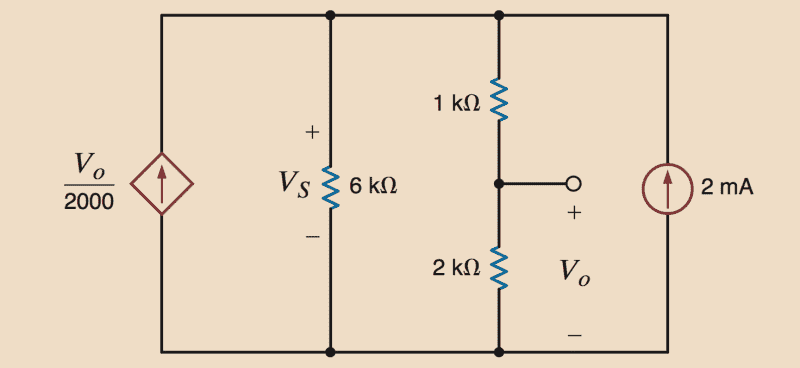
Screen Shot 2014-09-20 at 1.48.52 PM.png


My gut is telling me to use KCL, and applying it to the top left node above the 6k resistor yields:

##\frac{V_o}{2000} + 2 \times 10^{-3} - \frac{V_s}{6000} - \frac{V_s}{3000} = 0##

I am now somewhat unsure how to proceed. I know the potential across the branches is ##V_s##.
 
Physics news on Phys.org
Write another equation for the branch with the two resistors and Vo. The equation should relate Vo to the voltage Vs (the voltage of the node). Then you'll have something to replace Vo in your node equation, leaving you with just one unknown.
 
gneill said:
Write another equation for the branch with the two resistors and Vo. The equation should relate Vo to the voltage Vs (the voltage of the node). Then you'll have something to replace Vo in your node equation, leaving you with just one unknown.

I suspected I was trying to relate ##V_s## and ##V_o##, but I can't see it for some reason. Probably due to hunger. Applying KVL didn't seem to give me anything useful, so I'm still a bit unsure what to do.
 
The only equation I can see is: ##V_s = V_o + V_x## where ##V_x## is the voltage across the 1k.
 
The potential at the top node is ##V_s##. That branch with ##V_o## looks like a voltage divider to me... ;)
 
  • Like
Likes   Reactions: STEMucator
gneill said:
The potential at the top node is ##V_s##. That branch with ##V_o## looks like a voltage divider to me... ;)

I can't believe I forgot entirely about voltage dividers.

So I guess I could just say that ##V_o = [\frac{2k}{1k + 2k}]V_s = \frac{2}{3} V_s##

Subbing this into the KCL equation gives ##V_s = 12 V##, which then subbing back gives ##V_o = 8 V##.

I'm going to go eat now, thank you.
 

Similar threads

  • · Replies 2 ·
Replies
2
Views
2K
Replies
1
Views
2K
  • · Replies 3 ·
Replies
3
Views
2K
  • · Replies 3 ·
Replies
3
Views
2K
Replies
3
Views
1K
  • · Replies 20 ·
Replies
20
Views
4K
  • · Replies 4 ·
Replies
4
Views
2K
  • · Replies 1 ·
Replies
1
Views
2K
  • · Replies 7 ·
Replies
7
Views
3K
Replies
12
Views
2K