Calculating Node Voltage using Nodal Analysis

Click For Summary

Discussion Overview

The discussion centers around a homework problem involving the calculation of node voltage using nodal analysis in an electrical circuit. Participants are exploring the application of Kirchhoff's Current Law (KCL) and Kirchhoff's Voltage Law (KVL) to determine the voltage at Node 1, given a voltage source and various circuit elements.

Discussion Character

  • Homework-related
  • Technical explanation
  • Conceptual clarification

Main Points Raised

  • The original poster presents a circuit problem with specific parameters and expresses difficulty in applying KCL and KVL to find the node voltage.
  • Some participants inquire about the component directly connected between nodes 1 and 4, suggesting it might be the voltage source.
  • There is a question raised about the interpretation of the homework question, specifically whether the task is correctly understood by the original poster.

Areas of Agreement / Disagreement

Participants are engaged in clarifying the problem and its requirements, but there is no consensus on the interpretation of the question or the approach to the solution.

Contextual Notes

There are unresolved aspects regarding the application of KCL and KVL, as well as potential misunderstandings about the circuit configuration and the relationship between nodes.

Who May Find This Useful

This discussion may be useful for students learning about nodal analysis, KCL, and KVL in electrical engineering, as well as those seeking assistance with similar homework problems.

TheBigDig
Messages
65
Reaction score
2
1. Homework Statement
The circuit is driven by a voltage source,
Vs(t)= 8.2 cos(1.8 t − 0.25 )V .

The circuit elements are given as follows.
G1= 5 S,G2= 7.6 S,G3=3.8 S
(Gi is the conductance of corresponding resistor Ri)
L1= 20 H,C1= 5×10⁻² F

If we select Node 4 as the reference node, find the node voltage of Node 1, V1.

2. Relevant equations
Σ Ik = 0

ΣVk = 0

3. The attempt at a solution
I've been able to find values for the resistance R1 = 0.2Ω , R2 = 0.132Ω and R3 = 0.263Ω but continuing on from their is a bit of a struggle. I'm unsure as to how I can apply KCL and KVL in a way that will enable me to find the voltage.
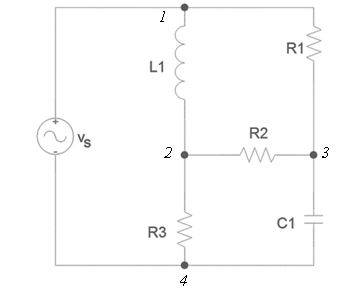
AC-steady-b.jpg


Physics news on Phys.org
Hi TheBigDig,

Please retain the formatting template headings when you construct your homework help request posts. This time I've re-inserted them for you and fixed the excessive use of bold font.

Regarding the problem, what component is directly connected between nodes 1 and 4?
 
gneill said:
Hi TheBigDig,

Please retain the formatting template headings when you construct your homework help request posts. This time I've re-inserted them for you and fixed the excessive use of bold font.

Regarding the problem, what component is directly connected between nodes 1 and 4?
The voltage source?
 
TheBigDig said:
The voltage source?
Yes. What can you conclude from that regarding the potential difference between nodes 1 and 4?
 
TheBigDig said:
If we select Node 4 as the reference node, find the node voltage of Node 1, V1.

Are you sure that's what the question asks?
 

Similar threads

Replies
15
Views
3K
  • · Replies 2 ·
Replies
2
Views
2K
  • · Replies 5 ·
Replies
5
Views
3K
Replies
2
Views
2K
  • · Replies 7 ·
Replies
7
Views
2K
  • · Replies 4 ·
Replies
4
Views
2K
  • · Replies 6 ·
Replies
6
Views
2K
  • · Replies 15 ·
Replies
15
Views
4K
  • · Replies 4 ·
Replies
4
Views
2K
  • · Replies 3 ·
Replies
3
Views
2K