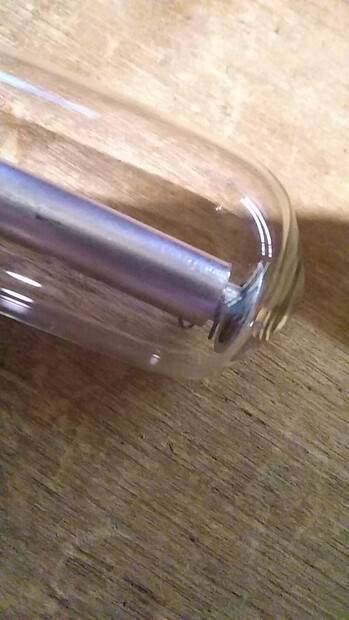
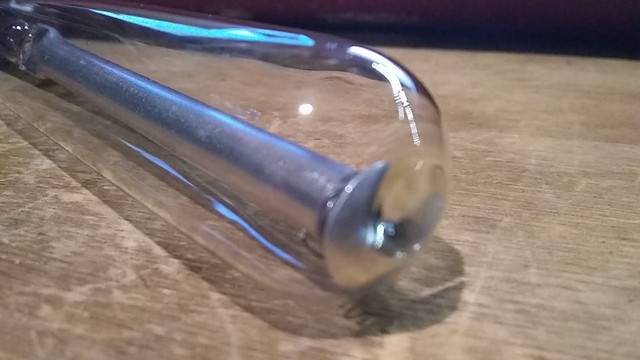
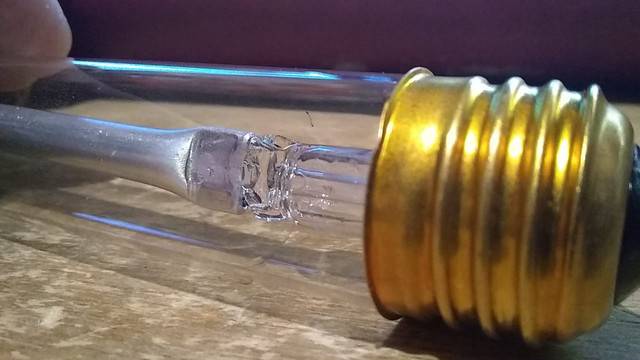
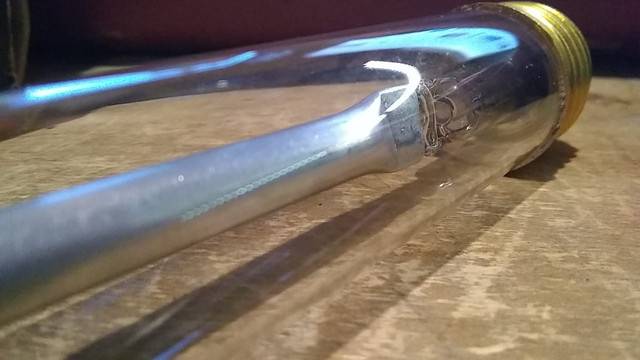
What is this type of bulb or lamp?

Click For Summary
SUMMARY

The discussion centers on identifying a specific type of lamp with an E27 base that operates on high voltage (HV) and is believed to generate ozone. Participants clarify that the lamp is likely an ultraviolet (UV) lamp, specifically designed for disinfection purposes, utilizing UV-C light to produce ozone from ambient oxygen. The lamp's operation involves a single high voltage connection and may utilize a low-pressure mercury discharge to generate UV light. The brand identified is "BIPROAM," with further details available through a linked product page.

PREREQUISITES
  • Understanding of E27 lamp bases and their applications
  • Knowledge of ultraviolet (UV) lamp technology, specifically UV-C
  • Familiarity with ozone generation principles and safety concerns
  • Basic electrical concepts related to high voltage (HV) systems
NEXT STEPS
  • Research "UV-C lamp technology and applications" for disinfection
  • Study "Ozone generation mechanisms in UV lamps" for safety insights
  • Explore "BIPROAM UV lamps" for product specifications and usage
  • Investigate "high voltage electrical safety" protocols for operating HV devices
USEFUL FOR

This discussion is beneficial for electrical engineers, lighting designers, health and safety professionals, and anyone involved in the use or design of UV disinfection systems.

Axxel
Messages
2
Reaction score
0
TL;DR
I need to know what is this type of lamp and a datasheet.
Hi there!

I have few years still without any solution.

I could find just only one exemplary of this bulb or lamp there I share pictures, this is exactly what I need to know what it is, brand or datasheet.

The base is E27.
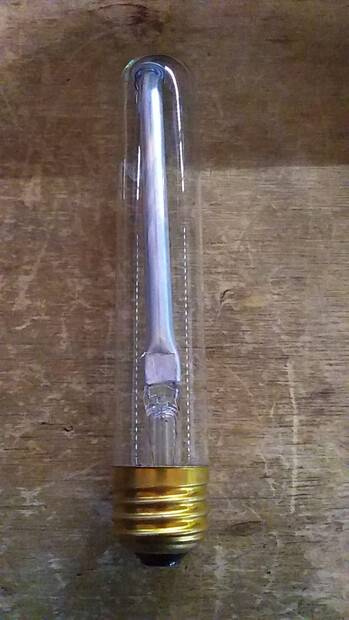
Imagen-de-Whats-App-2022-11-09-a-las-20-30-15.jpg


Imagen-de-Whats-App-2022-11-09-a-las-20-30-28.jpg


Imagen-de-Whats-App-2022-11-09-a-las-20-30-46.jpg


Imagen-de-Whats-App-2022-11-09-a-las-20-31-03.jpg


Imagen-de-Whats-App-2022-11-09-a-las-20-31-14.jpg


AND the most important, In this VIDEO you can see the lamp working: (I don't know is this usage is the correct usage, the lamp is powered with HV with only a single cable, it runs like a Plasma ball lamp) - Aparenlty these lamps are used to generate ozone.


Hope you can help me! I have YEARS with this issue... I never could resolve it...

Kindly Regards ;D
 
Engineering news on Phys.org
Axxel said:
the lamp is powered with HV with only a single cable
By HV, do you mean High Voltage? How is that to be reconciled with the E27 socket?I'm a bit puzzled. If you don't know what it is, how do you know you need it?
 
  • Like
Likes   Reactions: russ_watters
lampara-ozono-100mm-resina-cable-silicona.jpg


This is the lamp the same with not the E27 base. I think the E27 base can be useful to find something more "standart". I think this type of lamp is not designed to work with HV and making ozone, and this is the information I need, what is this type of lamp NORMALLY and what it is used for?
 
  • Like
Likes   Reactions: berkeman
Somehow "ozone production" doesn't add with electrodes encased in a leakproof bulb. Yes, high voltage sparks produce the ozone, but what is it worth if it is only inside?
 
  • Like
Likes   Reactions: russ_watters
Borek said:
Somehow "ozone production" doesn't add with electrodes encased in a leakproof bulb.
Actually, short wavelength UV bulbs can potentially produce enough ozone in the surrounding air to be hazardous:

Ozone Generation by Ultraviolet Lamps​

Holger Claus

Abstract​

The COVID-19 pandemic has generated a great deal of interest in ultraviolet germicidal irradiation (UVGI) as an important means to disinfect air and surfaces. The traditional lamp employed for UVGI has been the low-pressure mercury-discharge lamp that emits primarily at 254 nm in the ultraviolet photobiological band UV-C (100-280 nm). The recent development of even shorter-wavelength UV-C lamps, such as the Krypton-Chloride, 222-nm lamp, has led to greater concerns about the UV-C generation of ozone. It is well known that wavelengths below 240 nm more readily generate ozone. However, there is a great misunderstanding with regard to the actual generation and dissipation of ozone molecules by UV-C lamps. A review of this subject is much warranted. An overview of the ozone generation of various UV-C light sources is presented to give users a better understanding of risk and how to assure control of ozone when employing UV-C lamps.

10.1111/php.13391
 
The first image and the image in Post#3 appear to be the same lamp, so the search path below was followed.

The post#3 image has "BIPROAM" on the lamp, suggesting this search:
https://www.google.com/search?hl=en&source=hp&biw=&bih=&q=biproam

The fourth image of that Google search matches post#3 and leads to:
https://www.todoelectronica.com/lampara-ozono-100mm-resina-cable-silicona-p-89936.html

Google can not translate that page directly, but you can copy-paste the page text to Google translate to get something readable.

the lamp is:
a) an ultraviolet lamp
b) the UV generates Ozone from the Oxygen in the air
c) intended use is for disinfecting

I spotted 'Neon' and '28nM' somewhere on the site.

Cheers,
Tom
 
  • Like
  • Informative
Likes   Reactions: dlgoff, berkeman, russ_watters and 1 other person
Tom.G said:
The fourth image of that Google search matches post#3 and leads to:
It matches the image in post #3 EXACTLY. I smell a rat: if @Axxel has the same picture as on a web page how do they not know what the bulb is from the web page?
 
At first, I thought it might be a uv aquarium sterilizer.
 
  • Informative
Likes   Reactions: berkeman
  • #10
A low-pressure mercury vapour discharge inside the tube would generate UV, which in turn, generates ozone in the air outside the envelope.

The tube seems to have only one high voltage connection to the internal element. An electric field would need to pass through the capacitance of the envelope to the external "ground". I would expect the tube to be driven by high frequency AC, from a high voltage generator. Discharge current would be regulated by the capacitance of the glass envelope, the voltage and the frequency of excitation.
 
  • Like
Likes   Reactions: Tom.G and dlgoff

Similar threads

  • · Replies 6 ·
Replies
6
Views
3K
Replies
4
Views
1K
  • · Replies 26 ·
Replies
26
Views
3K
  • · Replies 6 ·
Replies
6
Views
2K
Replies
2
Views
2K
Replies
3
Views
5K
  • · Replies 12 ·
Replies
12
Views
2K
  • · Replies 7 ·
Replies
7
Views
2K
Replies
4
Views
2K
Replies
1
Views
1K