When does an object have kinetic rotational energy?

Click For Summary

Homework Help Overview

The discussion revolves around the concept of rotational kinetic energy, specifically when an object possesses this form of energy. Participants explore whether rotational energy is only applicable to objects rotating around an internal axis or if it also applies to objects in uniform circular motion, such as a ball attached to a string. The context includes rigid body dynamics and the relationship between translational and rotational kinetic energy.

Discussion Character

  • Exploratory, Conceptual clarification, Mathematical reasoning, Assumption checking

Approaches and Questions Raised

  • Participants question the conditions under which an object has rotational kinetic energy and whether it is equivalent to translational kinetic energy in certain scenarios. They discuss the decomposition of total kinetic energy into translational and rotational components and raise concerns about potential double counting in calculations. The original poster seeks clarification on when to treat an object as a particle versus a rigid body.

Discussion Status

The conversation is ongoing, with participants providing insights into the relationship between translational and rotational kinetic energy. Some guidance has been offered regarding the application of equations and the implications of treating objects as point particles or rigid bodies, but no consensus has been reached on all points raised.

Contextual Notes

Participants are navigating the subtleties of rigid body dynamics and the definitions of kinetic energy in different frames of reference. There is an emphasis on understanding the implications of using specific equations in various contexts, particularly regarding the treatment of particles versus rigid bodies.

Kolika28
Messages
146
Reaction score
28
Homework Statement
I'm a bit confussed when it comes to kinetic rotational energy.
Relevant Equations
##K=\frac{1}{2}I\omega^2##
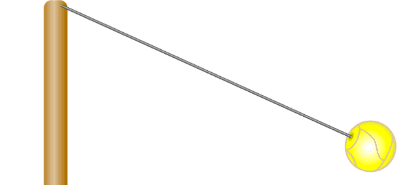
When does an object have rotational energy? Is it only if it rotates around an axis within the object? Does for example a ball attached to a string with a uniform circular movement have rotational kinetic energy?
1591448142965.png
 
  • Like
Likes   Reactions: Delta2
Physics news on Phys.org
It does -- have kinetic energy. You can see it as the usual ##\ {1\over 2} mv^2\ ## and you can also see it as ##\ K=\frac{1}{2}I\omega^2\ ## : $$ I = mr^2,\quad v = \omega r \quad\Rightarrow \quad \ {1\over 2} mv^2\ = \frac{1}{2}I\omega^2$$

Small detail: the ball also rotates around a vertcal axis through it center; I ignored that and considered the ball a point mass.
 
  • Like
Likes   Reactions: Lnewqban and Kolika28
So the rotational energy is the same as the kinetic energy in this example? But in several problems, for example when a ball dropps from a height. They wright the equation as this ##mgh= \ {1\over 2} mv^2\ + \frac{1}{2}I\omega^2 ## So I thought they where two different things?
 
There are some subtleties here; I'll restrict what I say to just rigid body dynamics. The short answer is that there is really just the total kinetic energy, ##T##. However, sometimes it can be useful to decompose this as the sum of a translational and a rotational part.

A rigid body undergoing pure rotation (i.e. rotating about a fixed axis) is often labelled as having rotational kinetic energy. If the rigid body is rotating at ##\omega## then the magnitude of the velocity of a mass element ##dm## is ##\omega r## and its kinetic energy is ##dT = \frac{1}{2} (dm) v^2 = \frac{1}{2} \omega^2 r^2 dm##. If you integrate this up over all mass elements, you find $$T = \int \frac{1}{2}\omega^2 r^2 dm = \frac{1}{2}\omega^2 \int r^2 dm = \frac{1}{2}I\omega^2$$ where ##I## is defined as the moment of inertia about the fixed axis.

But the concept can also be applied to general planar motion of a rigid body, thanks to König's theorem. This states that the kinetic energy of a body equals the kinetic energy of its centre of mass (as if it were a point particle), plus the kinetic energy in the frame of the centre of mass. If ##\vec{R}## is the position vector of the centre of mass and ##\vec{r}_i^{'}## is the position of the ith particle w.r.t. the centre of mass, then ##\vec{r}_i = \vec{R} + \vec{r}_i^{'}##. We then have

$$\begin{align*}
T = \sum_i \frac{1}{2}m_i \dot{\vec{r}}_i^2 &= \sum_i \frac{1}{2}m_i (\dot{\vec{R}} + \dot{\vec{r}_i^{'}})^2 \\
&= \sum_i \frac{1}{2}m_i \dot{\vec{R}}^2 + \sum_i \frac{1}{2}m_i \dot{\vec{r}_i^{'}}^2 + \dot{\vec{R}} \cdot \sum_i m_i \dot{\vec{r}_i^{'}}
\end{align*}
$$ Now since ##\sum_i m_i \vec{r}_i^{'} = \vec{0}## (definition of COM), then ##\sum_i m_i \dot{\vec{r}}_i^{'} = \vec{0}##. The expression becomes $$T = \frac{1}{2}M\dot{\vec{R}}^2 + \sum_i \frac{1}{2}m_i \dot{\vec{r}_i^{'}}^2 = T_{\text{CM}} + T{\text{w.r.t. CM}}$$ In the case of a rigid body undergoing general planar motion, however, in the frame of the CM the rigid body is undergoing fixed axis rotation about the CM, so the kinetic energy in the frame of the CM is just the rotational kinetic energy about this axis.

So in the most general case, the total kinetic energy of a rigid body ##T = T_{CM} + T_{rot}##, i.e. the sum of the KE of the centre of mass and the rotational KE about its centre of mass, as you have correctly written here:
Kolika28 said:
So the rotational energy is the same as the kinetic energy in this example? But in several problems, for example when a ball dropps from a height. They wright the equation as this ##mgh= \ {1\over 2} mv^2\ + \frac{1}{2}I\omega^2 ## So I thought they where two different things?

So really the two terms are just parts of a decomposition of the total kinetic energy. There are some cases where you must be careful not to double count: for instance, a particle undergoing circular motion about a fixed axis. You can either treat this as pure rotation with ##I = mr^2## and apply ##T = \frac{1}{2}I\omega^2##. Or you could use ##\frac{1}{2}mv^2##. Hopefully you can see that these are equivalent expressions.
 
  • Like
Likes   Reactions: Lnewqban, Delta2 and Kolika28
etotheipi said:
There are some subtleties here; I'll restrict what I say to just rigid body dynamics. The short answer is that there is really just the total kinetic energy, ##T##. However, sometimes it can be useful to decompose this as the sum of a translational and a rotational part.

A rigid body undergoing pure rotation (i.e. rotating about a fixed axis) is often labelled as having rotational kinetic energy. If the rigid body is rotating at ##\omega## then the magnitude of the velocity of a mass element ##dm## is ##\omega r## and its kinetic energy is ##dT = \frac{1}{2} (dm) v^2 = \frac{1}{2} \omega^2 r^2 dm##. If you integrate this up over all mass elements, you find $$T = \int \frac{1}{2}\omega^2 r^2 dm = \frac{1}{2}\omega^2 \int r^2 dm = \frac{1}{2}I\omega^2$$ where ##I## is defined as the moment of inertia about the fixed axis.

But the concept can also be applied to general planar motion of a rigid body, thanks to König's theorem. This states that the kinetic energy of a body equals the kinetic energy of its centre of mass (as if it were a point particle), plus the kinetic energy in the frame of the centre of mass. If ##\vec{R}## is the position vector of the centre of mass and ##\vec{r}_i^{'}## is the position of the ith particle w.r.t. the centre of mass, then ##\vec{r}_i = \vec{R} + \vec{r}_i^{'}##. We then have

$$\begin{align*}
T = \sum_i \frac{1}{2}m_i \dot{\vec{r}}_i^2 &= \sum_i \frac{1}{2}m_i (\dot{\vec{R}} + \dot{\vec{r}_i^{'}})^2 \\
&= \sum_i \frac{1}{2}m_i \dot{\vec{R}}^2 + \sum_i \frac{1}{2}m_i \dot{\vec{r}_i^{'}}^2 + \dot{\vec{R}} \cdot \sum_i m_i \dot{\vec{r}_i^{'}}
\end{align*}
$$ Now since ##\sum_i m_i \vec{r}_i^{'} = \vec{0}## (definition of COM), then ##\sum_i m_i \dot{\vec{r}}_i^{'} = \vec{0}##. The expression becomes $$T = \frac{1}{2}M\dot{\vec{R}}^2 + \sum_i \frac{1}{2}m_i \dot{\vec{r}_i^{'}}^2 = T_{\text{CM}} + T{\text{w.r.t. CM}}$$ In the case of a rigid body undergoing general planar motion, however, in the frame of the CM the rigid body is undergoing fixed axis rotation about the CM, so the kinetic energy in the frame of the CM is just the rotational kinetic energy about this axis.

So in the most general case, the total kinetic energy of a rigid body ##T = T_{CM} + T_{rot}##, i.e. the sum of the KE of the centre of mass and the rotational KE about its centre of mass, as you have correctly written here:So really the two terms are just parts of a decomposition of the total kinetic energy. There are some cases where you must be careful not to double count: for instance, a particle undergoing circular motion about a fixed axis. You can either treat this as pure rotation with ##I = mr^2## and apply ##T = \frac{1}{2}I\omega^2##. Or you could use ##\frac{1}{2}mv^2##. Hopefully you can see that these are equivalent expressions.
Ok, I think I understand a bit more now. So for a particle, the equation would then result in a double count. But when do I know if I can treat the object as a particle or a rigid body? Because if it was a rigid body, then I would have to use ##T = T_{CM} + T_{rot}## right? I'm sorry for all the questions, I just really want to understand this!
 
Kolika28 said:
Ok, I think I understand a bit more now. So for a particle, the equation would then result in a double count. But when do I know if I can treat the object as a particle or a rigid body? Because if it was a rigid body, then I would have to use ##T = T_{CM} + T_{rot}## right? I'm sorry for all the questions, I just really want to understand this!

Well ##T = T_{CM} + T_{rot}## is only really helpful for extended bodies, since a point particle has zero kinetic energy in the frame of its centre of mass (##T_{rot} = 0##)! It's best to think of ##T_{rot}## as the kinetic energy in the frame of the centre of mass. If you consider a particle to be a rigid body the relation is still just as valid!

You should note that the kinetic energy of a particle is always ##\frac{1}{2}mv^2##. If the particle is rotating about a fixed axis, it's kinetic energy is still ##\frac{1}{2}mv^2##. However ##T = \frac{1}{2}mv^2 = \frac{1}{2}mr^2 \omega^2 = \frac{1}{2} I\omega^2##. You might choose to call this term the rotational kinetic energy. At the end of the day the term rotational kinetic energy is really just a dressed up way of describing the bog standard kinetic energy of a particle or a bunch of particles about an axis; it's not a different quantity, just a term you might get if you decompose the kinetic energy.

I would recommend letting your intuition guide you here. Once you become familiar with the derivations, it should become fairly evident how the kinetic energy can be decomposed into weird and wonderful terms. If ever in doubt, remember that a point particle, tiny mass element etc. always has ##T = \frac{1}{2}mv^2##, and derive from there!
 
  • Like
Likes   Reactions: Lnewqban and Kolika28
You need to define what your system comprises.
If you are talking about the ball+pole then the ball energy would usually be called rotational KE. If just the ball usually it would usually be called translational KE (there are some subtleties here but not for now). As long as the accounting is done correctly in the maths, what it is "called" is neither critical nor always unique.
 
  • Like
Likes   Reactions: Kolika28 and etotheipi
hutchphd said:
You need to define what your system comprises.
If you are talking about the ball+pole then the ball energy would usually be called rotational KE. If just the ball usually it would usually be called translational KE (there are some subtleties here but not for now). As long as the accounting is done correctly in the maths, what it is "called" is neither critical nor always unique.

Agreed, the linguistics muddy the waters. I would much prefer that we didn't have the terminology "rotational kinetic energy", and instead just spoke of the "kinetic energy".

For a point particle undergoing fixed axis rotation you would just have two equivalent expressions for kinetic energy, ##T = \frac{1}{2}mv^2 = \frac{1}{2}I\omega^2##. For general planar motion, you would have kinetic energy of the CM + kinetic energy w.r.t. the CM, ##T = \frac{1}{2}MV^2 + \frac{1}{2}I_{CM}\omega^2##.

I suppose rotational kinetic energy is just the name we give to the expression ##\frac{1}{2}I\omega^2##. Helpful shortcut if you understand it, but potentially misleading if students are led to believe erroneously that it is a different concept!
 
  • Like
Likes   Reactions: Kolika28
Ok, I think I got it now (or I hope so 😁). Thank you so much for everbody's help. I really appreciate it!
 
Last edited:
  • Like
Likes   Reactions: Delta2 and etotheipi

Similar threads

Replies
9
Views
3K
  • · Replies 21 ·
Replies
21
Views
5K
  • · Replies 33 ·
2
Replies
33
Views
3K
Replies
4
Views
2K
  • · Replies 4 ·
Replies
4
Views
2K
Replies
2
Views
1K
  • · Replies 4 ·
Replies
4
Views
2K
  • · Replies 16 ·
Replies
16
Views
2K
  • · Replies 9 ·
Replies
9
Views
2K